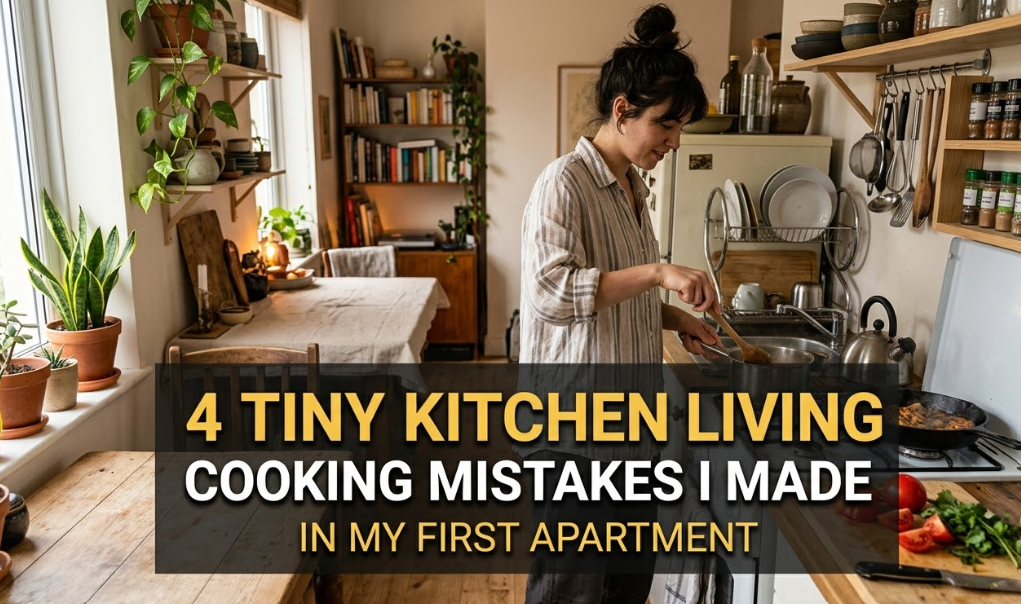
Meta Description: 4 Small Kitchen Cooking Mistakes I Made In My First Apartment — real lessons on space, storage, tools and habits every first-time renter needs to learn.
4 Cooking Mistakes I Made in My First Tiny Kitchen Apartment
I’ll never forget the day I moved into my first apartment.
I was excited. Independent. Mentally prepared to cook proper meals for myself.
Then I surprised myself by going into the kitchen.
It was about the size of a walk-in closet. One narrow counter. A two-burner stove. A refrigerator that buzzed like a malfunctioning lawnmower. And about four inches of drawer space.
I thought to myself, “How hard can this be?”
Pretty hard, it turns out.
For the next few months, I burned food, wasted money, ran out of counter space halfway through cooking and almost lost my mind looking for a lid that fit a pot. One mistake after another — not because I was a bad cook but because no one had ever shown me how to actively live, let alone try and cook, in a small kitchen.
So if you’re in your first little apartment or you’re about to move into one, this article is for you. I’m passing on the four biggest cooking mistakes I’ve ever made — and exactly how I fixed them.
Mistake #1 — I Over-Bought Kitchen Stuff Before I Even Cooked Anything
The Shopping Spree That Backfired
Even before I had unpacked my clothes, I hit the store and went crazy.
I purchased an entire 12-piece pot and pan set. A blender, a food processor, a hand mixer, a rice cooker and an air fryer. I picked up a knife block that contained eight knives, three cutting boards, a salad spinner, a colander, a mandoline slicer and a set of mixing bowls that nested but somehow still filled an entire shelf in the cabinet.
I felt like a real adult.
Then I tried to cook dinner.
There was no place to put anything. The counter was covered. The cabinets were stuffed. I had to shift the air fryer simply to open the fridge. When I went in search of the correct pot lid, five other things had to be unstacked and a cutting board teetered dangerously.
Cooking stopped being fun. It was a war on clutter.
Why This Mistake Happens
The eagerness of establishing your first kitchen can be very blinding. Stores and online shops make everything seem necessary. And when you have nothing to start with, it makes sense to buy everything at once.
But here’s the crux of it all: in a tiny kitchen, every item has to justify why it gets to occupy valuable real estate.
If something sits unused for two months, it’s not a kitchen tool — it’s just in the way.
What I Could Have Done Instead
Define a minimal, purposeful toolset. Cook for a few weeks first. Decide what you really need — not some generic list, but based on the way you actually cook.
Here’s a simple starter kit that can get you by in most tiny kitchens:
| Category | What You Really Need |
|---|---|
| Pots & Pans | 1 small saucepan, 1 medium skillet, 1 large pot |
| Knives | 1 chef’s knife, 1 paring knife |
| Cutting Boards | 1 large, 1 small |
| Utensils | Spatula, wooden spoon, ladle, tongs |
| Appliances | 1 multipurpose appliance (think: Instant Pot or air fryer — just one) |
| Storage | A set of stackable containers with matching lids |
Purchase things one by one, as you realize that you need them. This method is cost-effective, space-saving and keeps your kitchen functional.
The Rule That Changed Everything
Eventually, I devised a personal rule: one in, one out.
Whenever I wanted to bring a new kitchen item into the apartment, I had to determine what was leaving first. This one habit turned my tiny kitchen from a cluttered disaster to a place that actually worked.
Mistake #2 — I Didn’t Consider Workflow At All, Which Made Cooking Feel Chaotic Every Single Time
What a Kitchen Workflow Is
I had never heard the term “workflow” applied to cooking.
I assumed cooking was simply doing things until food happened. Chop some things. Turn on the stove. Stir things around. Hope for the best.
What I hadn’t realized is that professional cooks — even experienced home cooks — consider where things are placed and in what order they take place. This is known as kitchen workflow, and in a small kitchen it’s more relevant than anywhere else.
If you want to go deeper on this topic, Tiny Kitchen Living is a great resource for practical small-space cooking tips and kitchen organization ideas.
The Chaos I Created
Here’s how my cooking process unfolded in those early months:
- Begin the cooking process with all prep work undone
- Realize I have to chop an onion — but the cutting board is buried under the dish rack
- Make space by sending the dish rack to the floor
- Cut the onion — but forget to prepare a bowl for the cut pieces
- Dump chopped onion onto the counter (not a great move)
- Notice oil is too hot in the skillet
- Hurry to add the onion — spill a glass of water doing it
- Spend the rest of cooking in a mild panic
Sound familiar?
This wasn’t bad luck. It was poor prep and improper placement of items.
The Fix: Organize Your Kitchen Like a Flow, Not a Storage Facility
In a tiny kitchen, you have to view your space in zones.
Even if your kitchen is small, you can create three basic zones:
Zone 1 — Prep Zone This is where you chop, measure and prepare ingredients. Store your cutting board, knives and mixing bowls here. This should be the easiest-to-reach area of your counter.
Zone 2 — Cook Zone This is adjacent to or near the stove. This is where you place your spatulas, spoons, oil, salt and other frequently used items. You shouldn’t have to stretch beyond the burner to pick up what you need.
Zone 3 — Clean Zone This is by your sink. Store your dish soap, sponge and drying rack here. Plates and bowls should also be near this zone, making for easy loading and unloading.
Here’s a simple visual of how these zones can function even in a small space:
| Zone | Location | What Belongs Here |
|---|---|---|
| Prep Zone | Counter space farthest from sink | Cutting board, knives, bowls, measuring cups |
| Cook Zone | Counter space next to stove | Oils, spices, utensils, pot holders |
| Clean Zone | Counter space near sink | Dish rack, soap, clean plates, glasses |
The One Habit That Helped Me Most: Mise en Place
Mise en place is a French cooking term that means “everything in its place.”
It simply means: prepare all your ingredients before you start cooking.
Chop everything. Measure everything. Make sure all your tools are within reach. Only then turn on the stove.
This habit changed my cooking experience entirely. Meals became calmer. Food turned out better. I stopped burning things because I wasn’t scrambling mid-cook.
It takes an extra 10 minutes of prep. It saves you 30 minutes of stress.
Mistake #3 — I Lost a Lot of Food Because I Had No Real Storage Plan
The Refrigerator Full of Forgotten Food
Every Sunday, I did my grocery shopping.
I would come home with bags of fresh vegetables, proteins, dairy, sauces and snacks. I would shove everything into the fridge, feeling so organized and responsible.
By Wednesday, I couldn’t find anything.
Leftovers were shoved behind bottles. Vegetables wilted in the back corner. I would purchase a second bunch of cilantro because I hadn’t remembered that I had one buried somewhere. Half-used cans of beans sat in the fridge lidless, gradually drying out.
By the end of the week, I was discarding more food than I consumed.
Not only is this wasteful — it’s also costly. According to research from the USDA, the average American household wastes a significant portion of the food it purchases every year. In a small kitchen, bad storage habits make this problem even worse.
Why Tiny Kitchens Make Food Waste Worse
In a large kitchen, you have more space to spread out. You can see what you have. In a small kitchen, things pile up on top of each other fast. If something is out of sight, it’s out of mind — and then it’s in the trash.
A small fridge also means food is constantly getting squashed and shuffled around. That speeds up spoilage and makes it hard to maintain any system.
The Storage System That Actually Works
Eventually I developed a simple storage system that slashed my food waste. Here’s what it involved:
Clear containers, always. I upgraded from mismatched Tupperware and plastic bags to a cohesive set of clear, stackable containers. When everything is see-through, you can tell at a glance exactly what you have. No more mystery leftovers.
The “front row” rule. Anything that must be eaten soon goes in the front row of the fridge — at eye level. That includes leftovers, opened packages and produce that’s nearing the end of its life. New groceries always go behind what’s already there.
Label everything with a date. It sounds like something restaurants do — but it works at home too. A small piece of masking tape and a marker takes five seconds and saves you from guessing whether those leftovers are two days old or five days old.
Designated spots for everything. I assigned a specific place for each category of food and stuck to it. Dairy on the top shelf. Vegetables in the crisper drawer. Proteins on the bottom shelf (to prevent drips). Condiments on the door.
Here’s a quick reference guide:
| Fridge Area | What Goes Here | Why |
|---|---|---|
| Top shelf | Leftovers, drinks, ready-to-eat items | Eye level = easy to remember |
| Middle shelf | Dairy, eggs, snacks | Consistent temperature |
| Bottom shelf | Raw meats, fish | Prevents cross-contamination |
| Crisper drawers | Vegetables (high humidity), fruits (low humidity) | Extends freshness |
| Door shelves | Condiments, juices, butter | Temperature varies most here |
Pantry and Cabinet Storage Tips
The fridge wasn’t the only problem I had. My cabinets were equally chaotic.
Bags of rice, flour and oats were torn open and spilling out everywhere. Canned goods were piled randomly. Spices were piled on top of each other and tumbled out whenever I opened the cabinet door.
Here’s what helped:
- Move dry goods (rice, pasta, flour, oats) into sealed, clear containers. They stack better, stay fresh longer and look much more organized.
- Store canned goods in a single layer if possible, labels facing forward. This naturally forces you to rotate stock.
- Keep spices in a small rack or drawer organizer. Alphabetical order sounds nerdy, but it saves real time when you’re actually cooking.
Mistake #4 — I Cooked Complicated Meals When I Should Have Learned Simple Ones First
The Ambition Problem
I wanted to cook impressive food.
On my first real cooking weekend in the apartment, I decided to make homemade pasta from scratch, a slow-braised short rib and a soufflé for dessert.
I had a two-burner stove and one functioning oven rack.
I had never cooked any of this before.
I won’t recount what happened. Let’s just say it was a long, frustrating evening that ended with me eating cereal.
Why This Mistake Is More Common Than You Realize
When you’re newly independent and cooking for yourself, there is an inevitable pressure — from social media, cooking shows or simply your own ego — to prepare food that looks and sounds impressive.
But complex recipes in a small kitchen with limited tools and beginner skills is a recipe (no pun intended) for failure, waste and frustration.
And here’s the real problem: when cooking feels difficult and stressful, you quit doing it. You order takeout instead. You spend money you don’t have on food that isn’t as good for you.
Cooking in a tiny space is about building skills and confidence over time, not proving yourself on day one.
The Better Way: Get a Grip on Simple Meals First
Here’s a smarter way to build your cooking skills in a small kitchen:
Start with one-pan and one-pot meals. These are great for small kitchens because they require little equipment, make less of a mess and tend to be hard to mess up. Think stir-fries, pasta dishes, grain bowls and sheet-pan meals.
Master a few versatile base recipes. Once you can confidently make five or six foundational dishes, cooking becomes much easier. You begin to see the patterns — how to season correctly, how heat works, how to build flavor.
Here are five foundational recipes every tiny kitchen cook should master:
| Recipe | Skills It Teaches | Tools Needed |
|---|---|---|
| Scrambled eggs | Heat control, timing | Skillet, spatula |
| Pasta with garlic and olive oil | Building flavor, timing pasta | Large pot, skillet |
| Stir-fry with vegetables and protein | High-heat cooking, knife skills | Large skillet or wok |
| Roasted vegetables | Oven use, caramelization | Sheet pan |
| Simple rice dish | Liquid ratios, patience | Saucepan with lid |
Make the same recipe over and over. Most beginners never do this. They cook a dish once and don’t look back. But repetition is how you really improve. The second time you make something, it’s already easier. By the fifth time, it takes no effort.
Fail small and learn fast. Simple meals are low-stakes. If your stir-fry is slightly underseasoned, it’s still edible. If your soufflé collapses, you’ve wasted an hour and several ingredients. Keep the experiments small while your skills are still developing.
When to Level Up
When you’re able to prepare your five base recipes without referring to instructions — that’s when you can begin venturing into more demanding techniques. At that point, you’ll also have a clearer idea of what your kitchen can actually handle — which pots work best on your stove, how long it really takes for your oven to preheat and which tools are worth adding to your space.
So What’s the Connection Between All 4 of These Mistakes?
It’s useful to take a moment and see how all four of these errors are related.
Too much stuff → too little space → workflow breaks down → food becomes disorganized → meals become stressful → cooking feels overwhelming → you try complicated recipes to feel accomplished → it fails → frustration.
That was my routine for the first few months in that little apartment.
When mistake #1 (clutter) was cleared up, it became much easier to tackle mistake #2 (workflow). Once my workflow improved, I naturally became more organized about storage (mistake #3). And with my kitchen calm and functional, I could be more patient about developing skills slowly (mistake #4).
These aren’t four separate problems. They’re four pieces of the same puzzle: failing to respect what a small kitchen actually needs.
Quick Actions You Can Take Right Now
If you’re currently in a small apartment kitchen and starting to feel stuck, here are five things you can do right now:
- Remove three items from your kitchen that haven’t been used in the last 30 days. Put them in a box. If you don’t miss them in two weeks, donate them.
- Identify your prep zone. Clear that counter space completely. Make it a rule that nothing permanently lives there except your cutting board.
- Do one full fridge clean-out. Throw away anything expired. Move items that need to be eaten soon to the front. Wipe down the shelves.
- Pick one simple recipe and make it twice this week. Focus on the process, not perfection.
- Prep your ingredients before turning on any heat. Try it just once and notice how differently cooking feels.
FAQs About Cooking in a Tiny Kitchen
Q: What is the single most important thing to have in a tiny kitchen? A clear, open counter space for prep. Without it, nothing else works. Even a few extra inches of usable surface makes a huge difference in how functional your kitchen feels.
Q: What are the best small kitchen storage solutions? A wall-mounted pot rack or hanging rail system over the stove is one of the best investments you can make for a small kitchen. The inside of cabinet doors can also be used with hooks or small racks for lids. Magnetic knife strips mounted on the wall free up drawer space too.
Q: Should I get an air fryer for a small kitchen? Only if you’ll use it regularly and are willing to remove something else to make room for it. The air fryer is a genuinely useful all-in-one appliance — it roasts, reheats and crisps food without preheating your whole oven. But it takes up counter space, so be honest with yourself about whether your cooking style actually calls for one.
Q: How do I keep a tiny kitchen clean when I cook a lot? Clean as you go. While something is simmering, wash the bowl you used for prep. Wipe the cutting board down between uses. Keep a small bowl nearby to collect scraps as you chop. In a small kitchen, mess accumulates fast — so small habits of tidying during cooking prevent the big post-meal cleanups that make you never want to cook again.
Q: What should I cook when I’m exhausted and my tiny kitchen feels too small? Keep two or three “emergency meals” in your repertoire — dishes that take around 15 minutes, require minimal cleanup and use ingredients you almost always have on hand. Eggs in any form, pasta with olive oil and garlic, or a simple grain bowl with whatever’s in the fridge are all great options.
Q: How do I manage without a dishwasher in a small apartment? Use as few dishes while cooking as possible. A one-pot or one-pan meal literally means fewer dishes. Also, wash dishes in rounds rather than letting them pile up — a stack of dirty plates in a small kitchen takes over fast and makes the whole space feel unusable.
Wrapping It All Up
Living and cooking in a small kitchen is genuinely challenging — especially when you’re doing it for the first time.
But it’s also completely manageable. Millions of people cook great food every day in small apartments around the world. The secret isn’t a bigger kitchen. It’s smarter habits.
The four mistakes I made — buying too much stuff, ignoring workflow, wasting food through bad storage, and trying to cook beyond my skill level — are mistakes that almost everyone makes. They’re not signs that you’re a bad cook. They’re signs that nobody gave you the right information before you moved in.
Now you have it.
Start small. Keep it simple. Respect your space. And give yourself permission to learn at your own pace.
Some of the best meals I’ve ever made came out of that tiny, humming-fridge, two-burner kitchen — once I finally figured out how to use it right.