Meta Description: You no longer have to struggle with tiny kitchen living cooking. Here are 5 amazing tips I had to learn living in a studio apartment that are all about cooking smarter, faster and stress-free.
5 Mighty Tiny Kitchen Living Cooking Tips From My Studio Apartment
There I was. Standing in a kitchen about the size of a walk-in closet with a cutting board larger than my counter space, grappling with whether I made an awful mistake moving into a studio apartment.
Sound familiar?
Living cooking in a tiny kitchen is tough. No space. No storage. Just enough space to turn around without knocking something over. The first few weeks, I subsisted mainly on takeout and cereal. Not exactly the dream.
But then something shifted. Out of necessity, I began experimenting. I figured out systems. I reshuffled, repurposed and rethought how a little kitchen might really function for me — not against me.
And honestly? It changed everything.
These days I cook full meals, make ahead and even have small dinner gatherings — from a kitchen with one narrow counter, a two-burner stove, mini fridge and no dishwasher. If you’re dealing with this same struggle, here are five tricks to really change your experience.
Tiny Kitchen Living Cooking Is So Difficult to Start With
But before we get into the tricks, let’s discuss why small kitchens feel so demoralizing.
It’s not only about square footage. It’s about mental clutter. When your space is tight, every single thing you do feels more tense — cooking, cleaning up after yourself, even brewing a cup of coffee. Studies of environmental psychology suggest that cluttered or cramped spaces raise cortisol levels, the stress hormone. So your frustration is indeed backed by science.
The other problem is that most of us learned how to cook in full-sized kitchens. We’re used to layering ingredients, juggling multiple pots, dedicating space for everything. In a little kitchen, those habits do not apply.
The fix isn’t more space. The fix is a smarter approach.
Trick #1 — Cook in Layers, Not All at Once
The One-Pan Philosophy That Saves It All
My biggest mistake in the beginning was trying to cook like they do on cooking shows — multiple pots, multiple burners, multiple things going on at once. In a tiny kitchen, that’s a recipe for chaos, spills and burned food.
What set me free was cooking in layers using just one pan or pot.
Here’s what that means. Rather than stir-frying in a wok and then moving on to a pot of rice on one burner, steamed vegetables on another — I prepare everything in stages in one deep pan. First, cook the protein and transfer it to a plate. Then the vegetables, in the same pan with that oil and flavor. Toss in the rice at the end, pour in a little soy sauce and sesame oil, and you’ve got yourself a full meal.
One pan. One burner. Zero chaos.
Why This Works So Great in Tiny Spaces
Single-pan cooking is about more than saving counter space. It also:
- Cuts your cleanup time dramatically
- Develops more flavor, as ingredients share the fond (the browned bits) on the bottom of the pan
- Minimizes the number of utensils you require
- Prevents your tiny kitchen from becoming a disaster zone
This approach works for pasta dishes, grain bowls, curries, soups and even breakfast scrambles.
Follow This Layered Cooking Order
| Cook Order | Ingredient Type | Why This Order? |
|---|---|---|
| First | Proteins (chicken, tofu, eggs) | Have longest cook time |
| Second | Dense vegetables (carrots, potatoes) | Take a while to soften |
| Third | Soft vegetables (spinach, peppers) | Cook in no time |
| Last | Sauces, grains, seasonings | Just need to heat through |
Once you memorize this simple sequence, it becomes an organizing principle that can be applied to just about any recipe and performed with ease in a small kitchen.
Trick #2 — The Vertical Storage System That Freed Up My Counter
Your Counter Is Not a Storage Shelf
This was the most difficult habit to quit. When your kitchen is pint-sized, the counter is the only flat surface that you have — and so naturally, you begin stacking things on it. The toaster. The fruit bowl. The cutting board. The coffee maker. The random pile of mail that no matter what always ends up in the kitchen.
Before long, you’ve got maybe four inches of actual working space.
Here’s the rule I created for myself: nothing lives on the counter that is not used every single day.
Everything else goes vertical.
Creating a Vertical System That Actually Works
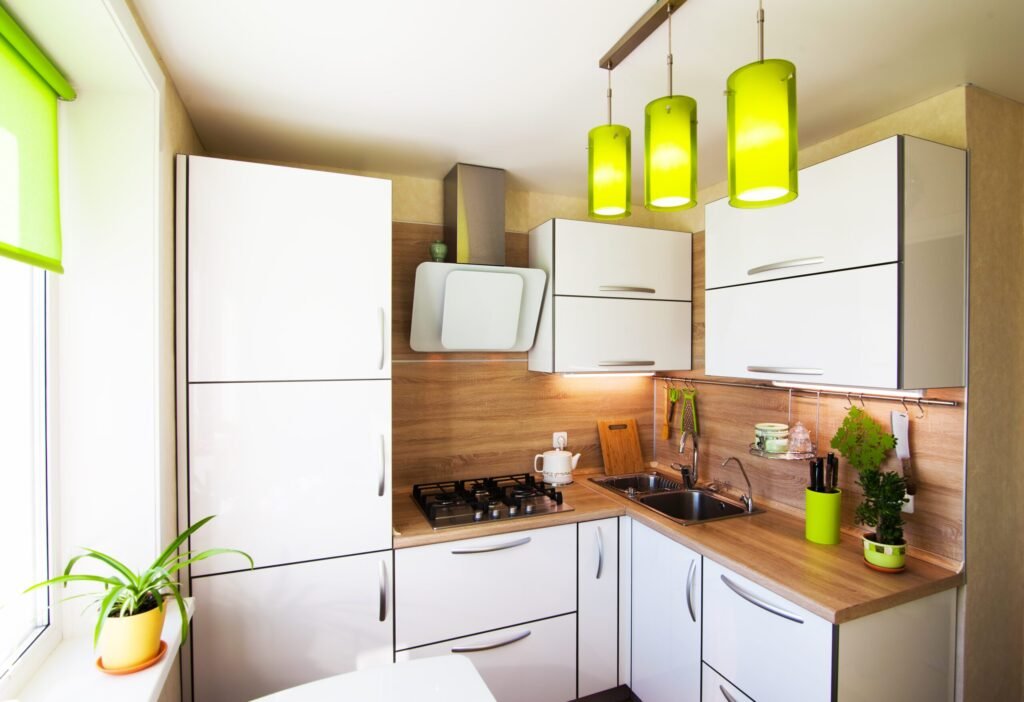
By vertical storage, we mean utilizing the real estate along your walls, cabinet doors and the space above your cabinets.
Here’s what I put into my studio kitchen on a shoestring budget:
Magnetic knife strip on the wall — This opened up a whole drawer I was using to keep knives, and gave me instant access to my blades while cooking.
Pegboard panel above the counter — I hung a small pegboard and hung my most-used pans, spatulas, ladles and measuring cups. It feels orderly, it’s convenient, and it cleared my counter completely.
Over-the-door organizer on the cabinet — I affixed a narrow over-the-door rack to the inside of my biggest cabinet. It currently stores spices, small condiment bottles and cooking oils that once crowded the counter.
Stackable shelf risers inside cabinets — These gave me twice the cabinet storage by creating two “floors” in a single shelf space.
Before and After Vertical Storage: A Quick Comparison
| Area | Before | After |
|---|---|---|
| Counter space | ~30% usable | ~85% usable |
| Cabinet capacity | Overcrowded | Doubled with risers |
| Utensil access | Buried in drawers | Hung and visible |
| Stress while cooking | High | Noticeably lower |
The transformation was almost immediate. Having more counter space meant I could actually prep food correctly, which led to better meals and a better attitude about cooking in my tiny space.
For even more ideas on making the most of your compact space, Tiny Kitchen Living is a fantastic resource packed with practical storage and cooking tips built specifically for small kitchens.
Trick #3 — Meal Prep Sunday Changed My Entire Week
Why Meal Prep Matters Even More in a Small Kitchen
In a full-sized kitchen you can even afford to cook fresh every night. You have room to pull it all out, cook freely and then clean up without it taking over your life.
In a small kitchen, cooking every night is exhausting. You’re constantly battling for space, going through the same cleanup cycle and working in the same cramped prep area night after night.
Meal prep solves this entirely.
By spending two to three hours on Sunday preparing ingredients and batch-cooking basics, I reduced my weeknight cooking down to roughly 15 minutes of work for each meal.
What I Actually Prep Each Week
I don’t meal prep full, completed meals. That gets boring fast. Instead, I prepare building blocks — elements that I can mix and match throughout the week.
My typical Sunday prep list goes something like this:
Grains: One big pot of rice, quinoa or farro. Lasts all week.
Proteins: I will roast a tray of chicken thighs or bake up some tofu. Sometimes I’ll hard-boil half a dozen eggs.
Vegetables: I chop everything — peppers, onions, zucchini, broccoli — and put them into small containers in the fridge.
Sauces: 2 or 3 sauces prepared in advance. A basic tahini dressing, a tomato-based sauce and perhaps a peanut sauce.
With these components prepped and ready to go, I can throw together a grain bowl, a wrap, a stir-fry or even pasta in minutes without major prep work during the week.
The Tiny Kitchen Meal Prep Timeline
| Time Block | Task |
|---|---|
| 0:00 – 0:20 | Start grains cooking, heat oven |
| 0:20 – 0:50 | Chop and store all vegetables |
| 0:50 – 1:10 | Prep and season proteins |
| 1:10 – 1:40 | Roast proteins while making sauces |
| 1:40 – 2:00 | Cool, store, label everything |
Two hours. Five days of quick, delicious weeknight cooking. That trade-off is totally worth it.
Trick #4 — The Miniature Appliance Swap That Gave Me Back My Kitchen
Stop Trying to Fit Full-Sized Appliances Into a Tight Space
When I moved in, I brought my standard-sized appliances with me. A full-size rice cooker that occupied a quarter of my countertop. A large slow cooker. A full-sized blender that was basically a roommate.
All of these had to go.
Swapping to compact, multi-function appliances was one of the best decisions I made for tiny kitchen living cooking. The small appliances you can buy today are truly incredible. You don’t have to compromise on quality anymore to find something that fits a studio kitchen.
The Swaps I Made
Full-size blender → Personal blender (single-serve) Same strength, takes up about one-tenth of the space. I use it for smoothies, sauces and soups.
Big rice cooker → Instant Pot Mini (3-quart) The Instant Pot Mini replaced my rice cooker, slow cooker, and pressure cooker all in one device. It takes up residence in the corner of my counter and performs the duties of three appliances.
Toaster oven + microwave → Compact air fryer toaster oven combo This one appliance toasts, air-fries, bakes and reheats. It took the place of two separate devices and opened up a large portion of counter real estate.
Large dish drying rack → Space-saving over-sink drying rack A rack that rests right over the sink doesn’t take up any counter width and allows dishes to drip-dry straight into the drain. This was a small change that made a big difference in the perceived openness of my counter.
According to Good Housekeeping’s guide to small kitchen organization, swapping bulky single-use appliances for multi-function ones is one of the top recommendations professional organizers make for studio and small apartment kitchens.
Appliance Audit Checklist
Before keeping any appliance in a small kitchen, ask yourself these three questions:
- Do I use this at least three times a week?
- Does it perform a function I cannot successfully achieve in another way?
- Can it be replaced by a multi-function device?
If you answered no to any of these, that appliance likely doesn’t deserve prime counter or cabinet space in your small kitchen.
Trick #5 — Cook Smarter With a “Station” Mindset
Act Like Your Kitchen Is a Restaurant Line
Professional chefs operate in kitchens that are surprisingly not much larger than a studio apartment kitchen. It’s not the space that makes them so efficient — it’s the system.
Restaurant kitchens function on a station model. Each cook has a zone, and all the tools they need for their station are within arm’s reach. Nothing is stored randomly. Nothing is wasted.
I adapted this concept for my tiny kitchen.
I divided my kitchen into three imaginary stations:
Station 1: The Prep Zone This is where I do most of the chopping. Everything having to do with chopping, peeling and measuring lives here. My knife strip is right above it. My measuring cups hang on the pegboard right next to it.
Station 2: The Cook Zone This is the stove and its six inches of counter on either side. I have a splatter screen, tongs, a wooden spoon and a pot holder stored here. Nothing else.
Station 3: The Plate and Serve Zone This is the tiny section of counter closest to the dining area (which, in my studio, is literally two feet from the kitchen). Bowls and plates are kept directly beneath it. A small trivet sits here for hot pans.
Why the Station Mindset Reduces Stress
When everything has a designated home and a clear purpose, cooking becomes almost second nature. You’re not looking for your spatula as something burns on the stove. You’re not rearranging cutting boards trying to locate your measuring spoon.
Your movements become efficient. Your stress drops. Your food actually improves because you’re focused on the cooking and not the chaos.
Setting Up Your Own Kitchen Stations
| Station | What Lives Here | What Stays Out |
|---|---|---|
| Prep Zone | Knife, cutting board, peeler, measuring tools | Decorative items, mail, random clutter |
| Cook Zone | Spatula, tongs, spoon, pot holder | Extra dishes, food packaging |
| Serve Zone | Bowls, plates, serving spoon, trivet | Appliances, storage containers |
It takes maybe half an hour to set this up. The payoff is every meal you cook thereafter.
Putting It All Together: A Week in My Tiny Kitchen
Here’s what an actual week looks like now that I have all five tricks running together:
Sunday: Two-hour meal prep session. Grains, proteins, chopped vegetables and two sauces are ready in the fridge.
Monday–Friday evenings: In and out of the kitchen in 15–20 minutes. Everything is prepped. My stations are clear. I cook a one-pan meal using the layered method. I plate at my serve station and sit down.
Cleaning: Because I only cook in one pan and have clear counter spaces, cleanup takes under 10 minutes most nights.
Hosting: When friends come over, I pull everything out of the fridge and use my station system to plate everything neatly — it looks and feels like I spent hours cooking.
That is the magic of getting your system right.
Common Tiny Kitchen Mistakes to Avoid
Even with the best tricks, a few habits can still undermine your small kitchen experience. Watch out for these:
Buying in bulk without storage space. Buying in bulk is cheap, but it wrecks small kitchens. Only buy what you’re actually able to store.
Keeping duplicate tools. You don’t need three spatulas. One good one is enough.
Ignoring the fridge door. The inside door of your fridge is prime real estate for sauces, condiments and small items. Use every inch.
Skipping the clean-as-you-go habit. One dirty pan on the counter in a small kitchen can ruin your entire cooking session. Rinse things while you cook.
Overcrowding the freezer. A well-organized freezer can be a big asset in tiny kitchen cooking. A cluttered one becomes unusable.
FAQs About Tiny Kitchen Living Cooking
Q: What’s the biggest tip for someone new to tiny kitchen cooking? Start with the vertical storage system. It gives you immediate, visible change and opens up the counter space to begin cooking comfortably. Everything else is built on having that physical room to work.
Q: Am I really capable of meal prepping in a tiny kitchen without it being stressful? Absolutely. The trick is to prep ingredients, not full meals. Chop your vegetables, cook your grains and prepare your proteins separately. This requires less space than putting together entire dishes, and it offers you far more flexibility throughout the week.
Q: Which appliances are really worth it in a studio kitchen? You can cover at least 90 percent of what you’ll need with an Instant Pot Mini, a personal blender and a compact air fryer toaster oven combo. Prioritize multi-function over single-purpose devices.
Q: How do I cope with cooking smells in a studio where the kitchen is open to the bedroom? Use a lid whenever you are frying or sautéing to cut down on splatter and smell. Have a window open when cooking if you can. A small activated charcoal air purifier next to the kitchen works very effectively. Also, avoid frying fish or cooking heavily spiced food in a closed environment without ventilation.
Q: Is tiny kitchen living cooking actually sustainable long-term? Yes — and many people discover that they like it better. Once you have your systems established, small kitchens are quicker to clean, cheaper to stock and encourage a kind of intentional cooking that can actually elevate your skill level. Many experienced home cooks prefer compact, efficient spaces over sprawling kitchens that often lead to disorganized messes.
Q: How do I make guests comfortable when cooking in such a small space? Meal prep everything in advance so that when guests arrive you’re primarily just plating and heating. Place guests in another area instead of crowding the kitchen. Serve food in courses or buffet-style so you’re not plating multiple dishes at the same time.
Wrapping It All Up
Tiny kitchen living cooking doesn’t have to mean bad meals, constant stress or dinner from a delivery app every evening.
With the right approach, a small kitchen turns into one of the most efficient cooking spaces you’ll ever use. Every tool has a purpose. Every inch has a function. And each meal becomes faster and more intentional.
To recap the five tricks:
- Cook in layers using one pan for cleaner, quicker, less stressful meals
- Go vertical with storage to reclaim your counter space immediately
- Prep on Sundays to cut weeknight cooking time down to 15 minutes
- Swap to compact, multi-function appliances that work for your space instead of against it
- Think in stations like a restaurant cook to bring efficiency and calm to every cooking session
Try one trick this week. See how it changes things. Then layer in the next one. In a month, your tiny kitchen will feel less like a hindrance and more like an exquisitely calibrated cooking machine.
Small space. Big flavors. Totally possible.