Meta Description: 9 tricks to maximize tiny kitchen living space — make every inch count, boost storage and ensure your small spaces feel surprisingly spacious – designers swear by these clever secrets
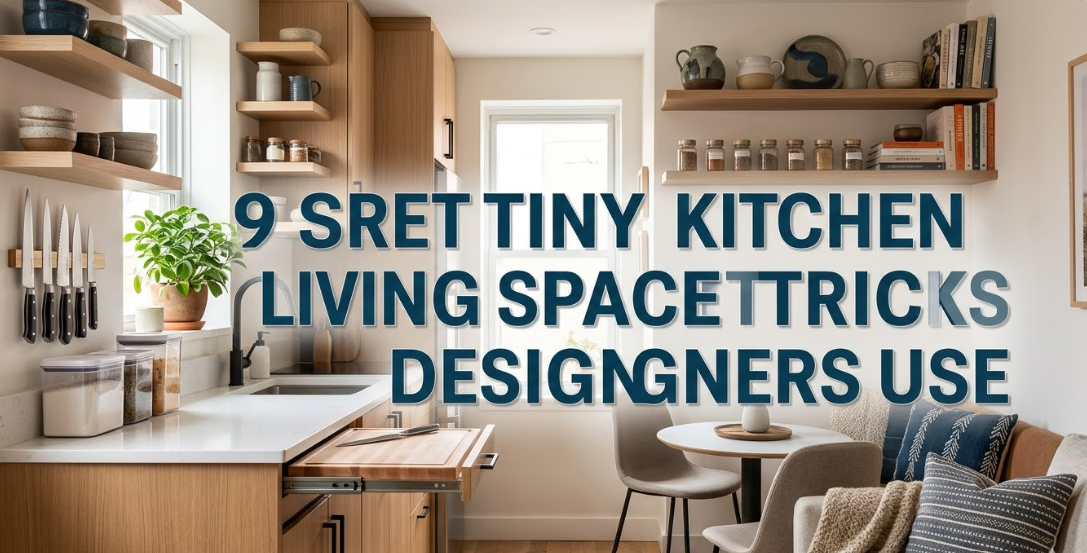
9 Designers’ Tricks to Turn Your Tiny Kitchen Into a Living Space
You consider your tiny kitchen and say, “There’s no way this is going to work.”
But here’s the thing — a professional designer will look at the same space and see endless possibility.
The difference isn’t money. It isn’t square footage. It’s knowing the right tricks.
In fact, small kitchens are one of the most fun design challenges around. Every inch matters. Every decision counts. And when you do it right, a tiny kitchen living space can feel just as functional — and double the stylish — as a big one.
This article is a backstage pass to the 9 secrets that designers apply every day. These aren’t generic tips. These are the real moves that can transform tight, cluttered cooking spaces into places you’ll actually enjoy spending time in.
Let’s get into it.
Trick No. 1: The Zone Method — Don’t Think in Square Feet
Most people see a small kitchen and say, “How do I fit everything in?”
Designers are asking a different question: “How do I make every action smoother?”
That change in mindset gives rise to the zone method. Rather than randomly assigning storage wherever it fits best, designers partition even a tiny kitchen into three distinct zones:
- Prep Zone — cutting boards, knives, mixing bowls
- Cook Zone — pots, pans, oils, spatulas
- Clean Zone — dish soap, sponges or scrubbers, and a drying rack
When everything is located near where you actually use it, you stop walking across the kitchen a hundred times when you cook. The space suddenly feels larger — not because it has expanded, but because it functions.
How to Apply This at Home
Watch yourself make one dish. Count how many times you walk to a cabinet nowhere near the stove. That’s wasted motion — and in a small kitchen, wasted motion feels like wasting space.
Focus your storage organization around those three zones. There is nothing new you need to purchase. Just rethink where things live.
Trick #2: Get Vertical — Your Walls Are Almost Free Storage
Your tiny kitchen living space may have limited floor space. But the walls? Those run all the way up to the ceiling.
Few people hang anything of consequence at eye level. Designers go all the way up.
Ceiling-height cabinets (rather than stopping a foot short) can double your storage. That awkward space above base cabinets — the place where you now stash dust bunnies — becomes actual, usable space.
The Wall Storage Hierarchy
| Level | Items Stored | Best Options |
|---|---|---|
| Eye level | Regular-use items | Open shelves, pegboards |
| Above eye level | Infrequent-use items | Cabinets, baskets |
| Ceiling level | Rarely used objects | Decorative bins, lidded boxes |
| Below counter | Heavy/bulk pieces | Deep drawers, pull-outs |
Pegboards Are Having a Moment
Pegboards are hot with interior designers right now — and for good reason. A single kitchen wall pegboard can hold pots, pans and utensils alongside spice jars and even small shelves. It leaves things out in the open without taking up drawer or cabinet space. And if you do it right, it looks actually super cool.
Add a pop of color to the pegboard, or keep it neutral. Either way, it turns a blank wall into an effective storage system.
Trick #3: Reflective Surfaces — The Light Trick That Changes Everything
Here’s one of those designer tricks that costs next to nothing: lighting opens up space.
But not just any light. The right kind, ricocheted off the right surfaces.
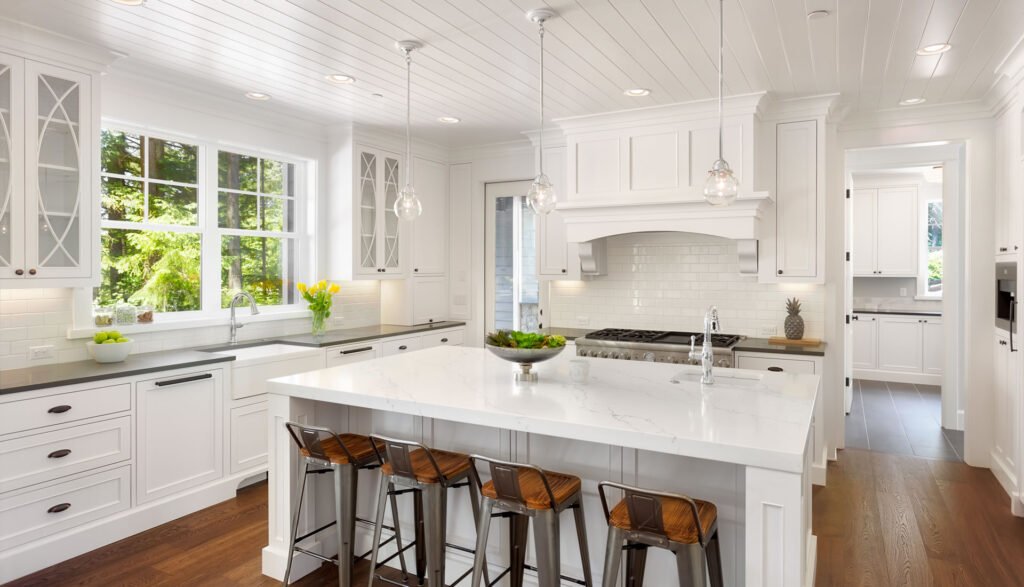
Reflective surfaces make the tiny kitchen feel larger. Glossy cabinet fronts, mirrored backsplashes, polished hardware, and even metallic pendant lights all collaborate to bounce light around the room.
Best Reflective Surface Choices for Small Kitchens
High-gloss cabinet finishes are the most dramatic choice. A matte finish absorbs light. A gloss finish throws it back into the room. The difference is striking — particularly in kitchens with little natural light.
Glass-front cabinets do double duty. They bounce light and give the illusion of more space because your eye can travel further into the cabinet instead of hitting a solid door.
Glossy glazed subway tile on the backsplash is a classic option for a reason. It’s affordable, easy to clean, and surprisingly effective at brightening up a dark kitchen corner.
One Thing to Avoid
Don’t overdo it. When every single surface is shiny and reflective, it makes things feel cold and clinical — like a hospital break room. Combine reflective surfaces with warm, matte materials (like wood, linen, or matte stone) to prevent the space from feeling sterile.
Trick #4: The Illusion of Continuity — Color and Pattern Done Right
Enter a tiny kitchen chopped up with too many colors, patterns, and textures. Then step into one where every element flows in a single, cohesive palette.
The second one feels twice as big. Every time.
Designers call this visual continuity. It’s the practice of guiding the eye smoothly around a space without encountering visual “stop signs.”
The Two-Color Rule
In a small kitchen, choose up to two dominant colors only. Usually:
- A neutral base (white, cream, light gray, or warm beige) for cabinets and walls
- One accent color for hardware, textiles, or a single feature wall
That’s it. Simple. Clean. Spacious-feeling.
Floors That Don’t Divide the Room
Small, busy floor tiles are one of the biggest mistakes in tiny kitchens. More grout lines = more visual breaks = smaller-looking space.
Designers prefer:
- Large-format tiles (12×24 or bigger) — less grout, more air
- Light-toned wood-look planks — warm and airy
- Continuous flooring that stretches from the kitchen into the adjacent living space, giving both rooms a more expansive feel
Trick No. 5: Furniture That Serves Double (or Triple) Duty
In a tiny kitchen living space, each and every piece of furniture must earn its place.
Designers refer to this as multifunctional design — and it is one of the greatest game changers in small space living.
A kitchen island that doubles as pot storage AND a dining table for two? That’s three jobs in one footprint.
Smart Multifunctional Furniture Ideas
- Rolling kitchen cart — extra prep space, storage underneath, moves out of the way when you need the floor space
- Fold-down wall table — mounted to the wall, lays flat when unused, seats two when extended
- Bar cart used as a pantry station — chic, mobile, and holds way more than it seems
- Bench with concealed storage — sits at a small kitchen table but holds linens or appliances inside
The Nesting Principle
Nested or stacked furniture is another designer favorite. Nesting stools that tuck under a counter. Stackable bins that maximize cabinet height. Nesting mixing bowls that occupy one bowl’s worth of space.
Each time you nest something, you make room for something else.
Trick #6: Appliance Editing — Less Is Undeniably More
Open any average kitchen cabinet and you will find:
- A panini press used twice a year
- A rice cooker they didn’t realize they had
- Three blenders (somehow)
- A quesadilla maker from 2014
Designers refer to this as appliance clutter — and it is quietly killing your small kitchen living space.
The 30-Day Rule for Appliances
Here’s an approach that professional organizers and designers suggest:
If you haven’t used an appliance in the past 30 days, it doesn’t deserve space on your counter or in a cabinet of a small kitchen.
That’s a tough rule. But in a small kitchen, it’s an essential one.
What to Keep Out vs. What to Store
| Always on Counter | Store Away | Donate/Remove |
|---|---|---|
| Coffee maker (daily) | Stand mixer (weekly) | Panini press (rarely) |
| Toaster (daily) | Blender (a few times/month) | Duplicate gadgets |
| Knife block | Instant Pot | Broken appliances |
When you pare your appliances down to the absolute necessities, you free up a significant amount of counter and cabinet space overnight. No renovation required.
Trick No. 7: Smart Lighting Layers — One Ceiling Light Is Never Enough
Here’s something designers understand that most homeowners do not: bad lighting makes a small kitchen feel like a closet.
A single overhead light casts shadows in every corner. It makes the ceiling feel lower. It flattens the space. And it makes cooking harder.
Good lighting, by contrast, opens a kitchen up entirely.
The Three Layers of Kitchen Lighting
Layer 1 — Ambient Light This is your standard room lighting. In a small kitchen, recessed lights or a ceiling fixture with a low profile are ideal. Steer clear of large, bulky chandeliers that visually drop the ceiling.
Layer 2 — Task Lighting This goes under cabinets and right above work surfaces. Under-cabinet LED strip lights are inexpensive, simple to install, and make prep work dramatically easier. They also introduce a warm glow that makes the entire kitchen feel more inviting.
Layer 3 — Accent Lighting This is optional but impactful. A small pendant light hung over a tiny island, or LED lighting inside glass-front cabinets, adds visual depth and personality. It makes the kitchen feel designed — not just functional.
The Color Temperature Secret
Most people just buy whatever light bulbs are on sale. Designers are very specific:
- 2700K–3000K (warm white) for a pleasant, cozy atmosphere
- 3500K–4000K (cool white) for a cleaner, more modern appearance
According to the U.S. Department of Energy, LED bulbs using warm white temperatures are significantly more energy-efficient and last far longer than traditional bulbs — making them the smartest choice for small kitchens on a budget.
Warm white in a tiny kitchen often makes the space feel more open and less institutional. It is a minor adjustment with a seriously big effect.
Trick No. 8: The “Less Stuff on the Counter” Principle
Designers are nearly obsessive about countertops in tight kitchens. They regard every inch of counter space as pure gold.
Well, in a tiny kitchen, it pretty much is.
The Counter Clarity Rule
The principle: if it does not need to be on the counter, it’s not on the counter.
That means:
- Paper towel rolls moved inside a cabinet door
- Fruit bowl replaced with a single hook on the wall or in the pantry
- Dish racks stored (or swapped with a mat that dries dishes and rolls up)
- Magnetic wall strip used instead of a knife block
When counters are clear, even the humblest kitchen seems workable. When they’re covered, even a large kitchen feels confining.
What Designers Keep on the Counter
There are very few things designers permit on countertops in a tiny kitchen:
- The coffee maker (if used daily)
- One small plant or a single decorative item (for personality)
- The toaster (if used daily)
- A cutting board (also works as a counter extender over the sink)
That’s often it. Ruthless? Yes. Effective? Absolutely.
Trick #9: Borrow Space From Adjacent Rooms
This is by far the most ingenious trick on this list — and the one that nobody ever thinks of.
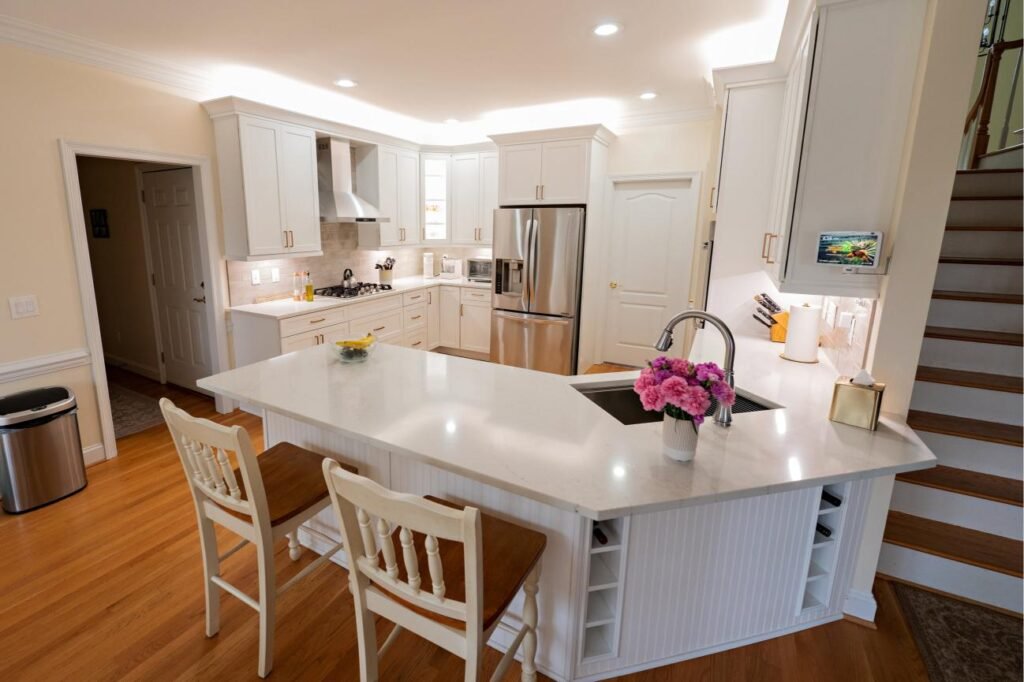
In a tiny kitchen living space, the kitchen doesn’t have to stop at the kitchen wall.
Designers examine what’s immediately next to the kitchen and ask: “Can I borrow a little of that space?”
How to Extend Your Kitchen Into Adjacent Areas
Open shelving into the dining area Rather than ending storage at the kitchen wall, extend open shelves along a dining room or living room wall. These can store cookbooks, serving dishes, and decorative jars — expanding your storage without getting into the kitchen itself.
A pantry nook carved out of a hallway Most apartments have at least a small, awkward hallway right next to the kitchen. A shallow built-in (even 12 inches deep) can store canned goods, small appliances, and dry goods — serving as a complete pantry that is not in the kitchen at all.
A bar cart in the living room Take your drink and entertaining supplies out of the kitchen altogether. An attractive bar cart in the living or dining room looks sharp, prevents guests from lingering too long in the kitchen while you’re cooking, and creates significant cabinet space.
The kitchen island that lives in the living room In open-plan tiny spaces, some designers feature a rolling kitchen island that’s technically positioned in the living room but rolls into the kitchen as needed. When cooking is complete, it rolls back and serves as a side table or console.
Before and After: A Borrowed Space Transformation
| Area | Before | After |
|---|---|---|
| Hallway wall | Blank wall | Pantry shelves, 12″ deep |
| Living room corner | Empty corner | Bar/pantry cart |
| Dining room wall | Art print only | Open shelves + art |
| Dining table | Dining only | Occasional prep space with cutting board |
Putting It All Together — A Quick Reference
Here’s a roundup of all 9 tricks designers use in tiny kitchen living spaces:
| # | Trick | Core Idea |
|---|---|---|
| 1 | Zone Method | Organize by action, not available space |
| 2 | Go Vertical | Use wall height all the way to the ceiling |
| 3 | Reflective Surfaces | Bounce light to visually expand the room |
| 4 | Color Continuity | Two colors max, large-format flooring |
| 5 | Multifunctional Furniture | Every piece must do 2–3 jobs |
| 6 | Appliance Editing | Only keep what you’ve used in the last 30 days |
| 7 | Layered Lighting | Ambient + task + accent lighting |
| 8 | Clear Counters | Treat counter space like it’s gold |
| 9 | Borrow Adjacent Space | Expand storage beyond the kitchen walls |
Frequently Asked Questions About Tiny Kitchen Living Spaces
Q: What is the single biggest mistake people make in a small kitchen? A: Clutter on the counters. It’s the quickest way to make a small kitchen feel suffocating. Clearing the countertops down to daily essentials has the most visible impact at zero renovation cost.
Q: Can a little kitchen actually feel big? A: Yes — absolutely. The above tricks demonstrate that spaciousness is largely a visual experience. The right lighting, colors, reflective surfaces, and organization can make a tiny kitchen feel strangely open and functional.
Q: How can I create storage without doing a renovation? A: Go vertical with pegboards and wall-mounted shelves, use the inside of cabinet doors, put hooks in any unused wall space, and use a rolling kitchen cart for extra storage. Not a single nail gun or building permit is required for any of these.
Q: What colors make a small kitchen feel larger? A: Light, neutral colors — white, cream, soft gray, and warm beige — make the most impact. Complement them with one accent color and a glossy finish on cabinet doors to reflect light throughout the room.
Q: Is an open floor plan best for a tiny kitchen? A: Generally yes. When the kitchen visually extends into an adjoining dining or living space (especially if they share the same flooring), both areas appear more spacious. But even enclosed kitchens can seem expansive with the right design moves.
Q: Do I have to spend a lot of money to improve a tiny kitchen? A: Not at all. The biggest changes — clearing counter space, zone organization, LED strip lights under cabinets, and a pegboard — are all extremely low-cost. Several of the tips in this article are totally free.
Q: What is the best lighting for a small kitchen? A: Layer your lighting. Use recessed ceiling lights for ambient light, LED strip lights under cabinets for task lighting, and a small pendant or cabinet interior lighting for accent. Use warm white bulbs (2700K–3000K) to keep the space feeling cozy rather than clinical.
The Real Secret Is Thinking Like a Designer
What ties all 9 tricks together is this: designers see beyond what’s there. They see what’s possible.
They look at a tiny kitchen living space and don’t dwell on its limitations. They ask how the space can function better, appear more deliberate, and feel larger than it actually is.
You don’t have to have a design degree to think that way. All it takes is the right framework.
Pick one trick from this list to start with. Maybe clear the counters today. Or this weekend, organize your cabinets by cooking zones. Or grab a set of LED strip lights for under your upper cabinets.
Each little change builds on the last one. Before long, your small kitchen won’t just be functional — it will be a space you’ll actually take pride in.
And that’s the real goal. Not a bigger kitchen. Just a better one.