Meta Description: Transform your small space into a functional oasis by making tiny kitchen living cooking habits. Learn 8 amazing tricks that free up counter space and simplify life.
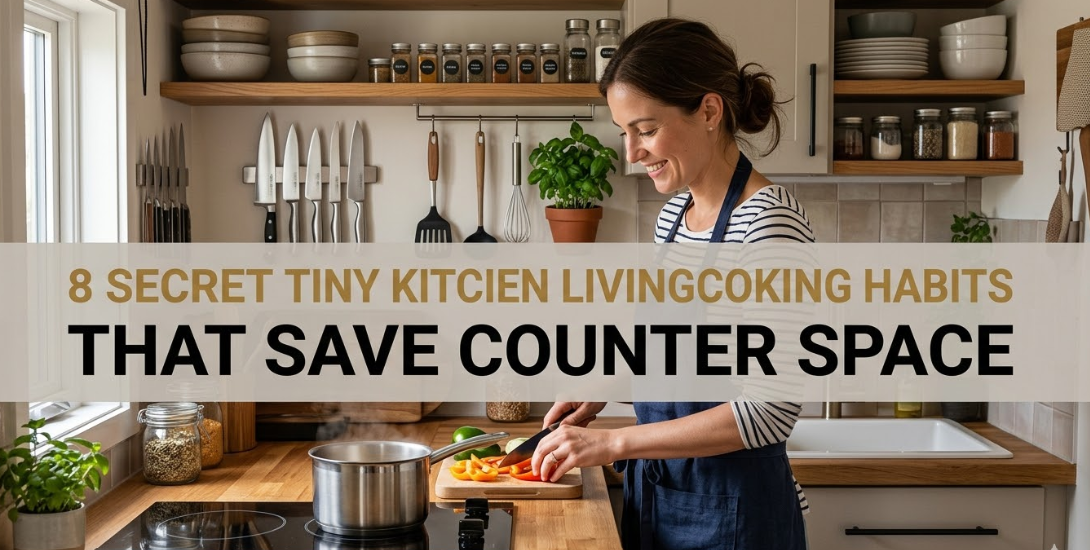
8 Secret Small Kitchen Living Cooking Habits That Save Counter Space
If you live in a tiny apartment, a studio or just one of those wonderfully small houses that’s built to stay at home — you know the challenge. Counter space is gold. Every inch matters. And when all those things stack up — the toaster, the cutting board, the coffee maker, the fruit bowl — cooking begins to seem like a puzzle you didn’t agree to play.
But here’s the thing: those people who make it work in their postage-stamp-size kitchens have no higher budgets or magic wands. They just have smarter habits.
These are not the tips you’ve heard a hundred times. It’s about the real-life daily rituals, small choices and ingenious configurations that truly redefine how a tiny kitchen feels and operates.
Let me now get into 8 secret tiny kitchen living cooking habits that will free your counter space and make the act of cooking feel easy — even in the smallest kitchen you’ve ever had. For more inspiration and ideas tailored to compact spaces, visit Tiny Kitchen Living — a great resource for making the most of every square inch.
1. The “One In, One Out” Rule for All Things Countertop
A lack of storage is not where most tiny kitchen problems begin. They start with too many things out on the counter “just in case.”
The one in, one out rule is straightforward. Every time something new comes in and lands on your counter, something must move out — to a drawer, a cabinet, a shelf or the donation pile.
Why This Is Better Than a Deep Clean
A big clean-up of the kitchen seems efficient, but within a week the clutter is back. The one in, one out rule is a practice, not an event. It recalibrates the way you think about your counter. You begin to ask, “Does this really belong here?”
Apply this specifically to appliances. The toaster oven, meanwhile, might need to go when you add a new air fryer — or be relegated to a shelf in the cabinet and only come out when needed.
Quick Rule-of-Thumb Table:
| Counter Item | Keep Out? | Better Location |
|---|---|---|
| Coffee maker | Yes (used every day) | Corner of counter |
| Toaster | Maybe | Cabinet shelf |
| Stand mixer | No (weekly use) | Lower cabinet |
| Knife block | Yes | Back corner or magnetic wall strip |
| Fruit bowl | Optional | Top of fridge or hanging basket |
| Spice rack | Depends | Drawer inserts or wall-mounted |
This clears 30–40% of your counter without resorting to throwing stuff away.
2. Mise en Place for Cooking — But Make It Tiny Kitchen Style
Mise en place is a French cooking term that chefs use. It translates as “everything in its place.” Professional cooks have everything prepped and organized before they start to cook.
This habit is a counter-space lifesaver in a tiny kitchen.
How to Go About It Without Making More Mess
Most home cooks take out ingredients as they need them. That means 10 different things go on the counter at once — jars, bags, bowls, cutting boards, spice bottles. It looks like a disaster.
Tiny kitchen cooks turn the tables. Before anything hits the stove:
- Take out only what you need for that dish
- Measure out spices into one small bowl
- Put everything chopped first in one bowl or on a plate stacked
- Put every ingredient away as soon as it’s been used
That keeps the counter clean during cooking. The piles aren’t getting higher — you get to start fresh.
The One-Bowl Prep Method
Use one big bowl with little plates stacked in it instead of multiple prep bowls. As you prep each ingredient, slide it to one side of the bowl. Clean as you go. This slashes your dishes in half and keeps the counter practically spotless.
3. Vertical Thinking: Store Up, Not Out
If you think only horizontally — across the counter — there’s half your kitchen you’re missing. Tiny kitchen pros think vertically.
Walls Are Free Real Estate
Here’s what you can clear from the counter and move onto the walls:
- Magnetic knife strips — get those knives off the counter entirely
- Pegboards — hang pots, pans, utensils, lids
- Floating shelves — store spices, small appliances, jars
- Over-the-door organizers — ideal for pantry doors, cleaning supplies, wraps
A single pegboard above the stove can get rid of an entire drawer’s worth of counter clutter. A magnetic strip for knives opens up the space a knife block occupies — which is more than most people think.
Stack Smart Inside Cabinets Too
When the cabinet is arranged vertically — with risers, stackable containers and tiered shelves — you stop taking everything out to find one thing. That means less “temporary” mess on the counter as you search.
Vertical Storage Ideas by Space:
| Location | Storage Hack | Items to Store |
|---|---|---|
| Above stove | Floating shelf | Spices, oils, small jars |
| Inside cabinet | Risers + stackable bins | Canned goods, dishes |
| Side of fridge | Magnetic rack | Spice bottles, foil/wrap boxes |
| Pantry door | Over-door organizer | Snacks, wraps, bags |
| Wall near sink | Pegboard | Utensils, colander, cutting board |
4. The “Clean Counter Before Bed” Non-Negotiable
Here is the power habit of every person who lives well in a small kitchen. It’s not glamorous. But it works.
The counter resets to completely clear every night, before you go to bed.
An Empty Counter Changes Everything
When you wake up to a clear counter, your brain doesn’t start the day in chaos mode. You have space to make coffee, room to prep breakfast, room to think. A messy counter from yesterday makes everything harder when the next day dawns.
More importantly, it requires a daily reset. Nothing builds up. Nothing becomes permanent. The counter remains a workspace, not a storage shelf.
The 5-Minute Counter Reset
Keep it short so you will actually do it:
- Store away all dishes (or stack them neatly if drying)
- Wipe down the entire surface
- If something “landed,” return it to its home
- Return the dish soap, sponge and one or two everyday items to their places
That’s it. Five minutes. The following morning feels entirely different.
5. The No-Duplicate Rule — Multi-Functional Tools Only
Every tool must justify its place in a tiny kitchen. When two tools do the same task, one gets thrown out.
The Duplicate Trap
Most kitchens have duplicates lurking in plain sight:
- A can opener AND a multi-tool with a can opener
- A garlic press AND a knife (which does the same job)
- Three spatulas when one would do
- A colander AND a pot with a straining lid
Each of them takes up drawer or counter space. Multiply that by ten or fifteen doubles, and you’ve got a serious space problem.
Go Multi-Functional Wherever Possible
The best tiny kitchen tools do double- or triple-duty:
- Instant Pot / pressure cooker — replaces slow cooker, steamer, rice cooker, sauté pan
- Cast iron skillet — fits on stovetop AND in the oven, replaces several pans
- Immersion blender — takes the place of countertop blender for most things
- Box grater with built-in bowl — grater, zester and mixing bowl in one
- Cutting board with pull-out colander — prep and drain all on one surface
With every tool serving double duty, you own half as many things — and the counter tells that story.
Multi-Tool vs. Single-Use Comparison:
| Single-Use Tool | Multi-Functional Replacement | Space Saved |
|---|---|---|
| Rice cooker | Instant Pot | Large appliance slot |
| Countertop blender | Immersion blender | Significant counter space |
| Garlic press | Chef’s knife | Drawer space |
| Egg separator | Your hands | Drawer space |
| Avocado slicer | Knife + spoon | Drawer space |
6. The Refrigerator Door and Sides Habit Everyone Ignores
Your refrigerator is working harder than you realize — or it ought to be. The sides and top of the fridge are prime real estate in a small kitchen.
Use the Top of Your Fridge
A lot of fridge top space is wasted. But with an easy tray or basket, it becomes functional storage for:
- Non-refrigerated fruits (bananas, apples, citrus)
- A bread box or bread bag
- Cookbooks you use regularly
- A small spice basket for overflow spices
Just getting the fruit bowl off the counter feels surprisingly liberating.
Side-of-Fridge Magnetic Storage
Most refrigerators today have magnetic sides. Use them:
- Magnetic spice tins mounted on the side of the fridge = an entire spice rack cleared off the counter
- Magnetic paper towel holder = clears the counter holder
- Magnetic dry-erase board = grocery list, meal plan, notes
These aren’t just organizational hacks. They’re counter-clearing hacks. The fridge becomes an extension of your kitchen wall.
7. Meal Planning as a Counter-Space Strategy (Not Just a Budget Hack)
People generally think meal planning is for saving money or eating healthy. The real benefit for tiny kitchen people: fewer things on the counter at once.
How Meal Planning Cuts Down on Counter Clutter
You shop with a purpose when you plan your meals for the week. That means:
- The kitchen holds only the ingredients you require
- You don’t have five half-used produce items rotting on the counter
- You’re not reaching for random tools and appliances while figuring out dinner
An organized kitchen is a well-planned kitchen. If Monday is pasta night and Tuesday is stir fry, you know exactly which tools, pots and ingredients to have on hand. Everything else stays put away.
According to the USDA’s MyPlate meal planning guidelines, planning meals ahead not only reduces food waste but also encourages healthier, more intentional cooking habits — a perfect match for tiny kitchen living.
The Weekly Kitchen Reset Habit
Combine meal planning with a weekly kitchen reset every Sunday:
- Get rid of anything in the fridge that is going to expire
- Wipe down shelves and counter
- Set up for the first meal of the week
- Relocate appliances you’ll need this week to accessible spots and stow everything else
This weekly ritual takes 20–30 minutes and stops the gradual build-up of clutter that renders tiny kitchens uninhabitable by Thursday.
Sample Meal Plan + Tool Use Chart:
| Day | Meal | Tools Needed | Tools to Keep Stowed |
|---|---|---|---|
| Monday | Pasta + salad | One pot, colander, knife | Air fryer, stand mixer |
| Tuesday | Stir fry | Wok, spatula | Toaster, blender |
| Wednesday | Soup | Immersion blender, large pot | Waffle iron, rice cooker |
| Thursday | Tacos | Cast iron skillet, cutting board | Pasta machine, steamer |
| Friday | Sheet pan meal | Sheet pan, spatula | Everything else |
8. The “Prep, Cook, Clean” Rhythm — Never Let the Mess Breathe
The last habit is all about timing. Most people cook, then eat, then clean. Tiny kitchen pros build cleaning into the cooking process so the mess never completely materializes.
Cook in Phases, Clean Between Each One
Here’s how this looks in practice:
Phase 1 – Prep Chop, measure and organize everything. Wipe down the cutting board. Place packaging and bags in appropriate disposal containers immediately. The counter is almost clear before the stove even turns on.
Phase 2 – Cook As each ingredient goes into the pan, its prep bowl gets rinsed and set aside. Lids go back on spice jars. If anything spills, surfaces get a quick wipe.
Phase 3 – Plate While food is being plated, the pots get a quick soak in the sink. Counter gets wiped. By the time you sit down to eat, the kitchen is 80% clean.
Phase 4 – Post-Meal Just the plates, a pan or two and a few utensils. Five minutes of washing and the kitchen is completely done.
Why This Rhythm Matters More in Tiny Kitchens
In a large kitchen, you can leave a mess in one corner and still have space to work. In a tiny kitchen, there’s no corner. Mess spreads to your entire workspace instantly.
It’s the cook-clean rhythm that makes a tiny kitchen work during cooking — not just before and after.
Putting It All Together: The Tiny Kitchen Habits Loop
These 8 habits do not operate in isolation. They create a loop that keeps your kitchen functional, clear and stress-free day after day.
Here’s a simple visual of how they connect:
The Tiny Kitchen Habits Loop:
Plan (meal planning) → Set Up (mise en place + vertical storage) → Cook (prep-cook-clean rhythm + multi-functional tools) → Reset (clean counter before bed + one in, one out) → Repeat
With all 8 habits in place, the counter resets itself. You stop doing battle with the kitchen and begin collaborating with it.
The Real Cost of Counter Clutter in a Tiny Kitchen
Before we close, it’s important to understand why counter space matters so much — beyond looks.
| Impact of Clutter | What It Really Costs You |
|---|---|
| Less prep space | Slower cooking, more stress |
| Visual chaos | Mental fatigue, lower motivation to cook |
| Hidden tools | Duplicate purchases, wasted money |
| No clear zones | Inefficient movement, longer meal time |
| “Stuff builds on stuff” | Clutter doubles every few weeks |
A clear counter isn’t just nice to look at. It’s functional. It’s mental breathing room. In a tiny kitchen, it’s what makes the difference between dreading cooking and actually enjoying it.
FAQs: Tiny Kitchen Living Cooking Habits
Q1: What’s the very first habit I can adopt in a tiny kitchen? Start with the “clean counter before bed” habit. It’s the quickest to deploy and yields the most obvious results overnight. After you wake up to a clear counter day in and day out, all of the other habits become much easier to build on.
Q2: How do I store appliances I use weekly but not daily? Store in lower cabinets or on a covered rolling cart. Prepare the appliance and store it in the cabinet so that setup is fast. The trick is to make “putting it away” as convenient as “taking it out.”
Q3: Are tiny kitchen habits feasible in a communal kitchen or rental? Absolutely. Most of these habits are behavioral, not structural. You will not need to drill holes or do any permanent installation. Freestanding shelves, magnetic strips on the refrigerator and over-the-door organizers can all work in rentals.
Q4: How do I get a roommate or partner on board with these habits? First, keep your own area of the kitchen clean. Seeing the difference visually awakens curiosity for most people. Emphasize what’s in it for both of you — more counter space for everyone — and do not critique their habits.
Q5: Is it possible to do serious cooking in a really tiny kitchen? Yes — and a lot of professional cooks like small, tight kitchens because you can reach everything. The secret is habits and organization, not square footage. Some of the best home-cooked meals are prepared in galley kitchens the size of a hallway.
Q6: What’s the biggest mistake people make with small kitchens? Treating the counter as storage. The counter is a workspace, not a shelf. Once you start putting stuff there permanently, the kitchen is gone. Stay clean and use every other surface — the walls, sides of the fridge, insides of cabinets — for storage instead.
Q7: Do I have to spend money to create these habits? Many of these habits are completely free. The behavioral shifts — clean as you cook, clear the counter every night, plan your meals — cost nothing. Some storage tools (magnetic strips, pegboards, shelf risers) are inexpensive and pay for themselves immediately in reduced stress and improved function.
Final Thoughts: Small Kitchen, Big Life
A tiny kitchen isn’t a limitation. It’s a design challenge — and these 8 habits are your toolbox.
The secret that those who’ve spent time in tiny kitchens know is straightforward: cooking doesn’t get better because the kitchen gets larger. It gets better because you work it smarter.
Choose one of these habits this week. Maybe it’s cleaning the counter before going to bed. Perhaps it’s replacing two single-use tools with one multi-functional one. Choose the habit that seems easiest and expand from there.
In a month, your kitchen will feel like a different place — no structural changes, just a change in habits making all the difference.
Tiny kitchen living cooking habits aren’t about necessity. They’re about intention. And intention, it turns out, is the best use of counter space there is.