Meta Description: Tiny living kitchen organizing ideas cabinet can help you turn your cramped cooking space into a functional haven. Here are 12 creative and cost-effective strategies that really pan out.
12 Organization Ideas for Tiny Kitchen Living Cabinets
Is your kitchen cabinet a black hole where Tupperware lids go to die? You open the door, something tumbles out and so now you’re reorganizing everything just to get one pan. Sound familiar?
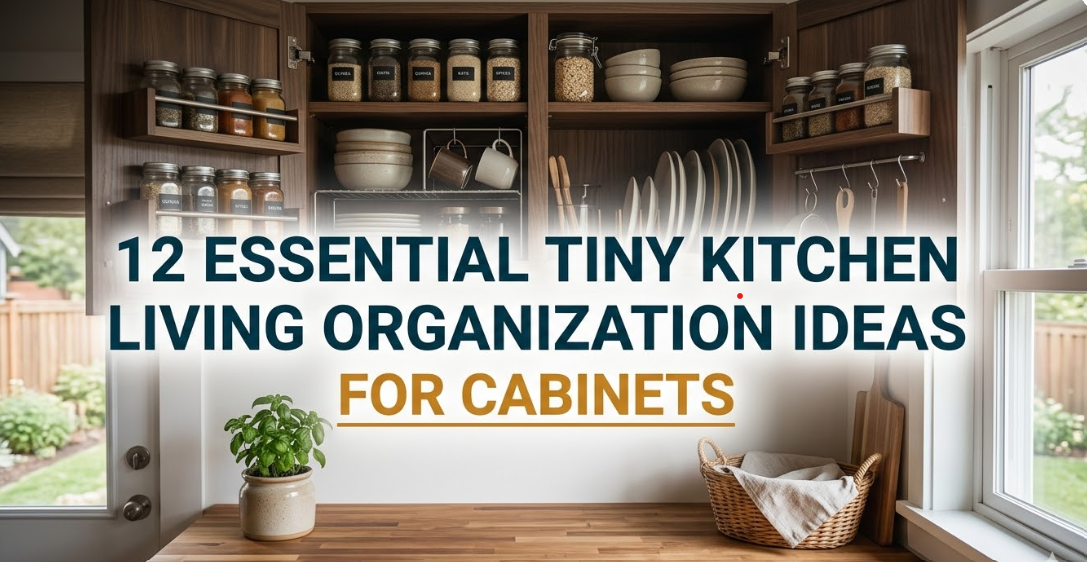
There’s no reason to live in chaos just because you’re living in a small space. With the best tiny kitchen living organization ideas for cupboards, even the most cramped kitchen can appear spacious, usable and surprisingly serene.
This guide explains 12 practical, proven strategies — no expensive renovations necessary. Just some sleek thinking, basic tools and a few hours of your weekend.
Why Cabinet Organization Is More Important in Tiny Kitchens
Clutter conceals itself easily in a big kitchen. In a tiny one, every foot matters.
Cluttered cabinets waste space, slow cooking and make daily routines maddening. Research in home design has consistently shown that organized kitchens can help take the stress out of meal prep and even inspire people to cook more meals at home.
It isn’t about working toward a Pinterest-worthy kitchen. The goal is a kitchen that serves you.
Let’s get into it.
Garnish With Stackable Shelf Risers
The vast majority of cabinet shelves are placed far apart. That space above your stack of plates and below that shelf? It’s wasted real estate.
Stackable shelf risers give you usable space in an instant. Put one inside a cabinet and you’ve got two levels where only one used to be.
Use them for:
- Plates and bowls
- Canned goods
- Spices and small jars
- Mugs
They’re inexpensive (typically $10–$25), they come in wire, bamboo or plastic and you need absolutely no installation.
Quick Tip
Before purchasing, measure the height of your cabinet. Adjustable risers are ideal for cabinets with odd spacing.
Install a Tension Rod for Pot Lids
Pot lids are arguably the most annoying thing to store in any small kitchen. They slide, clang and don’t stay put.
Here’s an easy solution: a tension rod, mounted vertically inside a cabinet, that creates slots for lids. No drilling. No damage. Just a pole stuck between the top and bottom shelf.
Two parallel tension rods can also hold lids horizontally in, like a rack.
Cost: Less than $10 Time to install: Two minutes
This is one of the most underrated tiny kitchen living organization ideas for cabinets since it solves a real everyday frustration for next to nothing.
Add Pull-Out Drawer Organizers
Deep cabinets are deceptive. You think you have plenty of space, but then everything stacks up and you’re never able to get to the back.
Pull-out drawer inserts slide into existing cabinets, converting them to functional drawers. Most models do not require any tools or permanent fixtures.
They work great for:
- Pots and pans
- Mixing bowls
- Cutting boards
- Baking sheets
Seek out ones with smooth gliding tracks that can be adjusted in width. Great options that fit most standard cabinets include brands such as Rev-A-Shelf.
Why This Works
Pull-outs solve the “digging-through-the-cabinet” dilemma. In one fluid motion, everything is made visible and accessible.
Use Door-Mounted Organizers
The back of your cabinet doors is prime, unused real estate.
Over-the-door organizers clip or install onto cabinet doors and allow you to create pockets, hooks or racks for items that you reach for all the time.
Great uses include:
- Spice packets and seasoning blends
- Measuring cups and spoons
- Cleaning supplies under the sink
- Rolls of foil, plastic wrap and parchment paper
Simple wire organizers cost $5–$15 and are widely available at home goods stores. Some snap on with adhesive strips — no drilling needed.
Best Cabinet Doors to Target
- The kitchen-sink cabinet
- The cabinet nearest to your stove
- Any cabinet you open several times a day
Rethink Your Spice Storage Completely
Spices are the number one space killer when it comes to small kitchen cabinets.
Most people store spice jars upright, occupying an entire shelf. Instead, try these smarter alternatives:
Option A: Magnetic spice tins Mount a magnetic strip inside the cabinet door or on the wall. Stick magnetic tins on it. Instant space savings.
Option B: Tiered spice rack A two- or three-tiered rack fits in a cabinet and allows you to see every bottle at a glance.
Option C: Drawer spice organizer Lay spices horizontally in a shallow drawer insert, labels facing up. No better way to see everything clearly.
| Storage Method | Space Saved | Visibility | Cost |
|---|---|---|---|
| Upright on shelf | 0% | Low | Free |
| Tiered rack | 40% | Medium | $15–30 |
| Magnetic tins | 60% | High | $20–40 |
| Drawer organizer | 50% | Very High | $10–25 |
Store Baking Sheets and Cutting Boards on Their Sides
Flat items like baking sheets, cutting boards and cooling racks occupy huge amounts of cabinet space when stored flat.
The fix? Store them standing upright.
Put a vertical file organizer (yes, like the one for your office paperwork) inside your cabinet. Insert your flat items in like files. They’re easily accessible individually without disturbing everything else.
You can also purchase dedicated pan organizers featuring adjustable dividers intended just for the kitchen.
Time savings: No more moving four items just to reach the one buried at the bottom.
What to Store Vertically
- Baking sheets and cookie trays
- Cutting boards
- Muffin tins
- Wire cooling racks
- Pizza pans
Use the “Zones” Method to Organize a Cabinet
Random storage is your tiny kitchen’s enemy.
The zone method means putting items together according to how and when you use them, then storing each group close to where you will actually use it.
Zones for a small kitchen:
- Cooking zone (near the stove): pots, pans, oils, spatulas
- Prep zone (around counter space): cutting boards, mixing bowls, measuring tools
- Drink zone (around the coffee maker or refrigerator): mugs, glasses, coffee/tea items
- Pantry zone (top cabinets): dry goods, canned foods, snacks
When everything lives where you use it, cooking is faster and putting things away becomes automatic.
For more small-space inspiration and practical tips, Tiny Kitchen Living is a fantastic resource dedicated entirely to making compact kitchens work harder for you.
This is one of those free tiny kitchen living organization ideas for cabinets that makes all the difference.
Declutter Before You Organize (Seriously)
This step is not exciting — but it is the most important one.
No amount of organizers can remedy a cabinet stocked with things you don’t need.
Before purchasing even a single shelf riser or drawer insert, comb through every cabinet and ask:
- Have I used this in the past 6 months?
- Do I own duplicates of this?
- Is this damaged, stained or something I intended to replace?
Donate, throw out or sell what doesn’t make the cut.
The One-Year Rule
If you haven’t used it in a year, you likely don’t need it in a small kitchen. Be ruthless. The less you have, the more effective your organization will be.
One mistake people make is buying the organizers first and then trying to fit everything in. Instead, do it backwards — first declutter, then organize.
Store Dry Goods in Transparent Containers
Open bags of flour, rice, pasta and cereal are messy, unsightly and attract pests.
Clear, airtight containers solve all of this at once. They stack neatly, preserve food longer and let you see how much of anything you have without opening anything.
Look for containers that are:
- All the same size (so they stack nicely)
- Square or rectangular (not round — round containers waste corner space)
- BPA-free and airtight
Use a piece of tape and a marker to label each container. Simple works best.
Popular brands: OXO Good Grips, Rubbermaid Brilliance, Vtopmart
Space Comparison
A box of pasta occupies about three times as much cabinet space as the identical pasta stored in a flat-bottomed container. This scales up to an entire shelf’s worth of freed space over five or six staple items.
According to the Good Housekeeping Institute, switching from original packaging to uniform airtight containers is one of the most impactful changes you can make in a small kitchen pantry or cabinet.
Hang Hooks for Small Tools on Inside Cabinet Doors
Small kitchen utensils — whisks, ladles, measuring spoons — end up jumbled in a drawer or occupy precious cabinet shelf space.
Instead, hang a row of small hooks inside a cabinet door. That way, you can hang your tools right on them.
You can use:
- Command hooks (no marks, easy to relocate)
- Adhesive hook strips
- Small screw hooks (for something more permanently fixed)
This is especially useful inside the cabinet above or next to your stove — keeping the cooking tools you use most often within arm’s reach.
Tools that hang well:
- Measuring spoons
- Ladles and spatulas
- Vegetable peelers
- Whisks
- Oven mitts
The Correct Way to Stack Pots and Pans
Most people stack pots by size. Not incorrect, but it creates a big problem: to get the pan on the bottom, you have to move everything on top.
Here’s a smarter system:
Stack by frequency of use. The pan you use most goes on top. The stock pot you use once a month goes on the bottom or in a less accessible cabinet.
Place pot protectors (soft fabric circles) between stacked pans so they don’t scratch.
For lids, use the tension rod trick from tip #2 or hang a lid rack on the cabinet door.
Nesting Organizers
Always stack nesting mixing bowls if you have them. Same goes for measuring cups. Do not let them live separately — it takes up too much room.
Review and Optimize Every Quarter
The most organized kitchen isn’t one you set up once. It’s one you maintain.
Once every three months, take 20–30 minutes and do a quick cabinet audit:
- Did anything migrate out of its zone?
- Do you have new items without a proper home?
- Is anything in the cabinet you haven’t touched since the last audit?
Small adjustments keep big messes from accumulating again.
Set a reminder on your phone. Think of it as a mini reset, not a major project. Thirty minutes every quarter keeps your tiny kitchen living organization ideas for cabinets working long-term.
A Quick-Reference Summary
| Tip | Cost Range | Difficulty | Impact |
|---|---|---|---|
| Shelf risers | $10–25 | Easy | High |
| Tension rod for lids | Under $10 | Easy | Medium |
| Pull-out drawer inserts | $20–60 | Easy-Medium | Very High |
| Door-mounted organizers | $5–20 | Easy | High |
| Smart spice storage | $10–40 | Easy | High |
| Vertical flat item storage | $10–25 | Easy | High |
| Zone method | Free | Medium | Very High |
| Decluttering | Free | Hard (mentally) | Extreme |
| Clear containers | $20–50 | Easy | High |
| Hook strips inside doors | $5–15 | Easy | Medium |
| Smart pot stacking | Free | Easy | Medium |
| Quarterly audit | Free | Easy | Very High |
Bonus: What NOT to Do in a Small Kitchen Cabinet
Some “organization” moves certainly backfire, even if done with the best of intentions.
Avoid these common mistakes:
- Getting too many organizers all at once. Begin with one or two changes, see what works and expand.
- Keeping things you never touch in prime space. Your most-used items deserve the best real estate.
- Ignoring vertical space. Most people only think horizontally. Look up.
- Mixing zones. When coffee mugs find their way next to the canned tomatoes, the whole system starts to break down.
- Skipping labels. Labels keep things from being put back in the wrong place in a small kitchen.
Tiny Kitchen Cabinet Organization FAQs
Q: What’s the one best thing I can do to organize a small kitchen cabinet?
A: Declutter first. No organizer in the world helps a cabinet that’s bursting with items you don’t use. Purge what you don’t need, then arrange what’s left.
Q: Are tension rods strong enough to hold pot lids?
A: Yes, for standard lids. Heavy-duty-rated tension rods can support lids weighing several pounds each. Be sure to check the weight rating before buying.
Q: How do I organize cabinets if I’m renting and can’t drill holes?
A: Almost everything here will work without drilling. Damage-free options include Command hooks, tension rods, pull-out inserts and adhesive strips.
Q: How should I organize a corner cabinet in a small kitchen?
A: Lazy Susans (rotating turntables) are the gold standard for corner cabinets. Simply spin and the back of the cabinet comes to you — no more dreadful dark corners.
Q: How long does a complete kitchen cabinet reorganization take?
A: For a standard small kitchen, expect 2–4 hours of work. Decluttering takes the longest. The actual organizing, once you have your supplies in hand, goes much more quickly.
Q: How can I organize cabinets on a budget?
A: Absolutely. Many of the best ideas — the zone method, vertical stacking, decluttering — cost nothing. Starting a full cabinet overhaul with shelf risers and one or two door organizers can definitely be done under $30.
Q: How often should I reorganize my kitchen cabinets?
A: A full declutter once or twice a year is enough. Setting aside just 20 minutes every three months for a quick audit is enough to keep things from falling back into disarray.
Wrapping It All Up
A small kitchen doesn’t have to be a battle every time you make dinner.
The right tiny kitchen living organization ideas for cabinets help you reclaim space you never knew you had, reduce daily frustration and even enjoy spending time in your own kitchen.
Start small. Pick three or four ideas that fit your biggest pain points. Try them this weekend. When you see how much difference even one change can make, you’ll want to keep at it.
The most organized kitchen is the one that functions well for your life — not the one that looks like perfection on Instagram. Keep it practical, keep it simple, and keep adjusting until it resonates.
Your kitchen is small. Your potential for organization? Anything but.