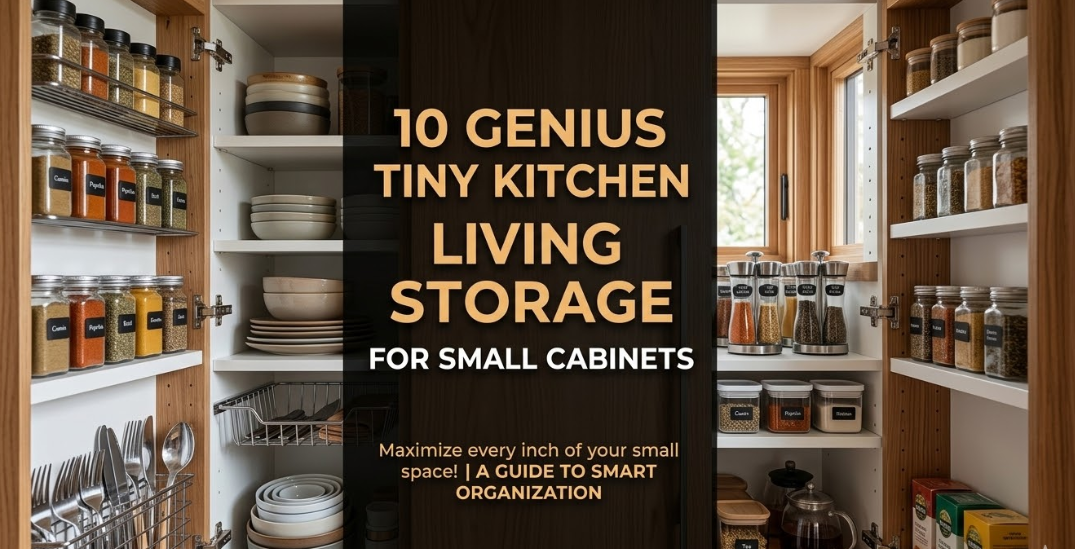
Meta Description: Tiny kitchen living storage nightmare? Not any more! Discover 10 genius ways to use every inch of your small cabinets and kitchen space today.
Storage Solutions for Tiny Kitchens: 10 Genius Ideas for Small Cabinets
If you reside in a small apartment or a tiny home, you understand the challenge. The kitchen is like a puzzle with too many pieces and an undersized table. Pots and pans, spices, snacks — where does it all go?
The good news? A small kitchen does not equal a messy kitchen.
Even the littlest cabinets can store more than you’d ever assume, with the right tiny kitchen living storage solutions. You just need to think smart, not large.
This article takes you through 10 genius, cheap and functional storage tips that work. There’s something here for everyone, whether you rent or own your place.
Let’s get into it.
Why Tiny Kitchen Storage Is a Big Deal
Small kitchens are incredibly common. Studio apartments, starter homes and old houses all seem to have one thing in common — lack of cabinet space.
The average new home has gotten smaller in the past few years, according to the National Association of Home Builders, and kitchens tend to be the first to forfeit square footage. That means millions of people face the same storage challenge every day.
But here’s the thing — a messy kitchen is not only frustrating. It actually slows you down when cooking, makes cleaning more difficult and can even cause wasted food because you can’t see what you have.
Well organized storage can remedy all of that.
Idea #1: Go Vertical With Stackable Shelf Risers
Without even realizing it, the average person is only utilizing half of their cabinet space.
Think about it. You pile one plate on top of the other, one pot inside another, and you pronounce it finished. But what about that open space between your items and the shelf above?
Stackable shelf risers remedy this in a snap.
These simple tools sit on your cabinets and provide a second tier of storage. You can stack plates on the bottom and cups on the riser above — all in the same space you were hardly using before.
What to Consider When Choosing a Shelf Riser
- Adjustable height — so it works for different cabinets
- Anti-slip feet — so it doesn’t move around
- Metal or bamboo material — for ventilation and easy cleaning
They’re sold at most home goods stores and run between $10 to $30. It is one of the least expensive upgrades you can do.
Idea #2: Hang a Pegboard on the Inside of Cabinet Doors
The interior of your cabinet doors is nearly free real estate. Most people never use it.
Mount a small pegboard or adhesive organizer to the inside of a door for hanging measuring spoons, pot lids, small tools or even spice packets. This makes them easy to reach without occupying any shelf space.
How to Get This Set Up — The Easiest Way
- Take your cabinet door measurements
- Purchase a pegboard cut to fit, or use an adhesive hook strip
- Screw it in (if you own your home) or use heavy-duty adhesive strips (if renting)
- Add hanging hooks and organize your items
This is especially effective for lids, which can be notoriously difficult to store neatly.
Idea #3: Use a Tension Rod for Cleaning Supplies
This one seems too basic to be effective. But it absolutely works.
Install a tension rod — the kind you use for a shower curtain — horizontally inside a cabinet. Then hang spray bottles upside down from the rod by their triggers.
This saves space on the floor of your cabinet for other items and keeps your cleaning supplies organized and easy to access.
Other Ways to Use Tension Rods Inside Cabinets
- Divide baking sheets — store them upright like books
- Separate pot lids — line them up instead of stacking
- Organize cutting boards — stand them upright between rods
Tension rods are inexpensive — typically $3 to $8 each — and they need no tools or drilling.
Idea #4: Invest in Nesting Bowls and Collapsible Items
Here’s a reality about tiny kitchen living storage: the contents matter just as much as where you place them.
If you own five different-sized mixing bowls that don’t stack into each other, it’s a colossal waste of space. With nesting bowls, all five bowls take up the space of just one.
The same applies to collapsible items — colanders, measuring cups and even kettles now come in collapsible varieties that flatten down when not in use.
Items Worth Replacing With Collapsible or Nesting Versions
| Item | Regular Size | Collapsible/Nesting Size |
|---|---|---|
| Mixing bowls (set of 5) | ~18 inches tall stacked | ~4 inches tall nested |
| Colander | ~6 inches tall | ~2 inches flat |
| Measuring cups | ~8 inches spread out | ~3 inches stacked |
| Dish rack | Bulky, permanent | Folds flat when dry |
This type of swap requires no additional shelves or tools. You just buy smarter items.
Idea #5: Install a Pull-Out Cabinet Organizer
Deep cabinets are a trap.
You shove something to the back, forget about it and buy a new one because you can’t find the first. Sound familiar?
A pull-out cabinet organizer — also known as a sliding drawer insert — solves this problem completely. It pulls out like a drawer, giving you full access to everything inside without digging.
Best Places to Use Pull-Out Organizers
- Corner cabinets — universally difficult to reach
- Under-sink cabinets — deep and awkward to reach into
- Food storage cabinets — for cans, jars and dry goods
You can purchase pre-made options or have them custom-installed. Pre-made options from brands like Rev-A-Shelf or IKEA’s UTRUSTA range in price from $20 to $100 based on size.
Idea #6: Label Everything and Use Clear Containers
This isn’t exactly a “storage idea” in the classic sense. But it makes all the other ideas work better.
When your pantry items are stored in matching, clear containers with labels, you can see at a glance exactly what you have. You waste less food, you buy less of what’s already there, and everything looks tidy.
More importantly, clear containers stack perfectly. Random bags and boxes don’t. That alone can double the amount that fits in a cabinet.
A Quick Labeling System That Works
- Use a label maker or some masking tape and a marker
- Label both the front and the lid (for stacked containers)
- Write the expiry date on anything that has one
Airtight containers also keep food fresher over time, saving you money. For more clever ideas like this, Tiny Kitchen Living is a great resource packed with practical small-space inspiration.
Idea #7: Think Outside the Cabinet — Add a Small Floating Shelf
Sometimes the ideal tiny kitchen living storage solution is actually outside of a cabinet entirely.
If you have any open space on your walls — even just 12 inches wide — a small floating shelf can accommodate quite a lot. Spices, oils, small jars, cookbooks or a fruit bowl can all move to the wall, freeing up valuable cabinet space for things that actually need to be hidden.
Tips for Floating Shelves in Small Kitchens
- Keep them at eye level or a little above — so items are easy to grab
- Choose brackets with a weight rating — at least 20–30 lbs per shelf
- Position near the stove — for easy access to oils and spices while cooking
- Keep them clutter-free — a crowded floating shelf makes the whole kitchen feel smaller
You don’t need many shelves. Even one strategically placed shelf can make a real difference.
Idea #8: Make the Most of Under-Sink Space
The cabinet under the kitchen sink is perhaps the most underutilized space in any kitchen.
It’s awkward because of the pipes, sure. But with the right organizers, a huge amount can fit in. Think cleaning supplies, extra dish soap, sponges, trash bags and more.
The Under-Sink Toolkit
Here is a straightforward setup that works in most under-sink cabinets:
Step 1: Install a two-tier expandable shelf around the pipes to create upper and lower storage zones.
Step 2: Hang spray bottles on a tension rod (see Idea #3).
Step 3: Add a small bin or caddy on the side for sponges, rubber gloves and scrubbers.
Step 4: Stick adhesive hooks on the inside of the door for trash bags or foil rolls.
This four-step system can transform a chaotic under-sink area into a well-organized mini supply closet.
Idea #9: Use Magnetic Strips for Knives and Metal Items
Knife blocks occupy valuable counter space. Knife drawers are dangerous and dull blades. There’s a better option.
A magnetic knife strip attaches to the wall or even inside a cabinet door. It holds knives, metal scissors, bottle openers and other small metal tools. Everything is visible, accessible and safe.
Why Magnetic Strips Are Better Than Knife Blocks
| Feature | Knife Block | Magnetic Strip |
|---|---|---|
| Counter space used | Yes (significant) | No |
| Blade wear | High (wood slots rub) | Low (no contact) |
| Hygiene | Hard to clean inside | Easy to wipe |
| Number of items | Limited by slots | Flexible |
| Cost | $20–$80 | $10–$35 |
If you’re hesitant to mount one on the wall, look for magnetic strips designed to go inside cabinet doors. They exist, and they’re great.
Idea #10: Build a DIY Spice Drawer Insert
Spices are a storage nightmare in any small kitchen.
Most people keep them stacked chaotically in a cabinet — you can’t see what’s at the back — or lined up on the counter, taking up valuable workspace. A smarter choice: a tiered spice drawer insert.
It’s a simple tray that fits in a drawer and tilts your spice jars so you can see all the labels at once. You can purchase one for $15–$30, or DIY it with some wood and basic cutting.
How to Set Up a Spice Drawer
- Clean and empty your spice drawer
- Measure the drawer’s interior dimensions
- Purchase or build a fitting tiered insert
- Sort spices alphabetically, or by cuisine type
- Place labels on the top of each lid so you can read them from above
This works best in a drawer right next to your cooking station so you can quickly grab spices while cooking.
How These Ideas Work Together
Not a single storage idea will revolutionize your kitchen by itself. But combine several of these strategies, and the effect is dramatic.
Here’s a simple chart showing how much additional space you can reasonably gain with these ideas:
| Storage Idea | Estimated Space Gained |
|---|---|
| Stackable shelf risers | +30–40% cabinet capacity |
| Pull-out organizer for deep cabinets | +50% usable access |
| Nesting/collapsible items | Saves 1–2 full shelves |
| Under-sink organization | Frees up 1–2 other cabinets |
| Floating shelf (spices/oils) | Frees up half a cabinet |
| Spice drawer insert | Saves entire spice cabinet shelf |
Start with two or three of these ideas and see how your kitchen transforms. Then layer in more over time.
Budget Breakdown: What This All Costs
You’re not required to spend a fortune to improve your kitchen storage. Here’s a realistic budget guide:
| Item | Low-End Cost | Mid-Range Cost |
|---|---|---|
| Shelf risers (set of 2) | $10 | $25 |
| Tension rods (pack of 3) | $8 | $15 |
| Pull-out cabinet organizer | $20 | $60 |
| Clear containers (set of 10) | $20 | $45 |
| Magnetic knife strip | $12 | $35 |
| Floating shelf (with brackets) | $15 | $40 |
| Spice drawer insert | $12 | $30 |
| Pegboard door organizer | $10 | $25 |
| Total (estimated) | ~$107 | ~$275 |
At the high end, a full kitchen storage refresh costs less than one piece of furniture — and pays off for years.
Common Mistakes to Avoid With Small Cabinet Storage
Even with the best ideas in hand, a few mistakes can ruin all your hard work.
Overloading shelves. Just because you can fit more doesn’t mean you should. Leave about 10–15% of each shelf empty so it’s still easy to add or remove items.
Ignoring the pantry door. The inside of a pantry door can hold a full rack of spices, snacks or foil/wrap rolls. Don’t waste it.
Buying organizers before measuring. This is the number one mistake. Always measure your cabinets before buying any inserts or risers.
Skipping labels. Organized systems fall apart within weeks without labels. Labels are what hold the system together.
Trying to change everything at once. Choose two ideas, execute them well and move forward. Doing too much at once leads to abandoned projects and wasted money.
FAQs About Tiny Kitchen Living Storage
Q: What is the single best upgrade for a tiny kitchen with very few cabinets?
A: Stackable shelf risers give you the most bang for your buck. They’re inexpensive, easy to install and instantly double your usable shelf space.
Q: Can I do these storage upgrades if I’m renting?
A: Absolutely. Most of these ideas do not involve any drilling or permanent alterations. Tension rods, adhesive strips and removable organizers are all renter-friendly. Just check with your landlord before adding anything wall-mounted.
Q: How can I keep my kitchen organized long-term?
A: The secret is a “one in, one out” rule. For every new item you bring into the kitchen, remove an old one you no longer use. Also do a 10-minute reset each week to put things back where they belong.
Q: Is installing a pull-out cabinet organizer difficult?
A: Not at all. Most pull-out organizers simply sit inside the cabinet and require no installation — you just place them in. The more complex drawer-style inserts might need a few screws, but most come with simple instructions.
Q: What containers are best for a tiny kitchen pantry?
A: Square or rectangular containers are more useful than round ones for small kitchens because they fit together without wasted gaps. Airtight, clear stackable containers from OXO, IKEA or Amazon Basics all work well and won’t cost you much.
Q: How do I organize a kitchen with only two cabinets?
A: Store what you use every day in the cabinets. Everything else — rarely used appliances, extra supplies — should find a place in another room or on a storage cart. Use every vertical inch inside your cabinets with risers, and use wall space with hooks and floating shelves.
Q: Is it worth buying custom cabinet organizers?
A: For most people, off-the-shelf options work just as well as custom ones. Custom organizers make sense if you have an unusually shaped or sized cabinet that standard products cannot fit.
Wrapping It All Up
A small kitchen doesn’t have to mean a cramped, chaotic one.
With the right tiny kitchen living storage ideas in place, even the smallest cabinets can become functional, organized and — dare we say it — a pleasure to use.
Start simple. Choose one or two ideas from this list that speak to your biggest pain points. Perhaps it’s the overflowing spice situation. Perhaps the under-sink disaster zone. Start there, see how it feels and build from there.
The goal isn’t a Pinterest-perfect kitchen. The goal is a kitchen that works for you — where you can cook without stress, find what you need quickly and keep things tidy without spending your whole Sunday reorganizing.
That’s a perfectly reasonable goal, no matter how tiny your kitchen is.
Ready to transform your small kitchen? Start with just one idea today — even the smallest change can make your kitchen feel completely different.