Meta Description: 5 Must-Have Small Kitchen Living Space Savers that instantly turn tiny counters into efficient cooking areas — see the best picks for small-space kitchens now.
5 Valuable Space-Saving Appliances That Are a Game Changer for Tiny Kitchen Living
Just because you have a small living space doesn’t mean you have to sacrifice great food or an effective cooking experience. Millions of people across the globe are opting for tiny homes, studio apartments and compact living spaces — and they’re doing so without sacrificing their passion for cooking.
But here’s the truth: A little kitchen can do better than a big one — if you have the right appliances.
The wrong tools take up counter space, add clutter and make cooking feel like a chore. The right ones do just the opposite. They serve double or triple duty, stow conveniently and transform a small kitchen into an unexpectedly capable cooking space.
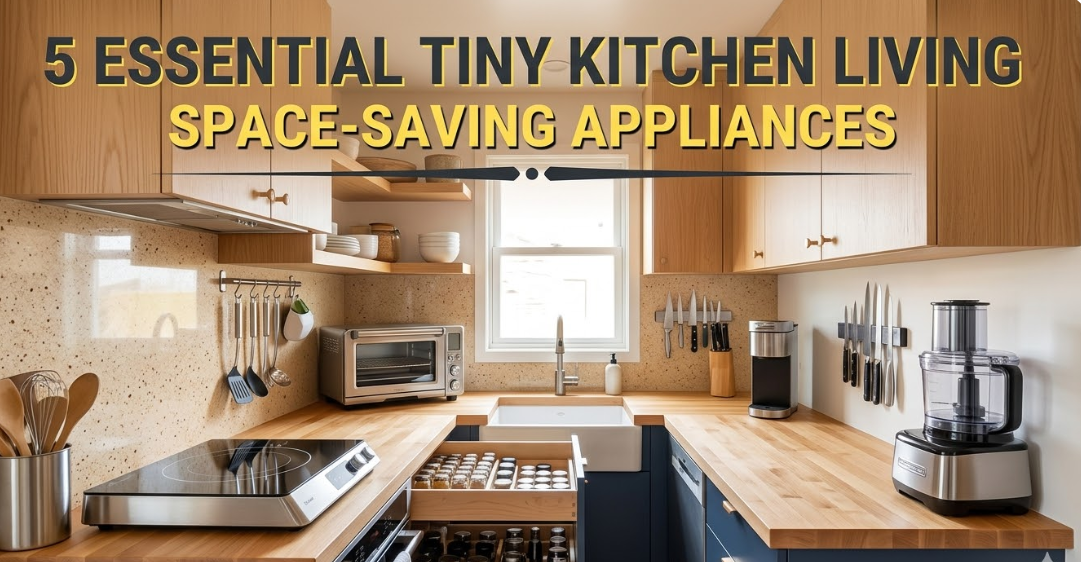
Here, we outline the 5 most important tiny kitchen living space-saving appliances to be aware of. This guide is made for you, whether you’re moving into your first studio apartment, downsizing into a tiny home or simply trying to take back your counter space.
Let’s get into it.
The Importance Of Your Appliance Choices In A Small Kitchen
In a big kitchen, a misbegotten appliance merely occupies space in the corner. In a small kitchen, it can block your working space, restrict movement and make the entire room feel chaotic.
Every inch counts.
This is also why not just any small kitchen living space-saving appliance will do — it has to be a smart one. The best combine multiple functions, have a small footprint and slot into your lifestyle seamlessly.
Here’s what makes a small-kitchen appliance good rather than maddening:
| Feature | Good Small-Kitchen Appliance | Bad Small-Kitchen Appliance |
|---|---|---|
| Size | Compact, wall-mount or stackable | Bulky, oversized for task |
| Functions | Multi-use (does 2–3 things) | Single use only |
| Storage | Easy to store when not in use | Hard to move or store |
| Power | Efficient for size | Uses a lot of power for little output |
| Ease of Cleaning | Dishwasher-safe or wipe-down clean | Many parts, hard to clean |
This table is an example of what we will come to as we dissect each appliance. This criteria is where you’ll begin to see why these five made the cut.
Appliance #1 — The Instant Pot (Multi-Cooker)
One Pot, Many Meals
If there’s one small-kitchen appliance that truly transformed our cooking experience, it might be the multi-cooker — and the Instant Pot is the most popular of the bunch.
That one pot can pressure cook, slow cook, sauté, steam, make rice and even bake. It has 7 to 14 cooking functions, depending on the model. That means it can replace your slow cooker, rice cooker, steamer and yogurt maker at the same time.
For a miniature kitchen, that’s quite a victory.
Why It’s Great for Small Spaces
The Instant Pot is available in multiple sizes. For one or two people, the 3-quart model is perfect. It’s about the size of a small mixing bowl and sits on a shelf when you’re not using it.
It also reduces cooking time by a lot. A whole chicken that requires 90 minutes in the oven comes out in roughly 25 minutes in the Instant Pot. Less cooking means less mess, also less heat in the kitchen, and less cleanup.
How It Saves Space
You own one instead of 4–5 different appliances. That might open up an entire shelf or an entire cabinet in a small kitchen.
Here’s a breakdown:
| What It Replaces | Approximate Space Saved |
|---|---|
| Rice cooker | Medium appliance (~1.5 sq ft) |
| Slow cooker | Medium appliance (~1.5 sq ft) |
| Steamer basket + pot | Multiple items |
| Yogurt maker | Small appliance (~0.5 sq ft) |
| Sauté pan (sometimes) | One less pan needed |
Best for: Those who cook many meals and want to cut back on the number of pots and appliances they own.
Note: The Instant Pot is not ideal for weeknight frying or grilling either. For those jobs, you’ll want to combine it with another appliance on this list.
Appliance #2 — The Compact Air Fryer
Crispy Food Without the Bulk
The air fryer emerged as one of our most beloved kitchen tools in the past decade — and with great reason. Air fryers use hot circulating air to cook food until crisp, similar to deep frying, only with little to no oil involved at all.
The newer compact air fryer models are a great match for small kitchens.
Why Air Fryers Are a Tiny Kitchen Hero
The early versions of air fryers were bulky machines that required serious counter space. But compact models today — with some the size of a lunchbox — provide identical results in only a fraction of the floor space.
A small air fryer (2–3 quart capacity or so) can:
- Roast vegetables in 10–12 minutes
- Cook chicken wings in 18–20 minutes
- Reheat leftovers better than a microwave ever could
- Easily make crispy fries, nuggets, and fish sticks
- Even bake small muffins or brownies
It eliminates the need to use a full-size oven for most everyday cooking tasks.
The Space Math
A standard kitchen oven is not only bulky, but will heat your entire kitchen while in use. A small air fryer is countertop-friendly, heating only the food and stowing in a cabinet or on top of the fridge when not in use.
In a small kitchen where you might not even have a full oven, this is transformative.
Compact Air Fryer Size Comparison
| Model Size | Best For | Approx. Dimensions |
|---|---|---|
| 2-quart | 1 person | 10″ x 8″ x 10″ |
| 3-quart | 1–2 people | 11″ x 9″ x 12″ |
| 5-quart (basket style) | Small families | ~12″ x 12″ x 14″ |
For genuine tiny kitchen living, go with 2–3 quart models. They are compact enough to fit on even the smallest counters.
Best for: Anyone seeking fast, crispy cooking without turning on an oven.
What to keep in mind: Compact air fryers have small baskets. If you’re regularly cooking for more than two, you might have to cook in batches.
Appliance #3 — The 2-Slice Toaster Oven (Not the Toaster)
More Than Just Toast
You might consider a toaster oven to be an upscale toaster. It’s not.
A good compact toaster oven can toast, bake, broil and reheat — all in a unit that sits flat on the counter and occupies less than a square foot. It’s one of the most underrated tiny kitchen living space-saving appliances out there.
How It Outperforms a Regular Toaster
A pop-up toaster toasts only bread. That’s all it does.
A compact toaster oven can:
- Toast breads, bagels and English muffins
- Make a small pizza or a tray of cookies
- Broil fish or chicken
- Reheat leftovers without making them soggy
- Roast vegetables or potatoes in smaller batches
For small-space cooks who lack a full oven — or wish to avoid heating up the whole kitchen — this is one of their shrewdest appliance swaps.
What to Look For
Not every toaster oven is created equal. If you have a small kitchen, look for these:
- Compact footprint — Under 15 inches wide ideally
- Interior size — Large enough for a 9-inch pizza or a small baking tray
- Convection setting — Cooks quicker and more evenly
- Easy-clean interior — Crumb trays and non-stick interiors for quick clean-ups
- Simple controls — Dial or digital with easy readouts
Breville, Cuisinart and Black+Decker all have solid compact toaster ovens in the $40–$200 range.
Space Saving Breakdown
| Regular Oven | Compact Toaster Oven |
|---|---|
| Built into wall or large range | Sits on countertop |
| Heats entire kitchen | Heats only food |
| Uses 2,000–5,000 watts | Uses 1,200–1,800 watts |
| Slow to preheat (10–15 min) | Preheats in 3–5 minutes |
| Not easy to store away | Many models can stay on shelf |
Best for: Occasional bakers who want more cooking flexibility without committing to a full oven.
Things to know: A toaster oven and an air fryer have overlapping capabilities. For those low on either cash or countertop real estate, some combo air fryer-toaster oven models do both jobs in a single unit.
Appliance #4 — The Immersion Blender (Hand Blender)
Blend, Blend, Done
Traditional countertop blenders take up most space in a tiny kitchen. They occupy forever-reserved counter space, come in huge and unwieldy containers, and are irritating to clean.
The immersion blender — also known as a hand blender or stick blender — solves all that.
How It Works
An immersion blender is a handheld appliance with the blending blade at the end. You insert it right into a pot, bowl or cup — blend — and finish. No pouring hot soup into a blender. No big machine to wash. No counter space needed.
It fits into a kitchen drawer.
What You Can Do With It
An immersion blender takes on a surprisingly large number of tasks for such a small appliance:
- Puree soups right in the pot
- Prepare smoothies in a tall cup or jar
- Whip cream or eggs
- Make salad dressings and sauces
- Puree baby food
- Mix pancake batter
- Crush ice (with a powerful model)
Most immersion blenders are sold as a kit with attachments — a whisk, a small food processor bowl and chopper — that make them all the more versatile.
Storage Is a Dream
Since an immersion blender is about as simple a device as it gets (most are between 12 and 15 inches in length and two to three inches in width), it slips into a drawer, cabinet or even a utensil holder on the counter without any fuss.
Now compare that to a conventional blender:
| Feature | Immersion Blender | Countertop Blender |
|---|---|---|
| Storage space needed | Drawer or small cabinet | Dedicated counter or shelf |
| Cleaning | Rinse blade under water | Disassemble + wash jar + base |
| Price range | $25–$100 | $50–$400+ |
| Versatility | High (with attachments) | High |
| Best for small kitchens | ✅ Yes | ❌ Takes too much space |
Best for: Anyone who frequently makes soups, smoothies or sauces and wants a blender that takes up less space.
Important notes: Immersion blenders do not have the same power as a high-end countertop blender. For very thick mixtures or frozen ingredients, they may have difficulties. But for 90 percent of everyday blending jobs, they do the job very well.
Appliance #5 — The Single-Serve Coffee Maker
Your Morning Drink, Without the Machine Mess
Coffee makers are ubiquitous in the home — but classic drip coffee makers are big, require a carafe, take up counter space and often brew more coffee than you actually drink, which means it goes to waste.
Enter the single-serve coffee maker — a genuine game changer.
Why Single-Serve Is Perfect for Tiny Kitchens
Single-serve coffee makers such as the Keurig Mini or Nespresso Essenza Mini are specifically designed with limited space in mind. For perspective, the Keurig Mini is just 5 inches wide — smaller than most coffee mugs placed side by side.
These machines:
- Brew one perfect cup at a time
- Heat up in under a minute
- Use pods or capsules (no measuring, no mess)
- Come in ultra-compact designs
- Can be stored on top of the refrigerator or on a small shelf
For small-space kitchen living, ditching a big drip coffee maker frees up significant counter real estate. If you’re looking for even more tips on making the most of a compact kitchen, Tiny Kitchen Living is a fantastic resource packed with practical ideas for small-space cooking.
Coffee Makers for Small Kitchens — Which Ones Are the Best?
| Type | Width | Best For | Space Rating |
|---|---|---|---|
| Standard drip maker | 8–12 inches | Families | ❌ Too wide |
| Single-serve pod machine | 4–6 inches | Individuals | ✅ Excellent |
| Pour-over (manual) | 3–5 inches | Minimalists | ✅ Best |
| French press | 3–4 inches | Budget-conscious | ✅ Great |
| Espresso machine | 6–12 inches | Espresso lovers | ⚠️ Depends on model |
If you want to make it even more minimal, a pour-over dripper or French press takes almost no space, costs next to nothing and makes great coffee. No electricity needed.
Best for: Solo coffee drinkers or those with one other person at home who are seeking a quick, no-fuss morning ritual.
Things to know: Pod-based machines generate plastic waste from the capsules. If sustainability is a priority, seek out reusable pod options or stick with a French press or pour-over setup.
What Do These 5 Appliances Do in Concert
Here’s where the magic happens. These five appliances are not just individually handy — they work together beautifully.
Imagine a whole day of cooking in a small kitchen with just these five tools:
- Morning: Single-serve coffee maker produces your cup in 60 seconds, while the toaster oven warms a bagel or pastry.
- Lunch: The air fryer revives leftover rice and veggies in eight minutes.
- Afternoon: The immersion blender blends a quick smoothie right in the cup.
- Dinner: The Instant Pot pressure cooks a chicken and vegetable stew in 30 minutes while you relax.
That’s a full day of meals — breakfast, lunch, an afternoon snack and dinner — from five small appliances that together occupy less counter space than a conventional microwave and coffee maker pairing.
Handy Tricks for Storing Small Kitchen Appliances
Getting the right appliances is only half the battle. The other half is storing them intelligently.
Here are a few space-saving storage tactics that work really well in tiny kitchens:
Use vertical space. Add floating shelves above the counter to store appliances you don’t use as much. Place things you use every day at counter height.
Stack when possible. The toaster oven can sit on the counter. The air fryer (when not in use) can sit on top of the refrigerator. The Instant Pot fits under the counter.
Use cabinet organizers. Lazy Susans, pull-out shelves and stackable racks help maximize cabinet space and keep things within reach.
Hang what you can. Hooks on the inside of cabinet doors are helpful for hanging things like an immersion blender, small tools or even the cord of a single-serve coffee maker.
The drawer rule: If an appliance can fit in a drawer, it belongs in a drawer. The immersion blender is the ideal example.
Budget Guide: How Much to Pay for Each Appliance
You don’t have to spend a lot to equip a small kitchen well. Here’s a realistic budget breakdown:
| Appliance | Budget Option | Mid-Range | Premium |
|---|---|---|---|
| Instant Pot / Multi-Cooker | $60–$80 | $100–$130 | $150+ |
| Compact Air Fryer | $30–$50 | $60–$90 | $100+ |
| Compact Toaster Oven | $35–$55 | $70–$120 | $150+ |
| Immersion Blender | $20–$35 | $40–$70 | $80–$100 |
| Single-Serve Coffee Maker | $30–$60 | $80–$120 | $150+ |
| Total | $175–$280 | $350–$530 | $630+ |
If you shop smart, a complete and functional tiny kitchen setup can be had for well under $300. Search for bundles, sales and refurbished products from trusted brands. The Good Housekeeping Institute regularly tests and reviews compact kitchen appliances, making it a reliable place to compare options before you buy.
FAQs About Tiny Kitchen Living Space-Saving Appliances
Q: Do I really need all five of these appliances? Not necessarily. Begin with those that align with your typical cooking habits. If you only occasionally make soups or smoothies, forgo the immersion blender. If you don’t drink coffee, skip that one. Start by choosing the two or three that reflect your real habits.
Q: Can the Instant Pot replace the air fryer? Not really. Certain Instant Pot lids have a separate air-fry lid attachment, and those combo models do both tasks. But a standard Instant Pot can’t air fry. They serve different cooking functions and work best as companions.
Q: Are these appliances easy to clean? Yes — that’s one reason they made this list. The inner pot of the Instant Pot is dishwasher safe. Many air fryer baskets are dishwasher safe. The toaster oven comes with a removable crumb tray. An immersion blender blade washes clean in seconds. The coffee maker just requires a rinse or a cleaning cycle.
Q: What if I have zero counter space? Focus on appliances that are easy to put away. The immersion blender and single-serve coffee maker are your best friends. For cooking, a small induction burner and an Instant Pot can handle most meals without permanently occupying counter space.
Q: Are air fryers and toaster ovens the same thing? They overlap in some functions (reheating, baking small items), but they are not the same. Air fryers circulate air more quickly and create crispier results. Toaster ovens distribute heat more evenly, making them better for baking. Combo models exist that do both. If counter space is genuinely limited, a combo air fryer-toaster oven is worth checking out.
Q: What’s the number one tiny kitchen space-saving appliance to buy first? The consensus among most cooking experts and tiny home dwellers: start with the Instant Pot. It replaces the most appliances, handles the widest variety of meals and clears out the most cabinet space instantly.
Wrapping It All Up
Living in a tiny kitchen doesn’t have to mean bland meals or kitchen frustration. A small kitchen can do everything a large one can — sometimes faster and mess-free — as long as you have the right five appliances.
In short, your five essential tiny kitchen living space-saving appliances are:
- Instant Pot — replaces 4–5 appliances and handles everything from soups to rice to yogurt
- The Compact Air Fryer — crispy food fast, small footprint, easy to store
- Compact Toaster Oven — bakes, broils and toasts without warming the entire kitchen
- The Immersion Blender — tucks into a drawer, replaces your countertop blender
- The Single-Serve Coffee Maker — a perfect morning cup in a machine no larger than a book
Select what works for your way of cooking. Add more as you settle into your new space. And remember — a clever small kitchen isn’t a matter of having less. It’s about having precisely what you need, at precisely the right size.
Your best days in the kitchen are still to come — no matter your square footage.