Meta Description: Yes, these tiny kitchen living mistakes are as common as you think. Learn 6 sneaky habits making your small kitchen feel a lot smaller — and how to battle them fast.
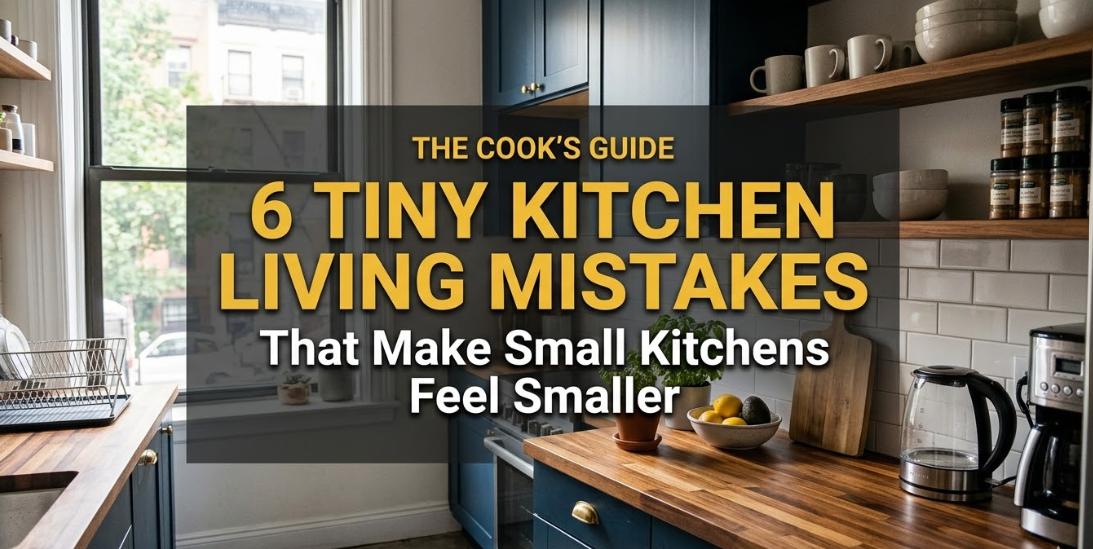
6 Little Kitchen Living Mistakes That Can Make Small Kitchens Feel Smaller
Small kitchens can be charming. They can be snug, efficient and even stylish. But one mistake — or six — and your tiny cooking space may suddenly feel more like a cupboard with a stove.
And the sad truth is, many people don’t even realize they’re making their small kitchens feel all the more cramped. It’s rarely one big problem. It is a series of small habits, choices and mistakes that quietly accumulate.
The good news? All of these mistakes are correctable.
Whether you’re in a studio apartment, a tiny home or simply have a kitchen that drew the short end of the square-footage stick, this guide is for you. Here are the six biggest tiny kitchen living mistakes we all make — and, more importantly, how to fix them.
Mistake No. 1: Considering Every Counter a Free Storage Space
This is the most common small space living crime out there. And it’s almost universal guilt.
It starts innocently. You leave the toaster out since you use it daily in the morning. Then the blender stays because it’s too heavy to move. Then it’s the knife block, the fruit bowl, the paper towel holder, the coffee maker, the mail pile and somehow — a candle.
Before long, your counter is left with zero usable space.
Why Counter Clutter Packs a Harder Punch in Small Kitchens
In a big kitchen, a sloppy countertop is aggravating. In a tiny kitchen, it’s stifling. Visual clutter misleads your brain into deciding that a space is smaller than it really is. Psychologists call this “perceived crowding.” When there’s no flat surface in the open that your eyes can rest on, your brain tells you this room is full.
Clutter on the counter also constrains your ability to actually cook. Without prep space, you’re working in weird little corners, making the experience cramped and frustrating.
The Fix
Use the “daily use only” rule. If you haven’t used it every single day, it doesn’t get counter space. Keep the blender in a cabinet. Put the toaster away in a pull-out drawer or appliance garage if you can.
Keep at least one full, clear stretch of counter — even if it’s only 18 inches. That open space will make your whole kitchen breathe.
Mistake No. 2: Going Dark When Lighter Colors Would Help Open Things Up
Color absolutely has huge power over how big or small a room feels. But plenty of folks are painting their tiny kitchen walls a dark, moody color — or hanging on to dark wood cabinets without balancing them out — and questioning why the area feels like a cave.
Dark colors absorb light. Less light translates to less sense of space. It’s simple visual physics.
The Most Common Color Mistake You Never Hear About
Here’s an even more focused point: it’s not just the wall color that matters. It’s the combination of surfaces. Dark cabinets and dark countertops and dark flooring create a layered darkness that makes a kitchen physically shrink.
Most people pick one dark element for drama — which can be gorgeous in a big kitchen — but in a small space, that same choice feels oppressive.
What Actually Works
You don’t need to go all white, either. Soft whites, warm creams, pale sage greens and muted grays all open up a space without veering into sterile. If you like bright color, deploy it as an accent — a colorful backsplash tile or painted island — while keeping adjacent surfaces light.
Reflective surfaces also help. Glossy cabinet fronts, mirrored backsplash tiles and light-colored countertops all reflect light around the room and create a sense of spaciousness.
| Surface | Best for Small Kitchens | Avoid |
|---|---|---|
| Walls | Soft white, pale gray, warm cream | Deep navy, charcoal, dark brown |
| Cabinets | Light wood, white, pale gray | Dark espresso (black without balancing) |
| Countertops | White marble look or light quartz | Very dark granite or slate |
| Flooring | Light tile or pale wood | Very dark tile or wood |
| Backsplash | White subway tile or light glass | All-dark mosaic with no contrast |
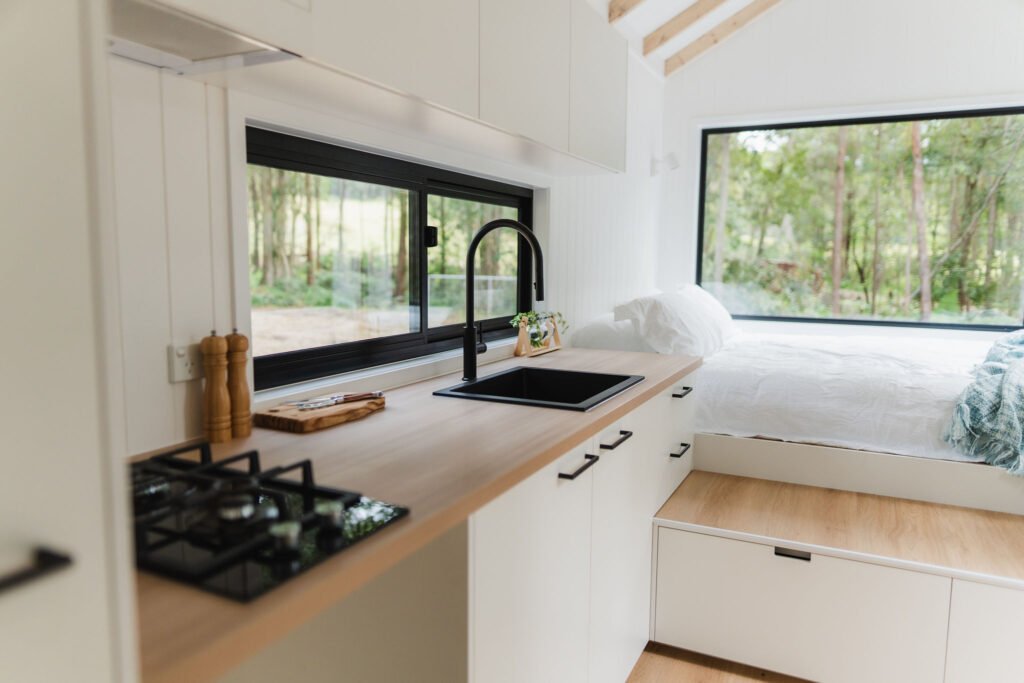
Mistake No. 3: Leaving the Walls Bare (or Hanging the Wrong Things)
Empty walls in a small kitchen are lost real estate. And yet the fear of making a small space feel “too busy” causes many people to leave their walls bare altogether.
That is a mistake, in two ways.
The first is that bare walls don’t truly make a room appear larger. They simply make it seem hollow and incomplete. Second, walls in a small kitchen are valuable storage and display space that can greatly help reduce clutter elsewhere.
The Incorrect Use of Wall Space
The opposite error is also common: hanging too many small, mismatched objects. A little print here, a mini hook there, an occasional clock elsewhere. Every time an object is too small for the wall, it ends up cluttering even more — not organizing.
Scale matters. Tiny objects on a large wall look foolish. And in a small kitchen, awkward means cramped.
Smart Ways to Use Kitchen Walls
Think functional and intentional. A magnetic knife strip frees knives from the countertop but adds a neat, modern look. A pegboard wall system holds pots, pans, utensils and even little shelves — keeping everything off your counters.
Using open shelving is another great approach. A handful of well-organized floating shelves will hold dishes, glasses, spices and plants while paradoxically making the kitchen feel more curated and open than a fleet of closed cabinets ever could.
The key is intentionality. Select one or two wall solutions that serve multiple purposes and are visually appealing.
Mistake #4: Not Taking Advantage of Vertical Space At All
Look up. What’s up there above your cabinets? Probably a dusty gap. Perhaps some decorative baskets that haven’t been touched in two years.
That area over your cabinets — and all the vertical space that exists in your kitchen — is going to waste. This is one of the most common tiny kitchen living mistakes, and one of the easiest things to fix.
Why Vertical Space Gets Overlooked
We naturally organize and think horizontally. Counters. Drawers. Lower cabinets. We’re used to reaching out, not reaching up. But in a small kitchen, horizontal thinking means you’re working with a fraction of your actual available space.
Most standard kitchens will have a 12 to 18-inch space between the top of upper cabinets and the ceiling. Many kitchens have even more. That’s wasted usable space, every single day.
Vertical Solutions: Practical and Functional Ideas
Install cabinet extensions that reach the ceiling. Reserve that top tier for things you rarely use — holiday baking pans, a giant stockpot, appliances you take out only once or twice a year.
If you have wall space, add a tall, narrow pantry unit. These can store a ton of food and kitchen products in a very small footprint.
Stack your storage. Use stackable bins and shelf risers inside your existing cabinets to essentially double the usable space on each shelf.
And don’t forget about the inside of cabinet doors — small racks and hooks on the inside of doors can hold spices, cutting boards, cleaning supplies and more.
For even more smart ideas tailored to compact spaces, Tiny Kitchen Living is a great resource to explore — packed with practical tips for making every inch count.
Quick Vertical Storage Ideas
- Ceiling-height cabinets — make the most of every inch from floor to ceiling
- Hanging pot racks — create more cabinet space, add visual interest
- Over-door organizers — pantry door, cabinet doors, even the fridge side
- Tall open shelving units — pantry or display + storage combo
- Stacked wire bins — inside cabinets to create multiple layers of storage
Mistake #5: Using the Wrong Lighting (Or Not Enough of It)
Lighting is one of the most underappreciated contributors to the perceived size of a kitchen. A dark kitchen is not only uncomfortable — it feels small, heavy and unpleasant.
But few people think of lighting when it comes to making a small kitchen feel larger. They focus on storage, color and layout. All important. But with the wrong light, everything else falls flat.
The One-Light Trap
One of the most widespread lighting mistakes in small kitchens is depending on a single overhead light source. One ceiling fixture — a flat, flush-mount light in particular — washes the room with light while creating shadows in corners and under cabinets. Those shadows make the space visually smaller.
The darker the corners, the smaller the room feels. Your brain physically senses a narrower room when certain edges are in shadow.
The Three-Layer Lighting Solution
Good kitchen lighting consists of three layers:
1. Ambient lighting — This is your primary overhead light. It must be bright enough to light the entire room evenly without casting severe dark shadows. Recessed lighting is especially effective in low-ceiling kitchens because it doesn’t hang down and consume visual headroom.
2. Task lighting — Under-cabinet lights are a total game changer in small kitchens. They cast direct light on your counter workspace, diminish shadows and add life and function to the whole space.
3. Accent lighting — A little light inside a glass-front cabinet, LED strip lights under floating shelves, or even a small pendant over a tiny island. Accent lighting draws your eye upward and adds depth.
When light spreads into all corners of your kitchen, the room instantly feels larger. According to the Lighting Research Center, layered lighting strategies significantly improve how spacious and functional interior spaces feel — a principle that applies directly to small kitchens.
| Lighting Type | Effect on Small Kitchen |
|---|---|
| Single flush-mount ceiling light | Creates shadows, makes space feel flat and small |
| Recessed ceiling lights (multiple) | Evenly lit, feels more spacious |
| Under-cabinet task lighting | Eliminates counter shadows, adds depth |
| Pendant lights hung too low | Visually cuts the room, can feel crowded |
| Pendant lights at right height | Adds style and draws eye upward |
| No accent lighting | Space feels one-dimensional |
| Layered lighting (ambient + task + accent) | Creates depth, feels significantly larger |
Mistake No. 6: Too Much Furniture — Or Furniture That’s Too Big
This mistake sounds obvious. But the thing is, most people don’t consider what they have in their kitchen to be “furniture.” They picture a table, one or two chairs, perhaps a small island or rolling cart.
But in a little kitchen, every physical thing that occupies floor space is furniture. And too much of it — or badly scaled furniture — kills the feeling of spaciousness faster than almost anything else.
The Island Problem
Kitchen islands are having a serious moment in home design. Everyone wants one. But in an undersized kitchen, a big, permanent island can be disastrous. It obstructs the flow of traffic, takes up floor space and creates a visual barrier that divides your kitchen and makes it feel smaller.
The problem is scale. An island designed for a 200-square-foot kitchen isn’t going to do the same job in one that’s 90 square feet.
The Dining Table Squeeze
The same problem crops up with dining tables. Homeowners cram a four-person table into a kitchen that can’t properly fit it. Chairs get pushed against the wall every time someone sits down. It becomes an obstacle course just to get to the refrigerator.
It doesn’t only look small — it functions small.
Right-Sizing Your Kitchen Furniture
The remedy is decorating with furniture that suits the actual room, not the room you wish you had.
Choose a small rolling cart over a fixed island. Pull it out when you need additional prep space and stow it away when you don’t.
If your kitchen won’t truly accommodate a larger one, select a bistro table for two over a four-person table. A well-fitted bistro setup feels intentional and cozy — not cramped.
Opt for pieces with open legs as opposed to solid bases. A table or island with exposed legs feels lighter and takes up less visual weight, making the room feel more open.
Consider bar stools at a counter overhang instead of an altogether separate table. It’s a classic small-kitchen solution that does away with the need for a table entirely.
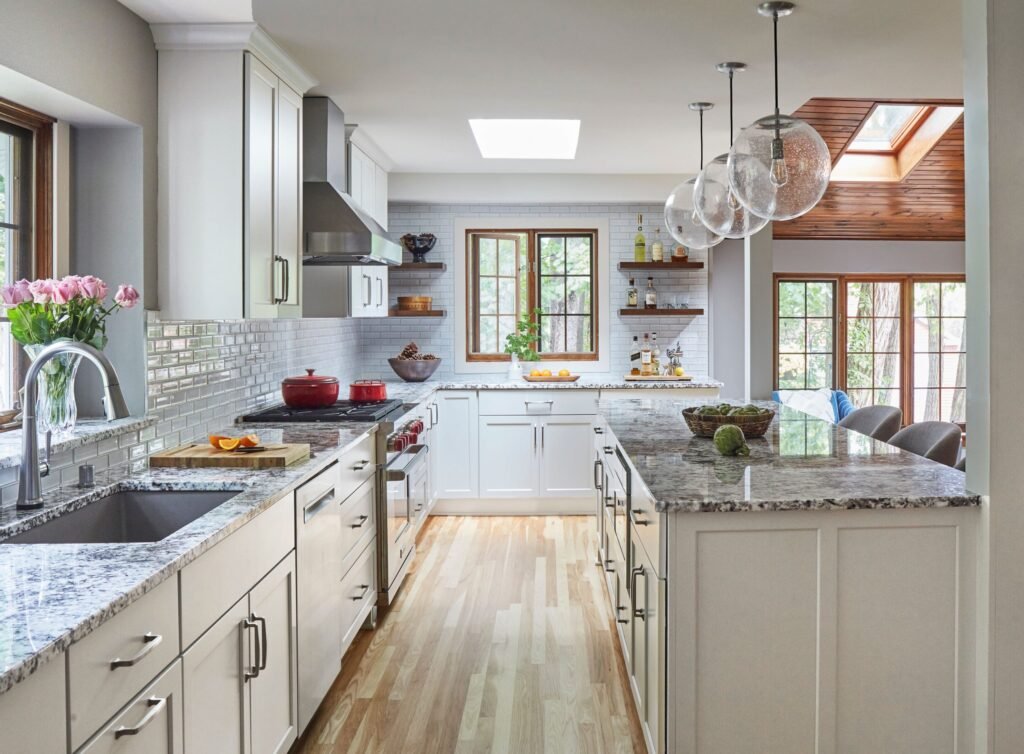
How These Mistakes Compare to One Another
All six mistakes are important, but some pack a greater punch depending on your particular kitchen. Here’s a quick reference:
| Mistake | Impact Level | Difficulty to Fix |
|---|---|---|
| Counter Clutter | Very High | Easy |
| Wrong Colors | High | Moderate |
| Ignoring Walls | Moderate | Easy |
| Wasted Vertical Space | High | Moderate |
| Poor Lighting | Very High | Moderate |
| Wrong Furniture Size | Very High | Moderate to Hard |
Pulling It All Together: The Small Kitchen Reset
If you’re feeling overwhelmed, don’t be. You don’t need to address everything at once.
Start with the easiest wins. Clear your counters. Declutter the surfaces. Look at what’s sitting out that doesn’t need to be.
Then move to lighting. Add under-cabinet lights. Replace a dim bulb with a brighter one. Open your curtains wider to let in more natural light.
Then look at your walls and vertical space. Could you add a shelf? A magnetic strip? A pegboard?
Reserve color and furniture updates for when you’re ready to take on a larger project. These require more planning and budget, but they can dramatically change the way your kitchen feels.
The goal isn’t perfection. All of this is aimed at a kitchen that feels open, functional and comfortable — even in the most compact footprint. Small kitchens are lovely places to be. All they require is some intentional design thinking to reach their full potential.
FAQs: Tiny Kitchen Living Mistakes
Q: What is the one mistake that can make a small kitchen feel even smaller?
A: Counter clutter is the biggest, most common culprit. When the brain sees that every surface is covered, it interprets that space as being utterly full — even though there’s technically room to move. The effect of clearing your counters, even partially, is immediate in terms of how open the kitchen feels.
Q: Does painting a small kitchen white actually help make it look larger?
A: Yes, lighter shades — white, cream, light gray, pale sage — reflect more light and give a feeling of spaciousness. If bright white isn’t your style, you don’t have to go that way, but lighter tones consistently make small spaces feel more open than darker ones do.
Q: Does open shelving help a small kitchen feel bigger?
A: Absolutely. Open shelving eliminates the visual bulk of closed cabinet doors and adds a feeling of depth. The trick is to keep the shelves organized and avoid overcrowding — messy open shelves can produce the opposite effect.
Q: Is a kitchen island a bad idea in a small kitchen?
A: Not necessarily. In fact, a small, rolling island that can be moved out of the way is a great solution. The mistake is putting in a big, fixed island that hinders traffic flow and eats up floor space the kitchen can ill afford.
Q: How can I add storage to a tiny kitchen without making it feel more cramped?
A: Focus on vertical storage — shelves that go higher, ceiling-height cabinets, over-door organizers and pegboards. Also use the insides of cabinet doors, drawer organizers and stackable bins within cabinets. The aim is to take storage off the counters and out of sight without adding more physical bulk to the room.
Q: Does lighting really change how big a kitchen feels?
A: Yes — significantly. Bad lighting casts shadows, and shadows make a room feel smaller and tighter. Installing under-cabinet task lighting and layering your light sources can make a dramatic difference in how airy and spacious a small kitchen feels.
Q: What color should I paint a small kitchen so it feels larger?
A: Soft whites, warm off-whites, pale grays and light greens are all good options. Matching your wall color closely to your cabinet color (a monochromatic palette) also gives you a seamless, expansive look that avoids the visual “chopping” effect of contrasting colors.
Final Thoughts
Tiny kitchen living mistakes are insidious. They creep in slowly, one little choice at a time — a misplaced appliance here, a dark paint color there, a light fixture that isn’t pulling its weight. None of these seem like big mistakes in the moment. But together, they chip away at the feeling of space until your kitchen seems smaller than it actually is.
The six mistakes we explored — counter clutter, wrong color choices, ignored walls, wasted vertical space, poor lighting and oversized furniture — are entirely fixable. Many of them cost little to nothing to address. And the difference they make is real, both in terms of look and utility.
Your small kitchen does not have to feel small. With a few purposeful adjustments, it can feel open, efficient and actually enjoyable to cook in. Make one fix today, and watch things change pretty quickly.