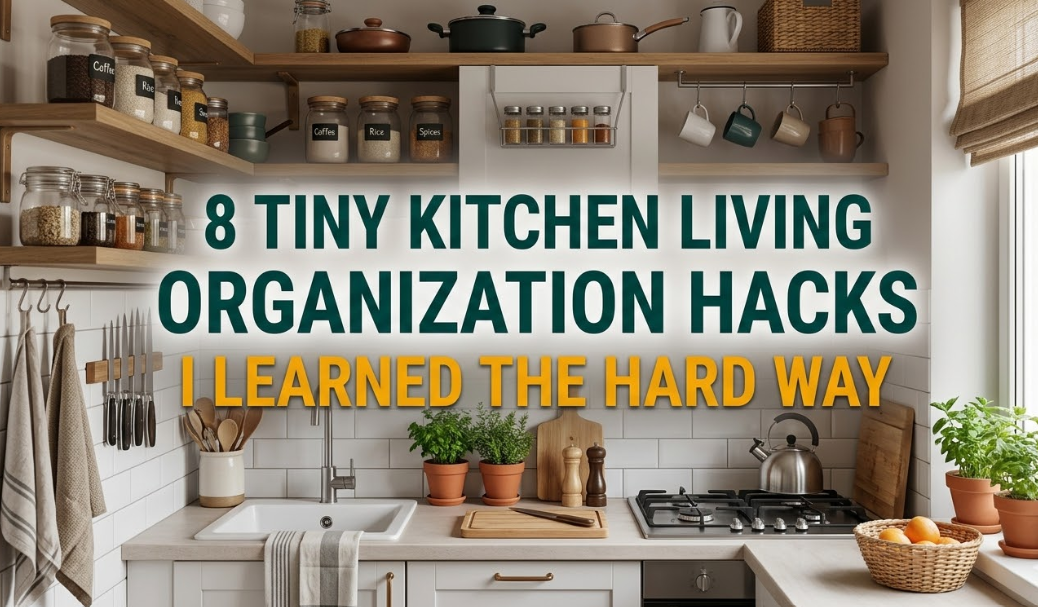
Meta Description: Eight organization hacks that actually save space and help you declutter in your tiny kitchen that we learned the hard way.
8 Best Tiny Kitchen Living Organizational Hacks I Learned the Hard Way
Nothing is more frustrating than a small kitchen.
You open a cabinet and a cutting board drops on your foot. You attempt to cook dinner but there is no counter space. You grab for a pan and three others tumble to the floor. Sound familiar?
I’ve been there. For many years, I lived in small apartments with kitchens that were barely larger than a closet. And I made every error you could make — purchasing the wrong storage solutions, overlooking vertical space, shoving items into drawers until they wouldn’t close.
However, slowly but surely and after much trial and error, I learned what actually works.
These aren’t Pinterest-perfect tips that seem beautiful in pictures but fail in practice. These are tiny kitchen living organization hacks I learned the hard way — some out of desperation, some by accident, and a few after completely losing my mind over a junk drawer.
If your kitchen is small, cluttered, or simply feels like a disaster no matter what you do, this guide is for you.
Hack #1: Don’t Think Horizontally — Go Vertical
The biggest mistake I made in my first tiny kitchen was using it like a regular one.
I just kept everything on the counter or in low cabinets. I ignored the walls. I pretended the space above the fridge didn’t exist. I didn’t pay attention to the backs of cabinet doors.
That was a huge waste.
The Walls Are Free Real Estate
Mounting a simple wall-mounted magnetic knife strip freed up an entire drawer for me. It cost under $20 and took 15 minutes to install.
After that, I added:
- A pegboard above my prep area for hanging utensils, small pans, and even a paper towel holder
- Wall-mounted shelving for spices, oils, and everyday jars
- Over-the-door organizers on the insides of cabinet doors for lids, wraps, and cleaning supplies
The difference was almost shocking. All of a sudden I had drawer space I didn’t know existed.
Think in Zones — Top to Bottom
Here is a mental model that has helped me tremendously:
| Zone | Height | Best For |
|---|---|---|
| High zone | Above eye level | Rarely used items, backup stock |
| Middle zone | Eye level | Daily-use items, dishes, glasses |
| Lower zone | Below counter | Heavy pots, appliances |
| Dead space | Backs of doors, side of fridge | Wraps, lids, small tools |
Once I began thinking in zones, every square inch of my kitchen became functional storage space.
Hack #2: The “One In, One Out” Rule Saved My Sanity
This one sounds simple. It is simple. But it’s also surprisingly hard to actually follow.
The rule: every time something new enters the kitchen, something old has to go out.
I used to be the kind of person who bought new gadgets on a whim. A spiralizer here. A special avocado slicer there. A third set of measuring spoons “just in case.” My drawers became a graveyard of things I’d used once and never touched again.
Clutter Is a Space Problem AND a Decision Problem
The actual problem with kitchen clutter is not that you have too little space. It’s that you’re holding on to things you don’t need.
Every item in your kitchen takes up both physical space and mental space. When your drawers are packed, it slows you down every single time you cook. You spend time searching. You get frustrated. Everything about being in the kitchen becomes stressful.
One in, one out makes you decide: Is this new thing worth giving up something else?
Often, the answer is no.
What to Audit First
If you’re ready to start decluttering right now, begin with these categories:
- Duplicate tools — do you really need four spatulas?
- Single-use gadgets — that quesadilla maker hasn’t been used in two years
- Mismatched containers — lids without bottoms, bottoms without lids
- Expired pantry products — definitely check the back of your cupboards
Purging these alone can free up valuable space without purchasing a single organizing product.
Hack #3: Stackable and Nestable Everything
I used to buy containers based solely on how cute they looked. That was a mistake.
In a tiny kitchen, how things stack and nest together matters far more than how they look.
Mismatched Containers Are the Enemy
Containers from random brands don’t stack neatly. They wobble. They fall. The gaps between them add up and waste space.
Switching to one uniform set of stackable containers — I use glass ones with locking lids — was a game changer. They stack perfectly in the fridge and in the cabinet. I can see what’s inside each one. Nothing gets lost or forgotten.
Pots and Pans: Nest Them or Store Them Vertically
Two options work well in a small kitchen:
Option A — Nesting cookware sets: These stack inside one another. An entire set fits in one cabinet.
Option B — Vertical pan organizers: These allow you to store pans standing upright, like files in a filing cabinet. You can grab exactly the one you need without moving everything else.
I prefer vertical storage because I hate playing Jenga with a stack of pans to get the one on the bottom. But both methods work well.
Hack #4: The Fridge Door Is Wasted Space — Fix That
Most people simply shove condiments on the fridge door and call it a day.
But fridge door organization is actually one of the most underused opportunities in a small kitchen.
What Actually Belongs on the Fridge Door
The fridge door is the warmest part of the refrigerator. That makes it best for items that don’t need to stay super cold, such as:
- Condiments and sauces
- Butter
- Drinks and juice
- Eggs (they’re fine on the door if you use them regularly)
Add Small Bins and Lazy Susans Inside the Fridge
Inside the main fridge, I added two small clear bins and one lazy susan (a spinning tray). This changed everything.
One bin holds “use first” items — leftovers and things on the verge of expiring. The other holds snacks and grab-and-go items. The lazy susan holds jars, sauces, and dressings so I can spin it to find what I need.
No more forgetting about food in the back. No more mystery containers.
| Before | After |
|---|---|
| Random stuff everywhere | Categorized by use and expiration date |
| Stuff hiding in the back | “Use first” bin keeps things visible |
| Hunting for condiments | Lazy susan makes everything reachable |
| Wasted door space | Organized by category, easy to grab |
Hack #5: Make Your Cabinet Doors Work Harder
I lived in my first tiny apartment for two years before I discovered I’d been neglecting half the storage space in my kitchen.
The insides of my cabinet doors were completely bare.
Clever Additions That Create Serious Storage
Here’s what I eventually installed:
Spice racks on cabinet doors — I mounted two small tiered racks on the inside of a cabinet door. My entire spice collection now lives there. The shelf that previously held spices is now free for other things.
Lid organizers — Pot lids are a storage nightmare. A door-mounted lid organizer keeps them upright and easy to grab.
Cleaning supply organizers — I added an over-the-door caddy under the sink. Sponges, dish soap, and cleaning sprays all live there now, off the floor of the cabinet.
The Tension Rod Trick
One of my favorite hacks is using a tension rod under the sink to hang spray bottles by their triggers. No drilling required. The bottles hang neatly, and the space beneath them is free for other things.
This one almost always gets raves when I show people my kitchen setup. If you want more clever ideas like this, Tiny Kitchen Living is a fantastic resource packed with practical small-space solutions.
Hack #6: The Drawer Divider Awakening
I used to think I needed more drawers. It turns out I just needed to organize the ones I already had.
My kitchen drawers were chaos. Everything just got tossed in. I’d have to dig through spatulas, bottle openers, rubber bands, takeout menus, and random batteries just to find a vegetable peeler.
Drawer Dividers Are Non-Negotiable
Adjustable bamboo drawer dividers were one of the best small purchases I ever made. I divided each drawer into clear sections:
- Drawer 1: Cooking tools (spatulas, tongs, ladle, whisk)
- Drawer 2: Prep tools (peelers, grater, can opener, garlic press)
- Drawer 3: Miscellaneous (rubber bands, batteries, takeout menus — yes, I kept a small junk section)
The secret is giving every item a specific home, and then actually putting it back there.
The Junk Drawer Isn’t Evil — Just Give It Rules
Every kitchen has a junk drawer. That’s okay. The problem is when the junk drawer gets out of control.
Give your junk drawer a small box or tray with compartments. Decide what’s allowed in it. Keep it to one drawer. Everything else that was living in there? Find it a proper home or throw it out.
Hack #7: Countertop Rules That Changed Everything
Counter space is the most precious real estate in a tiny kitchen. Treat it that way.
My rule: if it doesn’t get used at least three times a week, it doesn’t live on the counter.
The Appliance Audit
Most of us have way too many appliances on the counter. Here’s a quick way to decide what stays:
Ask yourself: Would I move this to use it, or do I keep it out because moving it is annoying?
If the answer is the latter — that appliance is taking up space without earning it.
For me, the coffee maker stays out. The blender, toaster, and stand mixer all live in the cabinet. I pull them out when I need them. Yes, it requires a little extra effort. But open counter space makes cooking so much more enjoyable.
According to The Spruce’s kitchen organization guide, keeping countertops clear is consistently ranked as the single most impactful change people make in small kitchens — and it costs nothing.
The “Empty Counter” Reset
Every night before bed, I do a 90-second counter reset. Everything that wandered onto the counter during the day goes back to its proper spot.
This one habit keeps the kitchen from feeling overwhelming. It takes hardly any time, but the effect is huge.
Hack #8: Label Everything (And I Mean Everything)
This one sounds almost too obvious to mention. But it made a bigger difference than I anticipated.
When things are labeled, you always know where they go. Guests know where things go. You stop playing the “which container is this?” guessing game.
What to Label in a Small Kitchen
- Pantry containers — flour, sugar, oats, rice, pasta, lentils
- Fridge bins — “use first,” “snacks,” “meal prep”
- Cabinet shelves — “baking,” “spices,” “canned goods”
- Drawers — even a small label on the outside helps
I use a simple label maker. You can also use masking tape and a marker if you want a more flexible system.
Labels Create Habits
Here’s something I didn’t expect: once things are labeled, you naturally start putting them back in the right place. The label creates a visual cue that makes organization automatic.
This works especially well if you share your kitchen with someone else. No more “where does this go?” conversations.
Putting It All Together: Your Tiny Kitchen Action Plan
If all eight hacks feel like too much, break it down.
Pick one problem area in your kitchen right now. Maybe it’s the stuffed junk drawer. Maybe it’s the heap of pots on the floor. Maybe it’s the counter so piled high you can barely chop a vegetable.
Fix that one thing first.
Then move to the next.
Small, consistent changes beat a dramatic one-day overhaul that collapses in a week. Believe me — I’ve tried it both ways.
Quick Reference: All 8 Hacks at a Glance
| # | Hack | Key Benefit |
|---|---|---|
| 1 | Go vertical | Unlocks hidden storage space |
| 2 | One in, one out | Prevents clutter from building back up |
| 3 | Stackable and nestable items | Maximizes cabinet and fridge space |
| 4 | Organize the fridge properly | Reduces food waste, easier access |
| 5 | Use cabinet door insides | Doubles usable storage per cabinet |
| 6 | Add drawer dividers | Makes every tool easy to find |
| 7 | Control the counter | Keeps workspace open and usable |
| 8 | Label everything | Maintains organization automatically |
Feel Like You Live in a Tiny Kitchen? Here Are Our Organization FAQs
Q: How can I organize a tiny kitchen with almost no cabinet space? Start by going vertical. Install floating shelves, wall-mounted racks, and pegboards. Use the insides of cabinet doors. Also audit what you already have — most people can discard 20–30% of their kitchen items and never miss them.
Q: What’s the best way to store pots and pans in a small kitchen? Use a nesting cookware set that stacks compactly or install a vertical pan organizer that allows you to store pans like files. Both work well. Vertical organizers are particularly useful if you dislike rummaging through a pile of pans.
Q: How do I keep a tiny kitchen organized when I share it with others? Labels help a lot. Assign every item a clearly marked home. Make the system so simple and obvious that anyone can follow it. Also, try doing a quick counter reset together each night — it only takes a minute and prevents buildup.
Q: Are pull-out cabinet organizers worth it in a small kitchen? Yes, particularly for corner and lower cabinets. Pull-out organizers allow you to reach items at the back without removing everything in front. They’re among the best purchases you can make for small kitchen storage.
Q: What should I never store on the kitchen counter? Items that don’t get used more than a couple of times a week. This includes specialty appliances, decorative objects, and anything that doesn’t serve a daily cooking function. Counter space is too precious in a small kitchen to devote to storage.
Q: How do I make my small kitchen feel bigger even if I can’t buy more storage? Declutter first — fewer items make any space feel larger. Then use consistent colors for containers and storage products. Keep countertops as clear as possible. Good lighting makes a huge difference as well. Even slight adjustments in these areas can help a tiny kitchen feel much more open.
Q: Is it worth buying matching containers for a small kitchen? Absolutely. Mismatched containers waste space since they can’t be stacked neatly. Matching sets — modular or square-shaped in particular — are far more space-efficient than a mix of round containers of various sizes.
Final Thoughts
Life with a tiny kitchen is no punishment. It’s just a puzzle.
And like any puzzle, it gets easier once you know how the pieces fit together.
The tiny kitchen living organization hacks in this article are simple, but they make a real difference when cooking in a small space. They don’t need a high budget or a weekend overhaul. Most require only a mindset shift about how you use space — and a willingness to let go of things that aren’t earning their keep.
Go vertical. Declutter ruthlessly. Use every surface with intention. Label what matters.
Your kitchen may be small, but it doesn’t need to feel that way.