Meta Description: Living organization in a tiny kitchen does not have to be stressful. 10 Daily Habits That Made My Small Kitchen Routine Stress Free
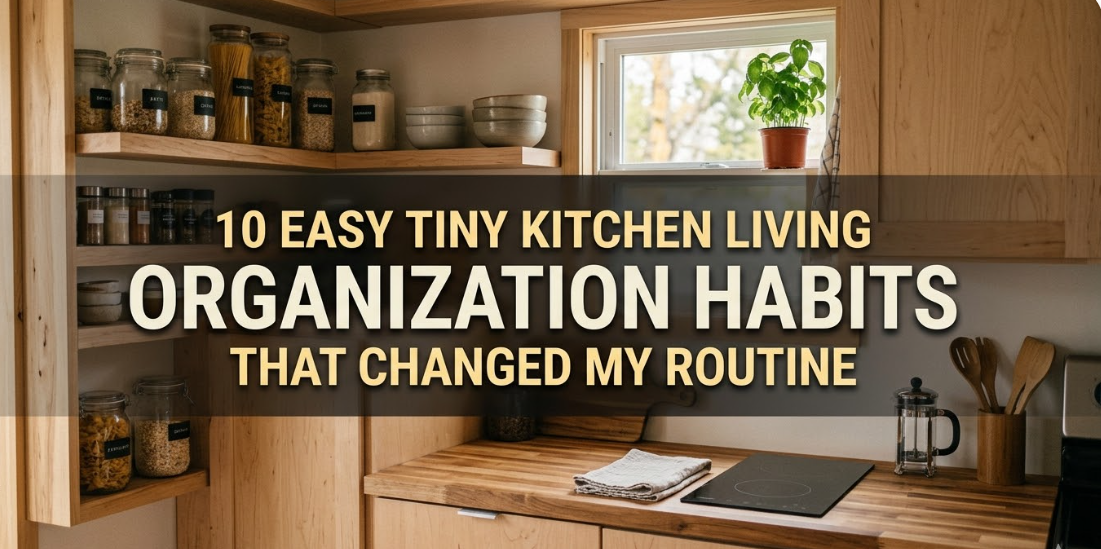
10 Tiny Kitchen Living Organization Habits That Made a World of Difference in My Day-to-Day
There are definite challenges that come with living in a small space. And if you’ve ever attempted to whip up a full meal in a closet-size kitchen, you know exactly what I’m talking about.
I was averse to stepping into my kitchen. Cluttered counters. Overflowing cabinets. Not much space for chopping vegetables without bumping something. It was like a daily fight — and I was losing.
Then I began establishing small, consistent habits. Not a giant overhaul. Not an expensive renovation. Just simple, repeatable routines that over time changed everything.
This article covers those habits. All of them are simple to get started with today. And if you commit to them, your tiny kitchen living organization will change faster than you might imagine.
Why Tiny Kitchen Organization Is About More Than Just Getting Things in Order
Most people assume that organization is cleaning. It isn’t.
Cleaning removes dirt. Organization creates systems. And in a small kitchen, a good system is the difference between a space that works for you and one that works against you.
Having an organized kitchen encourages cooking more. You waste less food. You save money. You feel less stressed. Research consistently demonstrates that cluttered areas boost cortisol — the stress hormone. So yes, a messy kitchen really does make you more anxious.
The good news? You don’t need more space. You need smarter habits.
If you’re just getting started, Tiny Kitchen Living is a fantastic resource packed with practical tips and ideas for making the most of a small kitchen space.
Habit 1: Carry Out a 5-Minute Reset Each Night Before Bed
This habit by itself transformed my mornings.
Every night, before I go to bed, I devote exactly five minutes to resetting my kitchen. Dishes are placed in the dishwasher or they get hand-washed. Counters get wiped. Whatever is left out returns to where it belongs.
That’s it.
My kitchen is ready when I wake up. I’m not faced with a mountain of last night’s mess. I can brew coffee and make breakfast without having to first unearth a clean mug.
Why This Works
The “fresh start effect” is a real phenomenon in psychology. A fresh start makes you more driven and, as a result, more productive. A clean kitchen at night = a better morning = a better day.
Set a timer if you need to. Five minutes goes by fast.
Habit 2: Give Everything in Your Kitchen a Place
Randomness is your enemy in a tiny kitchen.
If things don’t have a spot, they just accumulate wherever there is room. And in a tiny kitchen, there is no extra real estate to absorb the mess.
Go through everything you own. Ask yourself: does this belong in this kitchen? If so, give it an exact position. If not, get rid of it or take it out.
The One-In, One-Out Rule
Every time something new enters your kitchen — a new spatula, a mug gifted to you, a gadget — something else must also leave. It prevents your space from gently refilling over time.
Try labeling shelves and drawers if that helps. It may sound excessive, but it really works, especially if you live with roommates or family members.
Habit 3: Work That Vertical Space Like Your Life Depends on It
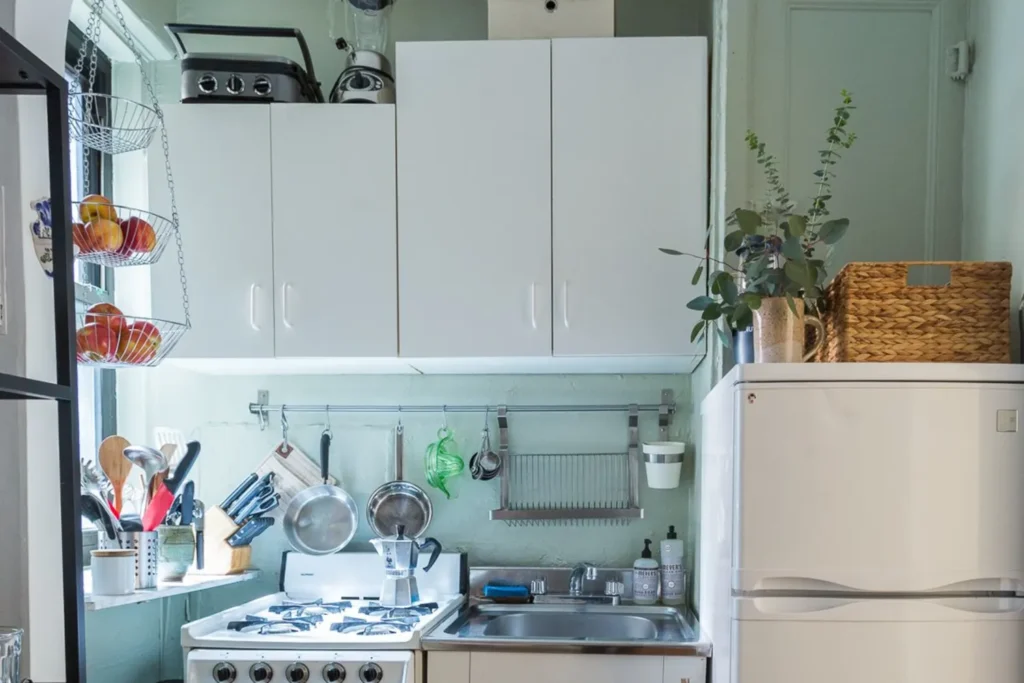
Most small kitchens are bad at horizontal storage. But vertical space? Almost always underused.
Look up. The walls above your counters, the insides of cabinet doors, the space above your refrigerator — all of this is usable real estate.
These vertical storage ideas work really well:
| Storage Solution | Best Used For | Approximate Cost |
|---|---|---|
| Magnetic knife strip | Knives, scissors, metal tools | $10–$25 |
| Over-door organizer | Spices, foil, cleaning supplies | $8–$20 |
| Floating wall shelves | Mugs, small jars, cookbooks | $15–$40 |
| Stackable shelf risers | Plates, cans, pantry items | $10–$20 |
| Tension rods inside cabinets | Pan lids, cutting boards | $5–$12 |
Vertical storage can effectively double how much you can stow away, without adding a single square inch of floor space.
Habit 4: Clear Off Your Counters to Almost Nothing
In a tiny kitchen, counter space is sacred.
Each item that occupies space on your counter steals working surface. And in a small kitchen, every inch of workspace is precious.
I challenged myself to allow only three things on my counter at any time: my coffee maker, a small dish soap dispenser stationed by the sink, and a single wooden cutting board. Everything else — toaster, blender, knife block — went into a cabinet or out of the kitchen altogether.
What to Consider Before Leaving Something on the Counter
- Do I use this every single day?
- Is there a place it can go that’s accessible but out of sight?
- Is it paying rent on the counter?
If it doesn’t pass the test, it goes. You will not believe how much bigger your kitchen will seem with cleared countertops.
Habit 5: Grocery Shop With a Plan (Every Time)
Impulse buying and tiny kitchens are a terrible combination.
Without a plan, things you buy accumulate. Duplicate items. Partially used packages wedged into the back of the pantry. Produce that goes rotten before you eat it.
I began meal planning every Sunday. I write down exactly what I’m going to cook for the week, and then I make a grocery list from that plan. I only purchase what I truly need.
How Planned Grocery Shopping Benefits a Small Kitchen
- Reduces food waste dramatically
- Prevents pantry and fridge overwhelm
- Saves money
- Speeds up cooking since all your ingredients are already in place
There’s only so much you can fit into a tiny kitchen. Be purposeful about what comes through the door.
According to the USDA’s FoodKeeper resource, knowing exactly what you have and planning meals around it is one of the most effective ways to cut household food waste — something especially important when storage space is tight.
Habit 6: Learn the Glories of Stackable and Nestable Storage
Not all containers are made equal when space is limited.
Odd-shaped Tupperware. Mismatched lids. Containers that can’t stack. These are the enemies of a well-ordered tiny kitchen.
Switch to uniform, stackable containers. Square and rectangular shapes are a far more efficient use of space than round ones. Glass containers that stack neatly are well worth the investment.
What to Look For in Storage Containers
- Uniform sizing (so lids fit across the set)
- Stackable design
- Airtight seals (longer freshness)
- Microwave and dishwasher safe (time and effort saver)
The same principle applies to pots and pans. Nesting cookware sets are designed specifically for small kitchens. A 3-piece set that nests into itself uses the same space as a single large pot.
Habit 7: Clean As You Go (Not After)
This is a game changer for small kitchens.
In a small space, clutter builds quickly. If you wait until after you’ve finished cooking to clean up, you walk out of the kitchen to a disaster zone. There’s just no room for it to build up.
Instead, clean as you go. While something simmers, wash the bowl that was used for prep. Blot a spill right away instead of allowing it to dry. As soon as you’re done with an ingredient, put it back in the fridge or pantry.
How This Habit Transforms the Entire Experience
Cooking in a clean environment has an entirely different feel than cooking amidst disorder. You think more clearly. You make fewer mistakes. You actually enjoy the process more.
Building this habit takes roughly two weeks. After that, it becomes automatic.
Habit 8: Develop Zones in Your Kitchen
You can — and should — create zones even in a small kitchen.
A zone is a space allocated for a particular category of activity. You don’t need much space to do this. You just need intention.
Here’s how a typical tiny kitchen can be zoned:
Prep Zone: Close to the cutting board. This is where knives, peelers, and graters reside.
Cooking Zone: Near the stove. Store oils, spices, and cooking utensils within reach here.
Cleaning Zone: Near the sink. Dish soap, a sponge, and the drying rack all belong here.
Coffee/Breakfast Zone: A designated corner for the coffee maker, mugs, and breakfast items. That way, your morning routine doesn’t throw off the rest of the kitchen.
You stop hunting for things when everything has a zone. You reach automatically. Cooking turns into a flow instead of a frustrating scavenger hunt.
Habit 9: Do a Kitchen Audit Each Season
Tiny kitchen living organization is not a one-time endeavor. It’s an ongoing practice.
Once every three months — spring, summer, fall, winter — I conduct a complete audit of my kitchen. This takes about 20–30 minutes. I go through every cabinet, drawer, and shelf. I check:
- What expired?
- What have I not used in three months?
- What’s broken or damaged?
- What’s duplicated?
Anything that doesn’t make the cut gets dropped. This seasonal habit prevents the slow creep of clutter that builds up in every kitchen over time.
A Simple Seasonal Audit Checklist
| Area to Audit | What to Look For |
|---|---|
| Pantry/dry goods | Expiration dates, duplicates, never-used items |
| Fridge | Old condiments, forgotten leftovers, expired items |
| Utensil drawers | Broken tools, purposeless items |
| Pots and pans | Damaged non-stick cookware, lids with no matching pot |
| Cleaning supplies | Empty bottles, expired products |
| Cabinets | Unused gadgets or appliances that ought to live somewhere else |
That may sound like a lot — but it adds up to about 30 minutes every three months. That’s a small price to pay for a consistently organized kitchen.
Habit 10: Embrace the “Less Is More” Mentality for Good
This is the habit that brings all the others together.
Organizing a tiny kitchen comes down to one core belief: you don’t need more stuff. You need the right stuff, used properly.
Most of us have more kitchen items than we ever actually use. Average American kitchens contain upwards of 200 utensils, gadgets, and tools, according to studies — most of which are rarely, if ever, touched.
In a small kitchen, everything must earn its place. If you don’t use it regularly, it shouldn’t take up room.
The Mindset Shift That Makes This Permanent
Stop thinking that decluttering means parting with things you love. Start thinking of it as making space for the life you actually live.
You don’t need six spatulas. You need one great one. You don’t need a quesadilla maker AND a panini press AND a sandwich toaster. Pick one. Use it well.
When you genuinely believe in the concept of “less is more” — not just as a catchphrase — your tiny kitchen becomes something that functions in your actual life.
How Do These 10 Habits Work Together?
None of these habits are tricks that stand alone. They build on each other.
The nightly reset keeps your home assignment system visible. Your zones make clean-as-you-cook easier. Planned grocery shopping keeps your stackable storage from overflowing. Your seasonal audit safeguards everything you have created.
Here’s a quick overview of how the habits stack up:
| Habit | Frequency | Time Required | Impact Level |
|---|---|---|---|
| 5-minute nightly reset | Daily | 5 minutes | High |
| Give everything a home | Once + ongoing | 30–60 minutes (setup) | Very High |
| Utilize vertical space | Once + adjust | 1–2 hours (setup) | High |
| Clear counters to the bare minimum | Once + maintain | 30 minutes (setup) | Very High |
| Meal plan before grocery shopping | Weekly | 15–20 minutes | High |
| Switch to stackable storage | Once | 30–60 minutes | Medium-High |
| Clean as you cook | Daily | No extra time needed | Very High |
| Create zones in your kitchen | Once + adjust | 1–2 hours | High |
| Seasonal kitchen audit | Quarterly | 20–30 minutes | Medium-High |
| Less is more lifestyle | Ongoing mindset | Ongoing | Foundational |
Real Talk: How These Habits Actually Worked Out for Me
I was skeptical when I first started. My kitchen was small and truly seemed hopeless.
So I began with only the nightly reset. In a week, that one habit made me feel better about my kitchen. So I added the counter clearance rule. Then I zoned the space. Then I switched to stackable containers.
In the span of about six weeks, my kitchen felt transformed. Not because I added anything. Because I stopped fighting the space and began working with it.
I cook more now. I waste less food. My grocery bills are lower. And I’m actually enjoying my time in my kitchen — something I never thought I’d say.
Living in a tiny kitchen doesn’t have to mean a compromise. With the right habits, it can feel purposeful, functional, and even a little wonderful.
FAQs About Setting Up a Tiny Kitchen Living Organization
Q: I have a tiny kitchen with no counter space whatsoever. Where do I start?
Begin by entirely clearing the counters of everything. Then return only things you use every single day. Try vertical storage — magnetic strips, wall shelves, over-the-door organizers — to maximize what little horizontal space you have. Even a small rolling cart can provide prep space when you need it and tuck away when you don’t.
Q: What are the best storage products for a very small kitchen?
Stackable containers with matching lids, tension rods for inside cabinets, magnetic knife strips, over-the-door organizers, and pull-out cabinet organizers are consistently the most helpful. Steer clear of single-use gadgets and any items that don’t serve a frequent function.
Q: How often should I declutter my small kitchen?
A light declutter monthly, and a full audit every season (every 90 days) is ideal. The nightly reset habit helps keep the bigger mess from accumulating in between.
Q: Is it possible for someone who cooks a lot to actually have a functional tiny kitchen?
Absolutely. Most professional chefs work in small, highly efficient kitchens. The key is intentional organization, smart storage, and habits that keep the space clear and ready for use. A cramped, tidy kitchen will outperform a big, messy one every time.
Q: What is the single most effective habit for organizing a tiny kitchen?
For most people, clearing the counters and keeping them clear has the quickest and most dramatic impact. It instantly makes the kitchen feel bigger and more usable. Pair that with the nightly reset and you will see a difference within days.
Q: Is it worth spending money on storage solutions for a rented tiny kitchen?
Yes — particularly removable, non-permanent solutions like tension rods, adhesive hooks, freestanding shelving, and rolling carts. These greatly improve your daily life and move with you when you leave.
Wrapping It All Up
Tiny kitchen living organization is not about achieving one perfect kitchen. It’s about having a kitchen that functions for your real life.
The 10 habits covered in this article aren’t rocket science. They don’t require a large budget or a major renovation. They require consistency — and a willingness to rid yourself of things that aren’t earning their space.
Just focus on one habit this week. Just one. The nightly reset is a great place to start.
Build from there. Be patient with yourself. And watch how a small kitchen can quietly become one of your favorite places in the home.