I still remember the morning I made scrambled eggs in my first studio apartment and knocked over a whole spice rack trying to reach the spatula. Everything came crashing down — the cumin, the paprika, the garlic powder — and I just stood there, eggs burning, wondering how people actually live like this.
That was my wake-up call.
A tiny kitchen isn’t a punishment. But an unorganized tiny kitchen? That’s a daily source of stress you don’t even realize is draining you. You lose ten minutes looking for the lid to a pot. You avoid cooking because the counter feels impossible to work on. You end up ordering takeout not because you want to, but because the kitchen is just… too much.
The good news is that it doesn’t take a renovation or a massive budget to fix it. It just takes a few consistent habits — and I mean habits, not one-time organizing sessions. Here’s what actually changed things for me, and for a lot of people living in small spaces.
1. The “Reset Before Bed” Rule — And Why It’s Non-Negotiable
This one sounds almost too simple, but it’s probably the single most impactful thing I changed.
Every night, before I go to sleep, I spend about five to seven minutes resetting the kitchen. Dishes washed or in the dishwasher. Counter wiped down. Cutting board back in its spot. Dish towel hung up. Nothing fancy — just returning the kitchen to its baseline state.
When I first started doing this, it felt like a chore. But within two weeks, I noticed something: mornings were genuinely less stressful. I’d walk into the kitchen, and it was ready for me. No mental overhead. No decision fatigue about whether to clean first or make coffee first.
In a tiny kitchen, this matters even more than in a big one. You don’t have spare counter space to work around yesterday’s mess. There’s no “I’ll just cook on the other side.” It’s all one side.
What this habit looks like in practice:
- After dinner, everything goes back to its designated spot
- Wipe the stovetop even if it looks clean (it usually isn’t)
- Empty the drying rack so it’s ready for tomorrow
- Quick sweep of the floor if needed
You’re not deep-cleaning every night. You’re just not letting chaos compound.
One thing I learned the hard way: skipping this habit for even two or three days creates a backlog that feels overwhelming. And when something feels overwhelming, you avoid it. And then it gets worse. The reset rule breaks that cycle before it starts.
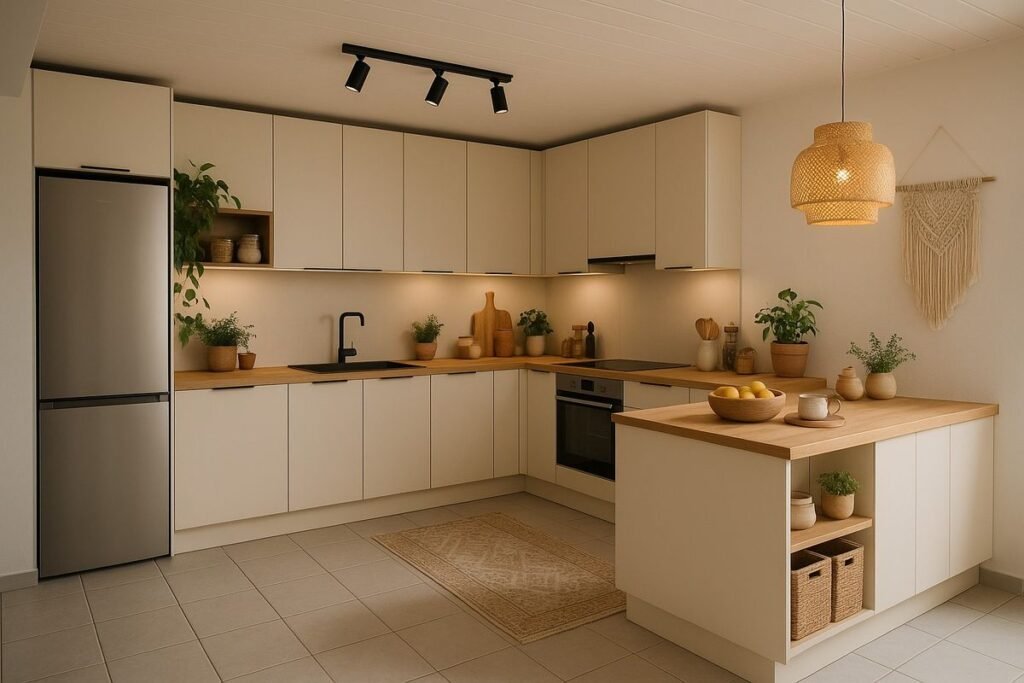
2. Assign Every Single Item a “Home” — And Be Ruthless About It
Here’s the real problem in most tiny kitchens: there are too many things without permanent spots. The olive oil lives “somewhere near the stove.” The measuring cups are “in one of the drawers.” The can opener is “probably in that junk drawer.”
That kind of vague storage is exhausting because your brain has to hold all of it. Every time you cook, you’re doing a mini scavenger hunt.
The fix is giving every single item in your kitchen one specific home — and making sure it always goes back there.
I went through my entire kitchen and asked two questions about each item: Do I actually use this? and Where does it make the most sense to live? Anything that didn’t earn a spot got donated or tossed. What stayed got a dedicated location.
For example:
| Item | Assigned Home |
|---|---|
| Cutting board | Vertical slot beside the fridge |
| Olive oil & salt | Right of the stove within arm’s reach |
| Measuring cups | Hooked inside cabinet door |
| Pot lids | Lid organizer inside lower cabinet |
| Spices | Magnetic strip on the wall |
Once everything had a home, cooking became genuinely faster. I stopped thinking “where is the thing” and started just cooking.
This is especially important in small spaces because you’ll sometimes need to check out 11 Easy Tiny Kitchen Storage Tricks I Wish I Knew Earlier — there are some genuinely clever ideas there for items you think have no good home.
The one mistake I made here: I assigned spots based on what was convenient for storing, not for using. The coffee mugs were in a high cabinet that I had to reach for every single morning. Moved them to the lowest shelf — problem solved. Think about frequency of use, not just available space.
3. The “One In, One Out” Rule for Kitchen Gear
Tiny kitchens get cluttered one impulse purchase at a time.
The cute avocado slicer. The mini waffle maker you used twice. The spiralizer that sounded so healthy in January. The third spatula because you couldn’t find the first two.
I’ve been there. And at some point, my kitchen was more full of gadgets than actual food.
The one-in, one-out rule is brutally simple: before anything new enters your kitchen, something else has to leave. Buy a new pan? One old pan goes. Get a new blender? The old one goes. New set of mugs? Some mugs have to go.
This habit alone keeps the slow creep of clutter from happening. You don’t need a quarterly purge if you’re consistently maintaining.
Here’s a quick gut-check I use when I’m tempted to buy something:
- Does this replace something I already have?
- Will I use this at least once a week?
- Do I have a specific spot where this will live?
If I can’t answer yes to at least two of those, I don’t buy it.
The harder version of this rule is dealing with things people give you. Housewarming gifts, hand-me-down appliances, well-meaning family members who think you need a bread maker. It’s okay to politely decline or quietly donate things that don’t have a place in your kitchen. Your space has limits — that’s not rude, it’s just reality.
For those times when you do invest in something new, it helps to know what’s actually worth buying. I’ve found that focusing on 6 Essential Tiny Kitchen Living Cooking Tools Every Small Kitchen Needs cuts out a lot of the noise about what’s actually useful versus what just looks nice on a shelf.
4. Use Vertical Space Like Your Life Depends on It
Most people organize their kitchens horizontally — things spread out across counters and stacked inside cabinets. In a tiny kitchen, that approach runs out of room fast.
The habit shift that changed everything for me was training myself to think vertically first.
Walls are underused real estate. Cabinet doors are wasted space. The insides of pantry doors can hold an entire spice collection. The space above the fridge is a legitimate storage zone.
Here’s what I added over time, slowly and without spending a fortune:
On the wall:
- A magnetic knife strip (took my knife block off the counter permanently)
- A small pegboard section for hanging pots and utensils
- A magnetic spice rack (this alone freed up an entire shelf)
On cabinet doors:
- Over-the-door organizers for wraps, foil, and cutting boards
- Small hooks for measuring spoons
- A mounted paper towel holder
Inside cabinets:
- Stackable shelf risers to double the usable height
- Lid organizers to stop the “avalanche of lids” situation
- Tension rods to create vertical dividers for baking sheets
None of this required drilling into load-bearing walls or doing anything complicated. Most of it was Command strips and inexpensive organizers from Amazon or IKEA.
The mindset shift matters as much as the tools. Once you start looking at walls as potential storage, you start seeing possibilities you missed before. If you want to go deeper on this, 9 Secret Tiny Kitchen Living Storage Ideas Using Wall Space has a really solid breakdown of what works and what’s just Instagram-pretty.
Common mistake: Going overboard and making the walls so cluttered that they’re stressful to look at. Vertical storage should feel intentional, not chaotic. If your wall looks like a hardware store exploded, scale it back.

5. Do a 10-Minute Weekly Audit — Not a Monthly Overhaul
Here’s the thing about organization: it’s not a one-time event. It’s maintenance.
Most people organize their kitchen once — maybe after moving in or after watching one too many home organization videos — and then let it slowly slide back into chaos over the next few months. Then they do another big overhaul. Then it slides again.
That cycle is exhausting.
The better approach is a quick 10-minute weekly audit. Same day, same time, every week. I do mine on Sunday mornings with coffee. Here’s what I look at:
1. Check expiration dates on anything opened in the fridge and pantry One expired jar in the back of the shelf doesn’t sound like a big deal, but multiply that by a year and you’ve got a storage problem disguised as a clutter problem.
2. Relocate anything that drifted from its home Things inevitably wander. The scissors end up on the counter. The can opener is somehow in the wrong drawer. Ten minutes once a week fixes this before it becomes a problem.
3. Wipe down the inside of one cabinet or drawer Not all of them — just one. Rotate through them weekly. Over two months, you’ve hit every single cabinet without it ever feeling overwhelming.
4. Check what’s running low Not a full grocery inventory, just a quick sweep. What do I need to restock? This prevents the “I thought we had soy sauce” situation mid-cooking.
5. Toss anything that’s clearly past its usefulness Wilted herbs. The sponge that should have been replaced two weeks ago. A bag of something you’ve been meaning to use but clearly won’t.
The whole thing takes under ten minutes if you actually do it every week. If you skip it for a month, it suddenly takes an hour. Consistency is the whole point.
The Mistake Nobody Talks About
One thing I wish someone had told me earlier: organizing for aesthetics first is a trap.
I spent money on matching containers and pretty labels before I’d even figured out my actual cooking habits. Turns out, I never actually needed twelve matching jars of dry goods — I use maybe four ingredients regularly. The rest was just… there. Looking nice. Taking up space.
Real organization in a tiny kitchen should match how you actually cook, not how someone’s Pinterest board cooks. If you only meal prep on Sundays, organize for that. If you make the same five meals on rotation, those ingredients should be the most accessible ones. If you never bake, stop giving the stand mixer prime real estate.
Also worth knowing: some of the 4 Tiny Kitchen Living Cooking Mistakes I Made in My First Apartment are exactly this kind of thing — decisions that looked organized but actually made cooking harder. Worth a read if you want to avoid the usual first-apartment traps.
A Quick Reference: Habits at a Glance
| Habit | Time Required | Frequency | Biggest Win |
|---|---|---|---|
| Reset before bed | 5–7 minutes | Daily | Stress-free mornings |
| Assign everything a home | 1–2 hours (setup) | Once + maintain | Faster cooking, less searching |
| One in, one out rule | 2 minutes per purchase | Per new item | Prevents long-term clutter |
| Use vertical space | 1–3 hours (setup) | Once + tweak | Dramatically more usable space |
| Weekly 10-minute audit | 10 minutes | Weekly | Consistent, sustainable order |
Wrapping Up (The Honest Version)
None of these habits are complicated. But they do require you to be consistent, and consistency is the part most people skip.
A tiny kitchen doesn’t have to be a stressful kitchen. It just needs a little more intention than a bigger one. When there’s less space, every decision about where something lives matters more. But that also means small improvements compound quickly.
Fix one thing this week. Just one. Maybe it’s finally assigning that cutting board a permanent home. Maybe it’s the five-minute reset tonight before you go to bed. Start small, and build from there.
Also worth reading: If you’re looking for ways to make your kitchen feel bigger without changing a single structural thing, check out 10 Brilliant Tiny Kitchen Living Space Hacks for Studio Apartments — some genuinely useful ideas in there that go beyond basic organization.