Meta Description: Tiny kitchen living organization doesn’t have to be a stress. Discover 6 genius secrets for making your small studio apartment kitchen both functional and beautiful.
Studio Living: 6 Organization Tricks for the Small Kitchen
One of the biggest challenges of living in a studio apartment is the kitchen. It’s small. It’s cramped. Somehow, it must do all that a full-size kitchen does.
But there’s good news: A small kitchen can be harmony-filled, not chaotic. With these clever organization hacks, even the smallest of cooking spaces can function like a charm.
Read on for 6 powerful low-cost living organization hacks real people use in tiny kitchens across studio apartments everywhere. All of them are accessible, affordable, and easy to install — even in a rental.
Let’s dive in.
Why Studio Apartment Kitchens Are a Beast Unto Themselves
Studio kitchens are not simply miniature versions of normal kitchens. They come with unique problems.
You might only have one drawer. Maybe two cabinet shelves. A counter not much bigger than a cutting board. And oftentimes, the kitchen is just a few feet from your bed or couch.
That means the clutter isn’t just annoying — it’s seen from everywhere.
More than 37 percent of renters in urban areas live in studio or micro-unit apartments, according to a 2023 survey by the National Apartment Association. As cities grow more expensive, many are making small spaces work harder.
The solution is not acquiring more stuff. It’s organizing smarter.
Secret #1: Go Vertical — Your Walls Are Untapped Storage Gold
Most people only think about horizontal space — counters, shelves, drawers. But in a small kitchen, vertical space is your best friend.
Think Beyond the Counter, Not Just On It
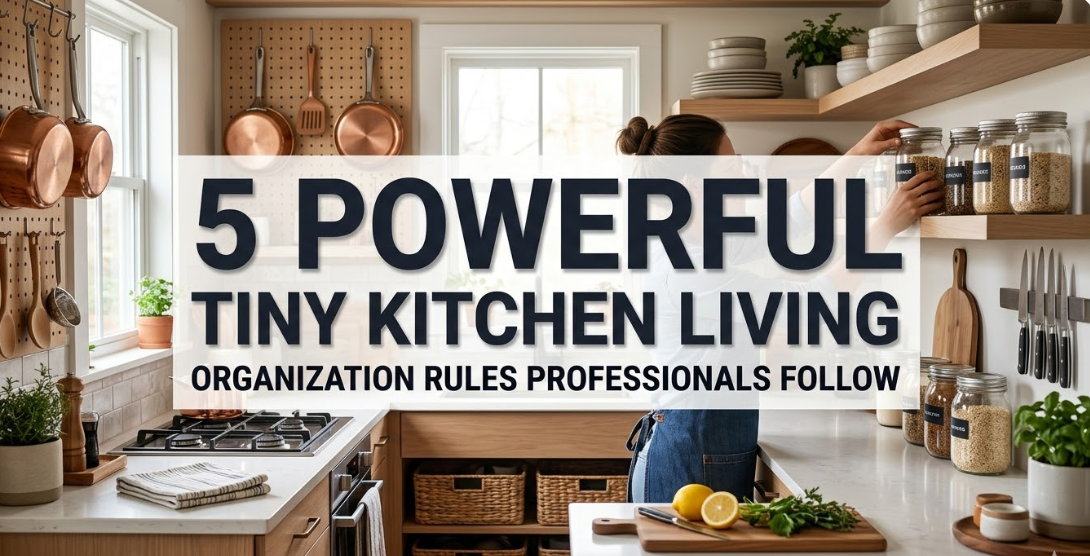
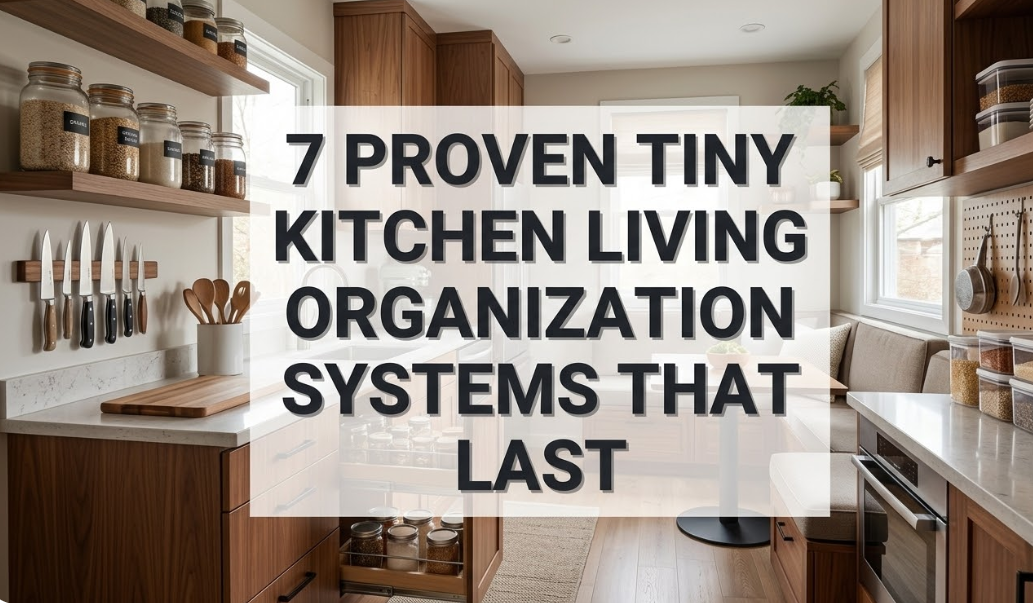
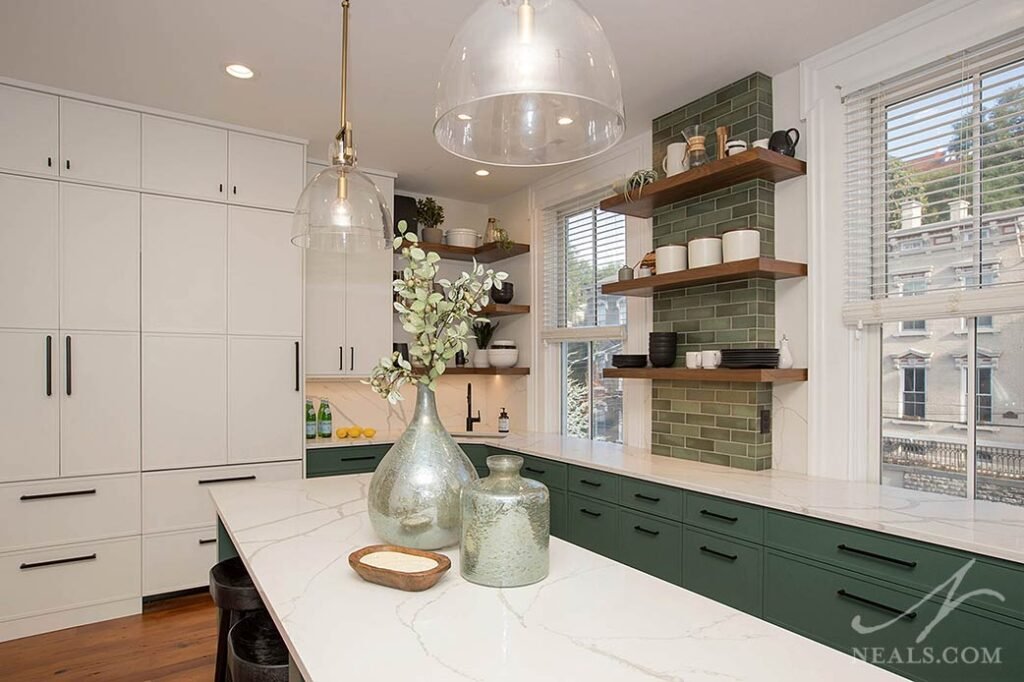
Place floating shelves over your counter or sink. These provide you with a place to store dishes, glasses, and jars of spice without using any counter space. A basic two- or three-shelf unit can provide dozens of cubic feet of storage.
Pegboards are another game-changer. Attach one to an empty wall and hang pots, pans, utensils, and even small baskets from it. It looks nice, keeps everything accessible, and clears space in your cabinets for other things.
Magnetic Strips Work Wonders
A wall-mounted magnetic knife strip clears knives from the counter altogether. You could also use magnetic spice tins on the side of your fridge. That’s your spice rack problem resolved — without using a single inch of shelf space.
Door Space Is Often Ignored
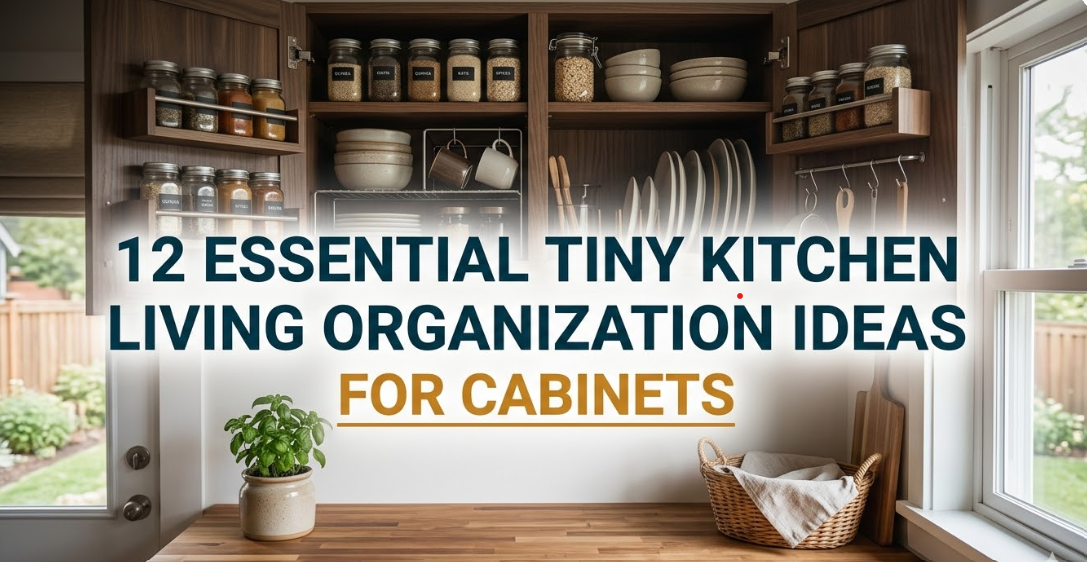
The insides of cabinet doors are prime real estate. Hang small hooks or over-door organizers there to store lids, foil, plastic wrap, or cleaning supplies.
| Vertical Storage Option | Best For | Estimated Cost |
|---|---|---|
| Floating shelves | Dishes, jars, décor | $15–$50 |
| Pegboard wall | Pots, pans, utensils | $20–$60 |
| Magnetic knife strip | Knives, metal tools | $10–$30 |
| Over-door organizers | Lids, wraps, cleaning items | $8–$25 |
| Magnetic spice tins (fridge side) | Spices, small items | $12–$35 |
Secret #2: The “One In, One Out” Rule Keeps Clutter Dead
This is likely the easiest rule in tiny kitchen living organization — and the most widely ignored one.
Every time you bring something new into your kitchen, something else has to go.
Why This Rule Actually Matters
Small kitchens fill up fast. One more appliance, one more set of mugs, one more stack of Tupperware — and before long you’re surrounded by things you don’t use and can’t locate what you do.
The “one in, one out” rule demands intention. It prevents clutter from taking over in the first place.
How to Apply It Every Week
Choose one day a week — Sunday, let’s say — to spend five minutes surveying your kitchen. Ask yourself:
- What haven’t I used in two weeks?
- Is there a duplicate of something I only need one of?
- Is it broken, expired, or sitting around for no reason?
If the answer is yes to any of those, it goes — donated, thrown away, or moved to a better location.
The Appliance Problem
The biggest offenders in small kitchens are appliances. That waffle maker you used a couple of times. The blender you swapped out for a better model. The rice cooker next to the Instant Pot.
Keep only the kitchen appliances you use weekly. Everything else needs to live somewhere else — in a storage unit, at a friend’s apartment, or in a donation bin.
Secret #3: Stackable and Nesting Everything Changes the Game
When cabinet space is at a premium, the shape of what you store matters just as much as what it is.
Why Random Shapes Waste Space
Lopsided containers, oddly shaped bowls, and non-stackable pots result in gaps and dead zones in your cabinets. Although the shelf is technically half empty, it’s effectively completely unusable because nothing fits in properly.
The fix? Go uniform.
Nesting Bowls and Cookware
Get a set of bowls that nest properly inside each other. The same goes for pots and pans — look for space-efficient sets designed to nest or stack. A single, bulky pot can take up the same space as one cleverly designed set of three pots.
The same logic applies to storing food. Square or rectangular containers stack better than round ones. A matching set stacks neatly, so finding lids and storing leftovers means no more searching through a heap of mismatched plastic.
The Magic of Drawer Dividers
Even if all you have is one drawer, a basic set of dividers can triple how usable it feels. Rather than a jumble of spatulas, peelers, and rubber bands, everything has its place. You stop losing things. You stop purchasing duplicates because you couldn’t find the original.
| Storage Type | Without Nesting/Dividers | With Nesting/Dividers |
|---|---|---|
| 3 pots and pans | Takes 3 separate shelf spots | Fits in 1 spot |
| Food storage containers | Chaotic pile, hard to find lids | Neat stacks, lids on top |
| Drawer tools | Tangled mess | Each item in its own section |
| Mixing bowls | Stacked awkwardly | Nests perfectly, no wasted space |
Secret #4: Force Your Counters to Work Harder (With Less Stuff on Them)
Here’s a counterintuitive truth: the cleaner your counters, the more functional they feel.
In a tiny kitchen, counter space is like currency. Every inch matters. The aim isn’t to tidy up what’s on your counter — it’s to reduce what exists there to begin with.
The “Counter Essentials Only” Rule
Don’t have more than three things on the counter. For the majority of studio apartment inhabitants, this translates to:
- A coffee maker or an electric kettle
- A fruit bowl or small utensil holder
- One frequently used appliance (toaster, etc.)
Everything else gets stored away. Yes, even if you use it daily. A toaster can reside in a cabinet and come out for breakfast. That two-second hassle is worth a clean, uncovered counter the other 99.9 percent of the time.
Use Your Counter Edges
The edges of counters — and especially corners — most often go to waste. A corner shelf or tiered counter organizer can add another “level” of storage right on the countertop without sacrificing usable prep space.
Under-Counter and Over-Sink Space
Take advantage of open space under your sink if you have it. A tension rod beneath the sink allows you to hang spray bottles, so the floor of the cabinet can hold other things. Stackable bins also work well there.
Over-sink shelves — the type that rest above the sink without mounting — add an impressive amount of storage. They’re ideal for dish soap, sponges, and small items that tend to clutter the countertop.
Secret #5: Organize Like a Convenience Store, Not Like a House
This secret may sound odd, but it works like a charm for tiny kitchen living organization.
Convenience stores specialize in small-space organization. Every inch is used. Every product has a zone. You can find what you need in seconds — even if you’ve never been to that specific store before.
Your studio kitchen should function the same way. If you want more inspiration and practical tips for making compact spaces shine, Tiny Kitchen Living is a great resource to bookmark.
Zone-Based Kitchen Organization
Break your kitchen up into functional zones, even if that means just one shelf or one drawer per zone:
- Cooking Zone: Pots, pans, oil, spices, cooking utensils
- Prep Zone: Cutting board, knives, mixing bowls, measuring cups
- Eating Zone: Plates, bowls, glasses, silverware
- Snack/Pantry Zone: Non-perishables, cereal, coffee, tea, and snacks
- Cleaning Zone: Dish soap, sponges, towels, trash bags
When everything has a zone, you always know where it lives — and where to find it.
Labeling Makes It Stick
You don’t need a fancy label maker. Masking tape and a marker does the trick just fine. Label your shelves, your containers, your bins. Labeling turns a zone system from a temporary attempt at organization into an enduring habit.
The Pantry Problem in Cozy Kitchens
The majority of studio apartments lack a pantry. That means dry goods, canned food, snacks, and cooking staples all compete for cabinet space.
The solution: a small rolling cart or freestanding shelf unit.
A narrow kitchen cart (12–18 inches wide) can work as a moveable pantry. Roll it out when you need it. Store it in a corner when you don’t. Several carts even feature a cutting board top for extra prep surface.
Secret #6: Embrace Multi-Purpose Everything
In a small kitchen, single-purpose tools are luxuries you cannot afford.
Everything you own should serve double or triple duty. This is the primary philosophy behind truly effective tiny kitchen living organization.
Multi-Purpose Kitchen Tools Worth Owning
Here’s a quick list of swaps that save serious space:
- Dutch oven → replaces a stock pot, a braising pan, and sometimes a slow cooker
- Immersion blender → replaces a full-sized blender and occasionally a food processor (for most tasks)
- Sheet pan → acts as a roasting pan, a baking tray, and a cooling surface
- Cast iron skillet → works on stovetop, in the oven, and even under the broiler
- Cutting board with built-in colander → preps and drains in one piece
According to Good Housekeeping’s small kitchen guide, swapping out bulky single-use tools for multi-purpose alternatives is one of the fastest ways to reclaim cabinet space in a compact kitchen.
Making Furniture Work as Kitchen Storage
This is particularly important in studio apartments where the kitchen spills out into the living space.
A kitchen island on wheels can serve as your dining table. An ottoman with storage can stash extra kitchen linens or small appliances. A bookshelf close to the kitchen can hold cookbooks, baskets of dry goods, and extra serving dishes.
Consider Every Purchase Before It Enters Your Home
One question to ask before buying anything for your kitchen: “Does this serve at least two purposes?”
If the answer is no, think long and hard about whether you truly need it. A single-function item has to justify its space in a small kitchen.
Putting It All Together: A Quick-Start Plan
If you’re ready to start transforming your tiny kitchen today, here is a simple action plan:
Day 1: Purge. Examine each cabinet, drawer, and counter. Get rid of everything you never use, that’s broken, or is a duplicate.
Day 2: Plan your zones. Decide where your cooking, prep, eating, pantry, and cleaning zones will live.
Day 3: Go vertical. Put up one or two floating shelves, a magnetic strip, or a pegboard if you’re allowed to mount things.
Day 4: Transition to nesting/stackable storage. Transfer mismatched containers into a matching set.
Day 5: Clear the counters. Commit to the three-item rule and find a home for everything else.
Day 6: Integrate one multi-purpose item or furniture piece that addresses a specific storage need.
Day 7: Label everything and start your weekly Sunday scan habit.
That’s one week. Seven days to a kitchen that actually works.
Common Mistakes When Organizing Small Kitchens
Even well-intentioned habits can keep some people stuck in a cluttered kitchen. Here are the biggest ones to watch out for:
Purchasing more storage bins before decluttering. More bins just mean more orderly clutter. Always purge first.
Keeping things “just in case.” In a small kitchen, “just in case” is the enemy. If you haven’t used it in a month, it probably doesn’t deserve prime real estate.
Ignoring the fridge door and top. The fridge door properly accommodates condiments and smaller items. The top of the fridge serves as a good spot for a small basket of onions, garlic, or cookbooks — as long as it’s off the floor and out of the way.
Forgetting to reassess. Your needs change. What you needed six months ago is likely not what you need today. Perform a complete kitchen audit every three to four months.
Frequently Asked Questions About Tiny Kitchen Living Organization
Q: How do I organize a kitchen with just two cabinets? For those cabinets, prioritize your most-used items. Use vertical solutions — shelves, pegboards, magnetic strips — for everything else. A rolling cart can replace a third cabinet entirely.
Q: What’s the best storage hack for studio apartment pantries? Use a narrow rolling cart or small freestanding shelf unit as your moveable pantry. Maximize space and visibility by storing dry goods in uniform, labeled containers.
Q: Can I organize a small kitchen without drilling into the walls? Yes. Tension rods, over-door hooks, freestanding shelves, magnetic fridge strips, and command hooks all operate without drilling. Most are also renter-friendly.
Q: How do I keep a small kitchen tidy in the long term? Build a weekly Sunday scan habit. Do a five-minute reset each evening. Practice the “one in, one out” rule. These three habits keep clutter from building back up.
Q: Are kitchen organization products worth the money? Some are, some aren’t. Prioritize nesting containers, a pegboard, floating shelves, and drawer dividers. Avoid trendy gadgets or single-purpose organizers that take up more space than they save.
Q: How can I make a small kitchen feel larger? Keep counters clear. Use light colors where possible. Add under-cabinet lighting if you can. Mirrors near the kitchen — in the adjoining living area — can create a visual illusion of more space.
Final Thoughts
A small kitchen need not hold you back.
With these 6 tiny kitchen living organization secrets, you have all the tools you need to turn a cramped, chaotic cooking space into one that truly works for you — every single day.
Go vertical. Purge regularly. Nest your storage. Clear the counters. Zone your space like a convenience store. And make everything pull double duty.
You don’t need a bigger kitchen. You just need a smarter one.
Pick one secret to start with this week. By next month, your studio apartment kitchen will feel like a whole new ballgame.