I still remember standing in my first studio apartment kitchen, staring at two cabinets, one narrow drawer, and a counter space barely wide enough to fit a cutting board. I had just moved in, boxes everywhere, and I genuinely thought — how do people actually cook in spaces like this?
Fast forward a few years, and that tiny kitchen taught me more about smart organization than any home décor blog ever could. Not because I read about it, but because I lived it. I made mistakes, bought the wrong things, rearranged shelves at 11 PM out of frustration, and slowly figured out what actually works versus what just looks pretty on Pinterest.
If you’re dealing with a small kitchen right now — whether it’s a studio apartment, a rental unit, or just a kitchen that never had enough room — these seven ideas are the ones that genuinely made a difference for me.
1. Stop Organizing by Category — Organize by Frequency Instead
This was my biggest mindset shift. For the longest time, I grouped things the “logical” way: all spices together, all baking stuff together, all pots in one cabinet. Made total sense in theory. In practice? I was climbing over things every single day to reach my one go-to pan.
The real game-changer was asking myself: what do I use every single day? Those things go at arm’s reach. What do I use once a week? One shelf back. What do I use once a month or less? Highest shelf, back of cabinet, or even outside the kitchen entirely.
Here’s the quick breakdown I use:
| Frequency | Where It Goes |
|---|---|
| Daily use | Counter, first drawer, eye-level shelf |
| 3–4x per week | Second shelf, accessible cabinet |
| Weekly use | Upper cabinet, lower cabinet back |
| Rarely used | Top shelf, pantry corner, storage outside kitchen |
My stand mixer, for example, went to live on top of the fridge. I use it maybe twice a month. But my skillet, my knife, and my go-to spatula? They’re within arm’s reach of the stove every single time.
2. Vertical Space Is Your Best Friend — Start Looking Up
Most small kitchen owners are thinking horizontally — left to right across the counter, front to back in the cabinet. But vertical space is where the magic is.
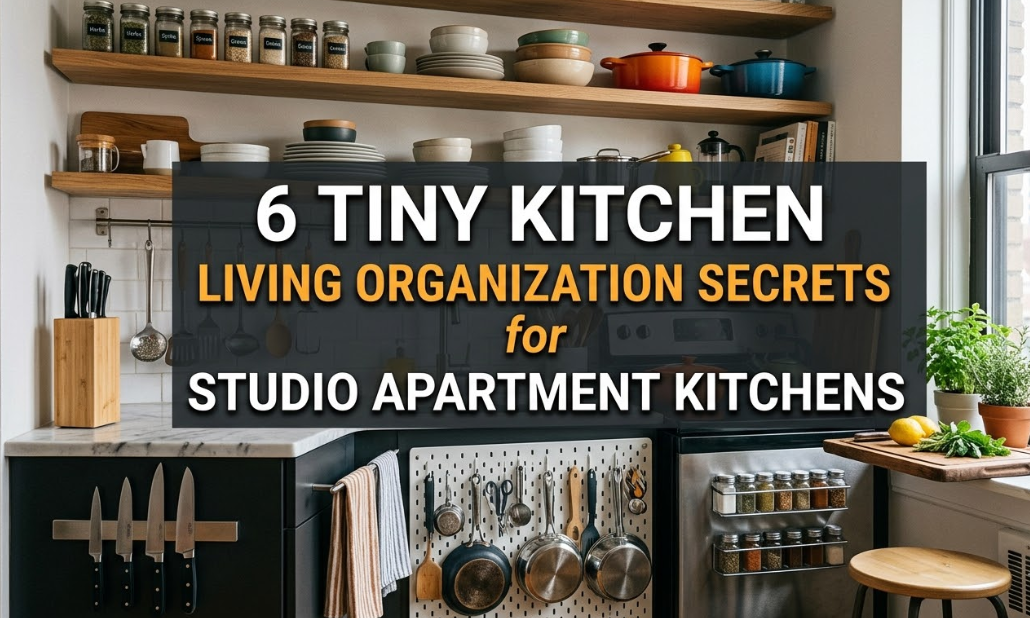
When I finally put up a simple magnetic knife strip on the wall, I freed up an entire kitchen drawer. That drawer previously held knives, random utensils, and somehow three corkscrews I didn’t remember buying.
Things worth going vertical with:
- Magnetic knife strips — keeps knives accessible and counter-clear
- Wall-mounted spice racks — works beautifully next to the stove
- Pegboards — sounds industrial but can look incredible with the right hooks and a coat of paint
- Over-door organizers — the back of your pantry door or cabinet door is basically a free shelf you’re ignoring
- Stackable shelf risers inside cabinets — these double your usable shelf space for almost no money
I put a small pegboard in the narrow space between my fridge and the wall. Three hooks, a small shelf bracket, and suddenly I had a home for my measuring cups, colander, and dish towels. That dead space had been completely wasted for a full year before I thought to use it.
If you want to dive deeper into this, check out these 9 secret tiny kitchen living storage ideas using wall space that genuinely transformed how I think about empty walls.
3. Invest in the Right Containers — Not Just Any Containers
Here’s a mistake I made early on: I bought a matching set of round airtight containers because they looked great. Clean, white, uniform. Lovely.
They were also a complete waste of space. Round containers in a square cabinet create dead corners everywhere. I was losing probably 30% of my cabinet space to air gaps around circular bins.
The fix? Square or rectangular containers only. They stack, they fit flush against each other, and they use every inch of the space you actually have.
What I now use and genuinely swear by:
- OXO Good Grips Pop Containers — rectangular, airtight, stack perfectly
- Vtopmart or DWËLL Pantry Bins — open-front, easy to label, great for grouped items
- Simple clear bins from IKEA (the VARIERA line) — inexpensive and highly practical
Label everything. I know it sounds fussy but after the third time I grabbed salt thinking it was sugar, I became a label person and I haven’t looked back.
Also worth mentioning: decanting (transferring things from original packaging into containers) is not just aesthetic. Bags of rice, pasta, and flour take up dramatically less space once they’re in uniform containers stacked on a shelf versus stuffed bags that don’t sit straight or seal properly.
4. The One-In-One-Out Rule — And Actually Following It
This one’s less about a physical hack and more about a habit, but it might be the most impactful thing on this list.
Every time I brought something new into my kitchen — a new pan, a gadget, a serving dish — something else had to leave. No exceptions.
Before I started doing this, my kitchen had accumulated things I genuinely forgot I owned. An egg poacher I used once. A rice cooker that took up a third of my counter. A mandoline slicer I was scared to use. None of these things were earning their space.
The question I now ask before anything enters my kitchen: does this replace something, or does it just add to the pile?
If it’s adding to the pile without replacing anything, I think hard about whether I actually need it. Usually, the answer is no.
This single rule has kept my tiny kitchen from sliding back into chaos more times than I can count. And honestly, cooking in a clutter-free space just feels different. There’s less mental noise. You move faster. Cleanup takes half the time.
5. Make Your Sink and Stove Area Do Double Duty
The area around your sink and stove is prime real estate in a tiny kitchen — but most people either leave it bare or crowd it with things that don’t belong there.
A few configurations that genuinely work:
Around the sink:
- An over-sink cutting board (fits across the basin, gives you a bonus prep surface)
- A slim dish drying rack that sits inside the sink rather than beside it
- A small caddy on the windowsill for dish soap, sponge, and scrubber — keeps them off the counter
Around the stove:
- A narrow rolling cart beside the stove for oils, salt, pepper, and cooking essentials
- A pot rail or S-hook strip above the stove (if you have a hood or wall space)
- A splatter guard that doubles as a shelf on some models
I added a rolling cart from IKEA (the RÅSKOG model, originally designed as a utility cart) beside my stove and it changed my life. Everything I needed while cooking was right there — no turning around, no searching, no clutter. When I had guests, I rolled it out of the way. Perfect.
If you’re making changes like these, you’ll want to avoid some of the common pitfalls first — have a look at these 6 tiny kitchen living storage mistakes that waste valuable space before you start rearranging things.
6. Rethink Your Junk Drawer (Or Eliminate It Entirely)
Every kitchen has one. That drawer where rubber bands, take-out menus, old batteries, a mystery key, and three dried-up pens go to retire. I’ve had several versions of this drawer and I’m not proud of any of them.
The junk drawer is a symptom of not having a proper home for miscellaneous items. In a big kitchen, you can afford that drawer. In a tiny kitchen, that drawer is potential storage you’re completely wasting.
Here’s how I cleaned mine up for good:
- Empty it completely — everything out on the counter
- Sort into three piles: keep in kitchen, belongs elsewhere, throw away
- For what stays: assign it a proper home using small bins or drawer dividers
- Use the drawer itself intentionally — mine became a dedicated utensil drawer with a bamboo organizer tray
Things that used to live in my junk drawer now live in a small labeled box in my hallway cabinet (batteries, tape, rubber bands) or got tossed entirely (seriously, when did I accumulate so many takeout soy sauce packets?).
The bamboo drawer divider I use is from Amazon — about $15, adjustable, and it keeps everything in its lane. Sounds minor, but opening a drawer and immediately finding what you need without digging is a genuinely satisfying feeling.

7. Do a Monthly Reset — Not a One-Time Overhaul
Here’s the uncomfortable truth about kitchen organization: it doesn’t stay organized on its own. Especially in a small space where there’s very little margin for things to drift back into chaos.
What I’ve found works better than an annual deep clean is a monthly 20-minute reset. No big reorganization, no buying new products. Just a quick run-through:
- Check what’s accumulated on the counter that doesn’t belong there
- Go through the fridge and pantry for anything expired or nearly empty
- Make sure everything is back in its designated spot
- Note if anything is consistently ending up in the wrong place (that’s usually a sign the “right” spot isn’t actually convenient)
That last point is important. If you find yourself constantly putting something in the “wrong” place, maybe the wrong place is actually where it should live. Organization should work with your habits, not against them.
I do my reset on the first Sunday of every month, usually while listening to a podcast. Takes about 20 minutes. And because I’m doing it monthly instead of waiting until things are disastrous, it never becomes a big project.
Common Mistakes I Kept Making (Until I Didn’t)
A few things I wish someone had told me earlier:
Buying storage products before decluttering. This is the most common one. People think more bins will solve the problem, but if you have too much stuff, more bins just means more organized clutter. Declutter first, then organize, then buy what you need.
Ignoring the top of the fridge. It’s flat, it’s accessible, and in a tiny kitchen it’s genuinely useful real estate. A small tray up there holds bread, fruit, or appliances you use occasionally.
Storing things based on how they look, not how you cook. Your kitchen should reflect your cooking routine, not a magazine photo. If you make eggs every morning, that pan should be the most accessible thing in your kitchen.
Overcrowding the counter with “helpful” appliances. Air fryers, toasters, coffee makers, blenders — they all promise convenience but they all eat counter space. Be ruthless about what earns a permanent spot on your counter versus what gets stored and brought out when needed.
For more on this, the piece on 8 secret tiny kitchen living cooking habits that save counter space is worth a read — a lot of the habits there directly tie into organization.
A Simple Framework to Get Started Today
If you’re staring at your kitchen right now and feeling overwhelmed, here’s the simplest place to start:
Step 1: Pick one cabinet or drawer — just one.
Step 2: Take everything out.
Step 3: Only put back what you’ve used in the last 3 months.
Step 4: Find a proper home for the rest, or let it go.
Step 5: Add a divider, bin, or riser if the space needs structure.
That’s it. Do that once a week for a month and you’ll have touched your entire kitchen without it ever feeling like a massive project.
Quick Reference: Tiny Kitchen Organization Wins by Budget
| Budget Range | Best Moves |
|---|---|
| Under $10 | Bamboo drawer dividers, command hooks, labels |
| $10–$30 | Shelf risers, magnetic knife strip, door organizer |
| $30–$60 | IKEA RÅSKOG cart, pegboard kit, stackable containers |
| $60–$100 | Wall-mounted spice rack system, pull-out cabinet organizers |
Tiny kitchens force you to be intentional in a way that big kitchens never require. And once you develop that intentionality — once you know where everything is, why it’s there, and how it serves your actual cooking life — you stop feeling cramped. You start feeling like you’re working with the space instead of against it.
It took me longer than I’d like to admit to get there. But the kitchen I have now, still small, still no island, still one oven — runs smoother than kitchens I’ve visited that are three times the size. Because everything has a place, and everything is in it.
If you’re just getting started and want to understand the full picture of what’s possible in a small kitchen space, this article on 11 tiny kitchen living design ideas that feel surprisingly spacious is a great next read — it ties together design and function in a way that’s genuinely practical.