Meta Description: Tiny kitchen living organization doesn’t have to be a nightmare. Here are 5 smart rules employed by professionals to make every corner of your tiny kitchen count.
5 Powerful Tiny Kitchen Living Organization Rules Professionals Follow
The struggle is real for anyone already living in a small apartment, studio, or cozy home. Counter space disappears fast. Cabinets fill up overnight. And somehow, the kitchen always seems to be working against you rather than for you.
But here’s the thing — professional organizers and interior designers who focus on small spaces don’t view tiny kitchens as a limitation. They see them as a puzzle. And every puzzle has an answer.
The good news? You don’t have to rip down walls or spend thousands of dollars on a renovation. All you need is the correct set of rules.
These are not vague pointers like “declutter more” or “buy matching containers.” These are the literal, specific rules that professionals use when they enter a small kitchen and morph it into a highly efficient workspace that feels double its actual size.
Let’s break them down — one powerful rule at a time.
Rule #1 — Everything Needs to Have a Home (And Its Home Has to Make Sense)
This is the first rule of tiny kitchen living organization. Before you purchase a single storage product, before you shuffle one shelf — you have to determine where everything lives.
Professional organizers call this “zoning.” Everything in your kitchen fits into a category, and each one of those categories belongs in its own zone.
How Zoning Works in a Small Kitchen
Consider your kitchen in three zones:
- The Prep Zone — Where you chop, mix, and cook. This is your countertop, and it should be as clear as possible.
- The Cook Zone — By the stove. Oils, spices, pans, and spatulas live here.
- The Clean Zone — By the sink. Here are dish soap, sponges, drying racks, and cleaning supplies.
When things exist in logical zones, you no longer waste time looking for stuff. And you stop tossing random things on the counter when you don’t know where else to put them.
The “One Reach” Rule
Professionals tend to adhere to what’s sometimes referred to as the “one reach” rule. If you use something every day, it should be within one action — no opening three cabinets, no fussing with other items.
Your coffee maker? One reach. Your most-used knife? One reach. That pan you cook in every morning? Definitely one reach.
Things you use once a week can be slightly more difficult to get to. Something you use once a month can be relegated to the back of a cabinet or up high.
A Simple Zoning Chart
| Zone | Location | What Goes Here |
|---|---|---|
| Prep Zone | Main counter space | Cutting board, mixing bowls, knives |
| Cook Zone | Near the stove | Pans, oils, spices, spatulas |
| Clean Zone | Near the sink | Soap, sponges, dish towels |
| Storage Zone | Cabinets/shelves | Appliances used weekly or less |
This single change — moving things to where they logically belong — transforms the feel and function of a small kitchen.
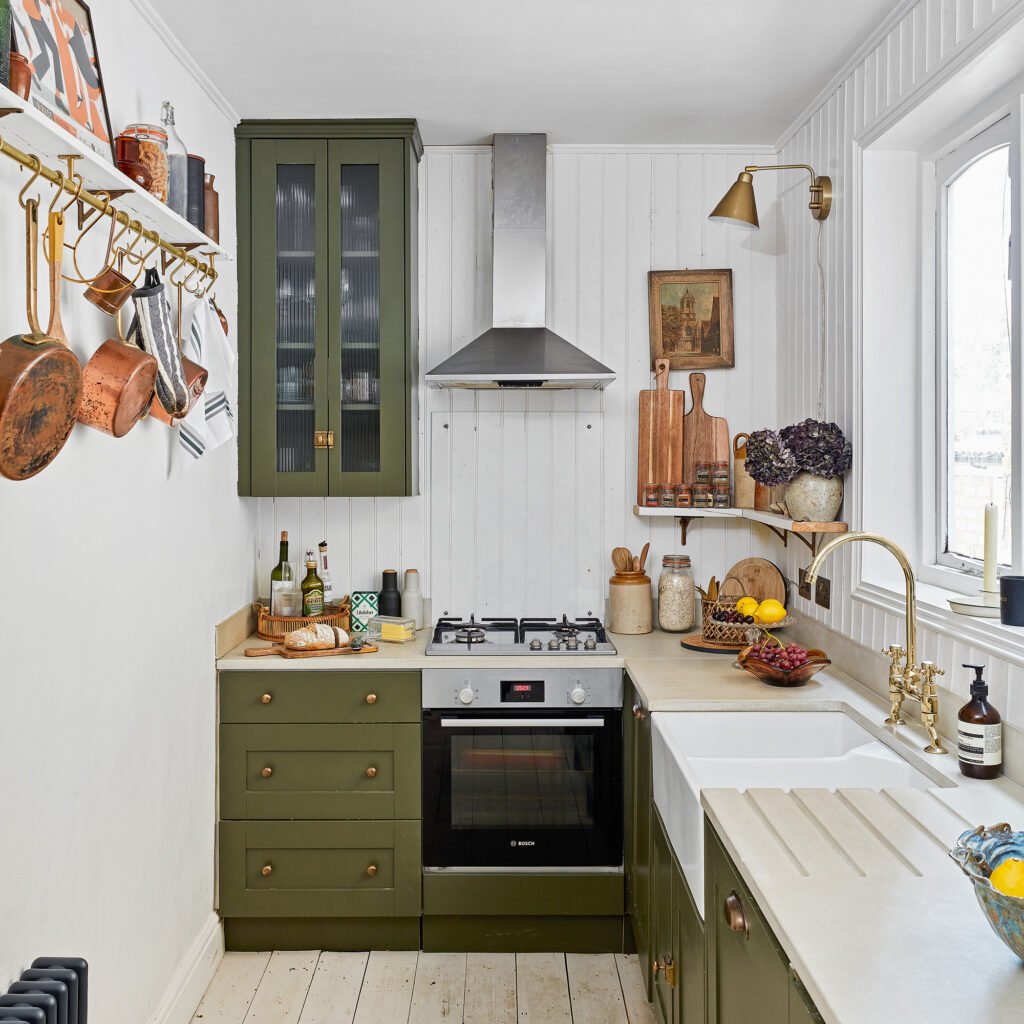
Rule #2 — Vertical Space Is Your Best Friend
In a kitchen, most people think horizontally. They fill up the counter. They cram the cabinets from front to back. And then they hit a wall and get stuck.
Professionals think vertically.
In a tiny kitchen, the walls and the height above your cabinets are some of the most underutilized real estate in your home. When you start taking advantage of vertical space, you suddenly discover you had a lot more storage room than you ever realized.
Go Up the Walls
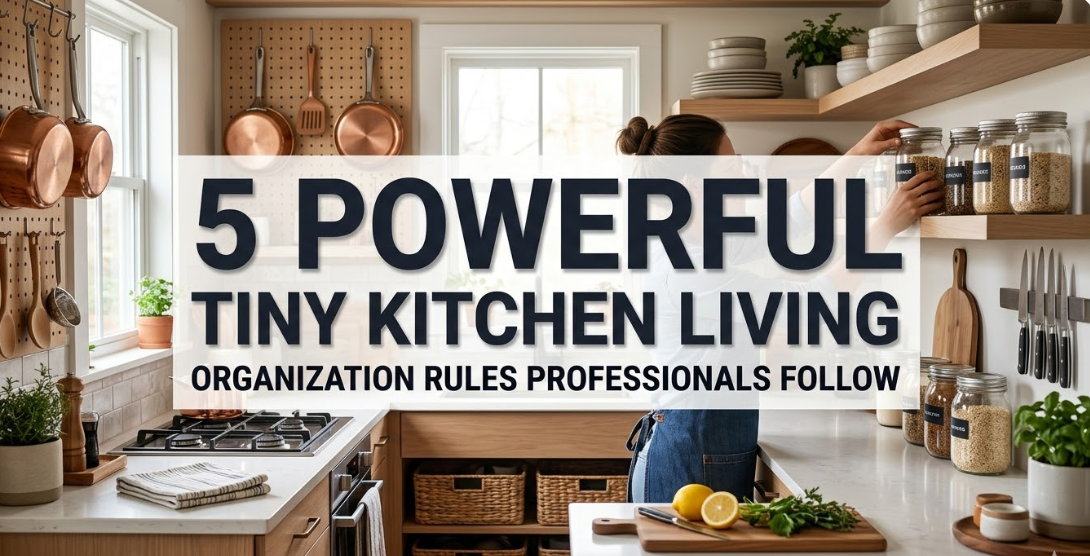
Add floating shelves over the counter or beside the stove. Use them for everyday dishes, spices, or small plants that keep things feeling fresh.
Wall-mounted magnetic knife strips clear out an entire drawer. A mounted paper towel holder saves counter space. A pegboard alongside the stove can hold pots, pans, ladles, and measuring cups — all visible, all accessible.
Stack Inside Cabinets
Use shelf risers or stackable organizers in your cabinets to double the usable space. Rather than stacking bowls directly onto one another — which means moving the entire stack every time you need the bottom one — use small risers to create two distinct levels.
Stack pots with lids stored vertically in a lid organizer. That alone frees up a vast amount of cabinet space.
Use the Cabinet Doors
The insides of cabinet doors are almost always wasted space. Add small racks or hooks to hold spice packets, aluminum foil, or cleaning supplies. Over-the-door organizers made for cabinet interiors are inexpensive and incredibly effective.
Vertical Space Ideas at a Glance
| Vertical Area | Storage Solution | Items to Store |
|---|---|---|
| Wall above counter | Floating shelves | Dishes, spices, décor |
| Wall near stove | Magnetic strip / pegboard | Knives, pans, utensils |
| Inside cabinets | Shelf risers | Bowls, plates, mugs |
| Cabinet doors | Over-door racks | Spices, foil, wraps |
| Top of fridge | Baskets or trays | Snacks, cookbooks, extras |
Once you’ve maximized vertical space, you may find that you don’t actually need more storage — you just needed to better utilize what you already had.
Rule #3 — Cut the Clutter Without Cutting the Joy
This is where many people go wrong. They read an organizing article, feel inspired, and clear out half their kitchen in one afternoon. Then two weeks later, they find out they actually needed that thing they tossed — and the motivation is gone.
Professional organizers have a smarter approach. They don’t just declutter — they audit.
The Kitchen Audit Method
Pull out everything in your kitchen and ask yourself three questions:
- Did I use this in the last 30 days?
- Do I have something else that does the same job?
- Would I buy this again today if I didn’t already own it?
If the answer to all three is “no,” that item is probably clutter. But if something makes you happy — even if it’s not something you use constantly — it’s worth keeping. Even a small kitchen can have lots of character.
The Duplicate Trap
Duplicates are some of the worst offenders in small kitchens. Three spatulas when you only ever use one. Four sets of measuring cups. Seven mismatched mugs when you live alone.
This is what professionals refer to as “silent clutter” — it takes up space without you even realizing it, because each individual piece feels so minor. Combined, duplicates can fill an entire drawer or cabinet.
Let go of everything but the best version of each thing you own. Donate or recycle the rest.
Multi-Function Items Are Non-Negotiable
In a small kitchen, ideally every item should serve more than one function. This is a hard rule for professionals.
A cast iron skillet can go from stovetop to oven. A blender can substitute for a food processor for many tasks. A cutting board with a built-in colander saves counter space and replaces a separate tool.
Before purchasing anything new for a tiny kitchen, ask: Does this serve more than one purpose? If the answer is no, think twice before bringing it in.
Quick Clutter Audit Checklist
| Item Category | Keep If… | Let Go If… |
|---|---|---|
| Appliances | Used weekly | Used bi-annually or less |
| Utensils | One of its kind | You own 3+ that do the same thing |
| Cookware | Multi-purpose | It does only one specific thing |
| Dishes | Matching set you use | Mismatched extras gathering dust |
| Food containers | Have matching lids | Lids are missing or cracked |
Decluttering done right isn’t about having less. It’s about having exactly what you need — and nothing that gets in the way.
Rule #4 — Systems Beat Willpower Every Single Time
This is one of the most important things a professional organizer will tell you. Organization is not about being a naturally tidy person. It’s not about willpower or discipline. It’s about having a system that makes the tidy choice the easy choice.
In a tiny kitchen, a good system means things go back where they belong without you having to think about it.
The “Easy Return” Principle
Professional organizers design all storage around the “easy return” concept. Putting something away should never be harder than taking it out.
If a pot requires you to remove six other items to put it back, it won’t go back. It’ll sit on the counter. And counter clutter in a small kitchen can quickly spiral out of control.
Make sure every item can return to its home in one smooth motion. If it can’t, redesign the storage until it can.
Label Everything
Labels sound boring. But they are among the most powerful organization tools in existence — especially in a shared kitchen or when you’re building new habits.
When a container is labeled, it has a permanent address. When a shelf has a label, everyone knows what goes there. Labels eliminate the decision fatigue of figuring out where something goes — which means items actually get returned to the right place.
You don’t even need a fancy label maker. Masking tape and a marker work perfectly.
The Reset Habit
Professional organizers often advocate for a daily “kitchen reset” — a five-minute routine at the end of the day where everything goes back to its home.
This isn’t cleaning. You’re not scrubbing counters or mopping floors. You’re simply returning items to where they belong, wiping down the stove, and clearing the counter.
Five minutes a day saves you the hour-long cleanup sessions that happen when things have completely gotten out of control.
Systems for the Most Common Pain Points
| Common Pain Point | System Solution |
|---|---|
| Cluttered counter | Clear rule: nothing lives on the counter permanently |
| Overflowing junk drawer | One small tray for “miscellaneous” — no overflow allowed |
| Lost container lids | All lids stored vertically in one dedicated spot |
| Expired food in back of pantry | FIFO rule — new items go behind old ones |
| Dish pile-up | One-touch rule — wash dishes immediately after use |
The system does the heavy lifting. You just follow it.
Rule #5 — Design for How You Actually Live, Not How You Think You Should
This is the rule that separates good organization from great organization. And it’s the one most people skip.
Many people set up their kitchen based on what they’ve seen on Pinterest or Instagram. Beautiful open shelving. Color-coded containers. Everything perfectly symmetrical.
Then real life happens. And the “perfect” system doesn’t match the way they really cook, eat, or move around the kitchen.
Professional organizers spend time watching how a person uses their kitchen before recommending a single storage solution. They observe. They ask questions. And then they design around the answers.
Know Your Cooking Style
Do you meal prep every Sunday? On prep day, you need accessible, large containers and clear counter space.
Are you more of a quick weeknight dinner kind of person? Your most-used pans and a few key spices should be front and center.
Are you a coffee-first-thing-in-the-morning person? Your entire coffee setup — machine, mugs, sugar, filters — should be one zone that requires zero thought at 6 a.m.
Your kitchen should be organized around your real habits. Not an idealized version of them.
Think About Who Else Uses the Kitchen
If your home is shared with a partner, roommate, or kids, your organization system needs to work for everyone — not just you.
Kids need things at their height. Roommates need labeled spaces so they know where things belong. A partner who cooks differently than you may need their own dedicated prep area.
The best tiny kitchen systems are tailored for the real people who use the space. For more practical tips built around real small-space living, Tiny Kitchen Living is a great resource worth bookmarking.
Don’t Fight Your Natural Tendencies
If you always drop your keys and wallet on the kitchen counter the moment you walk in, stop fighting it. Instead, place a small tray or bowl there to corral them. Work with your habits, not against them.
This is what professional organizers understand that most people don’t. The goal isn’t to become a different person. The goal is to build a system that makes your real-life habits work better.
According to the National Association of Productivity and Organizing Professionals (NAPO), the most sustainable organization systems are those designed around a person’s natural behavior — not an idealized routine they’ll struggle to maintain.
Questions to Ask Before Organizing
| Question | Why It Matters |
|---|---|
| How often do I cook from scratch? | Determines how accessible cookware needs to be |
| What’s the first thing I do in the kitchen each morning? | Shapes your “prime real estate” decisions |
| What always ends up on the counter? | Reveals habits to design around, not fight |
| Who else uses this kitchen? | Ensures the system works for everyone |
| What’s my biggest daily frustration? | Points to the first thing that needs fixing |
When your organization system matches your real life, it doesn’t feel like work to maintain. It just feels like home.
The Bigger Picture — How These Rules Work Together
These five rules are not meant to be applied in isolation. They build on each other.
You start by giving everything a logical home (Rule 1). Then you create more space by thinking vertically (Rule 2). You clear the way by cutting true clutter — not joy (Rule 3). You lock in long-term success with smart systems (Rule 4). And you make sure the whole setup fits your actual life (Rule 5).
Together, these rules form a complete approach to tiny kitchen living organization that professionals have refined over years of working in small spaces.
The result isn’t just a tidier kitchen. It’s a kitchen that truly supports you — one that makes cooking easier, mornings less stressful, and daily life just a little bit smoother.
FAQs About Tiny Kitchen Living Organization
Q: What do I do if my small kitchen is already a total disaster? Start with a full clear-out. Remove everything from one cabinet or drawer at a time, sort into “keep,” “donate,” and “toss,” then put back only what you’re keeping — in a logical, zoned spot. Resist the urge to do it all in one day.
Q: What are the best storage products for a small kitchen? Shelf risers, magnetic knife strips, over-door racks, stackable containers with matching lids, and pegboards are the most widely recommended. Always measure before buying anything.
Q: How can I organize a small kitchen with no pantry? Use vertical wall shelving, the tops of cabinets, and a rolling cart or small freestanding shelf as a pantry substitute. Transfer dry goods into clear, labeled containers to maximize every inch.
Q: How do I stay organized in a small kitchen long-term? Establish a daily reset habit (five minutes at the end of each day), label everything, and conduct a kitchen audit every three to six months to catch new clutter before it snowballs.
Q: Can a small kitchen still look stylish while being organized? Absolutely. Matching containers, cohesive colors, a few small plants, and open shelving with curated items can make a small kitchen feel intentional and beautiful — not just functional.
Q: Should I hire a professional organizer for a small kitchen? If the chaos is creating real daily stress and you’ve tried organizing yourself without success, yes — even one session with a professional can be transformative. Many also offer virtual consultations at reduced rates.
Wrapping It All Up
Tiny kitchen living organization is a skill. And like any skill, it gets easier once you know the rules.
Give everything a logical home. Think vertically. Cut the clutter that doesn’t serve you. Build systems that do the heavy lifting for you. And above all — design for the life you actually live, not the one you think you should have.
Your kitchen may be small. But with the right approach, it can be one of the most efficient, functional, and even enjoyable spaces in your home.
Start with one rule. Apply it this week. Then move to the next. Small steps in a small kitchen add up to something that feels surprisingly big.