I still remember standing in my first studio apartment kitchen, holding a cutting board in one hand and a pan in the other, genuinely unsure where to put either of them. The “kitchen” was basically a wall — a single strip of counter space that could barely fit a toaster and a coffee maker side by side. I cooked exactly two meals in it before I gave up and started ordering takeout every night.
That went on for about three weeks.
Then the takeout bills hit and I had a hard conversation with myself. I wasn’t going to move. I couldn’t afford a bigger place. So I had to figure out how to actually live in this kitchen — not just exist beside it.
What followed was months of trial and error, a few regrettable Amazon purchases, and some genuinely brilliant discoveries. These six hacks didn’t just make cooking manageable — they made my whole apartment feel less cramped. And that part honestly surprised me.
1. I Stopped Using My Counter As Storage — And It Changed Everything
This sounds obvious. It wasn’t obvious to me.
I used to keep everything on the counter: the toaster, the coffee maker, the fruit bowl, a knife block, paper towels, a little oil-and-vinegar station. It felt organized because everything was visible and within reach. But what it actually did was shrink my usable prep space to about the size of a dinner plate.
The shift happened when I read that professional cooks treat counter space like a surgeon treats an operating table — nothing goes on it unless it’s actively in use.
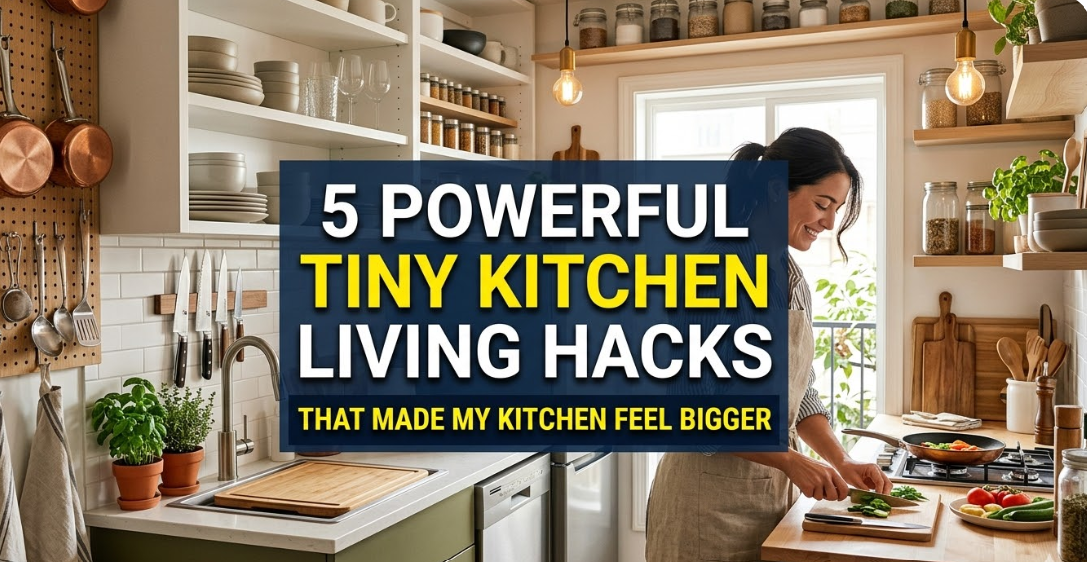
So I moved almost everything off. The toaster went into a cabinet. The fruit bowl went on top of the fridge. Paper towels got a wall-mounted holder. The knife block became a magnetic knife strip mounted on the side of a cabinet.
What I was left with was a counter that looked empty and felt enormous — even though the actual square footage hadn’t changed by a single inch.
The psychological effect on the rest of the apartment was real too. A clear kitchen makes the whole space feel less chaotic. I didn’t expect that.
Mistake I made: I put the toaster in a cabinet right next to my plastic bags and almost melted them the first time I made toast. Give heat-producing appliances some breathing room, even in storage.

2. Vertical Space Was Just Sitting There Doing Nothing
The average apartment kitchen has about 2–3 feet of empty air between the top of the counter and the bottom of the upper cabinets. I ignored that space for almost a year.
Once I started treating walls as storage real estate, everything changed.
Here’s what I added that actually worked:
| What I Added | Where | What It Replaced |
|---|---|---|
| Magnetic knife strip | Side panel of upper cabinet | Knife block on counter |
| Wall-mounted spice rack | Backsplash area | Jumbled spice cabinet |
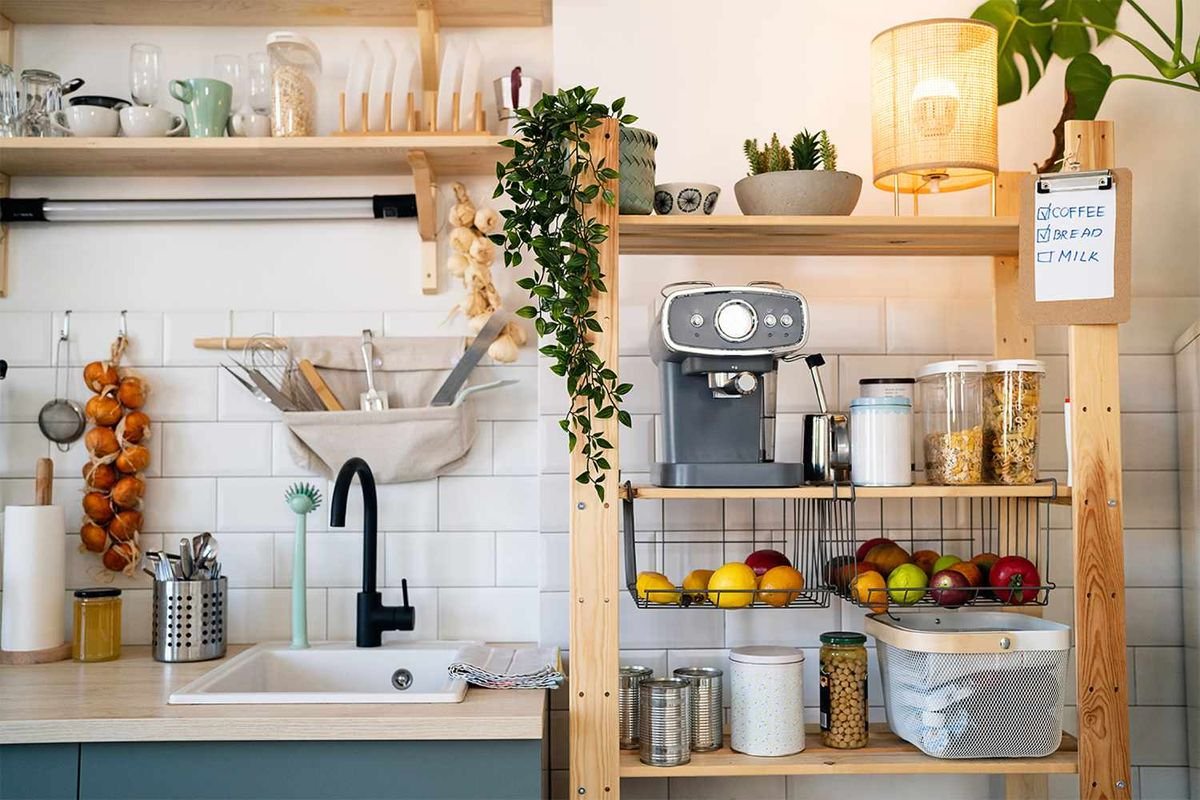
| S-hook rail | Inside cabinet door | Drawer full of utensils |
| Over-door organizer | Inside pantry door | Second shelf of pots/pans |
| Tension rod under sink | Under sink cabinet | Jumbled spray bottles |
The spice rack alone cleared out an entire cabinet shelf that I repurposed for my pots.
If you want to go deeper on using vertical space smartly, 9 Secret Tiny Kitchen Living Storage Ideas Using Wall Space breaks it down really well with specific product recommendations too.
Real tip: Before you start drilling holes, use Command strips for test placement. Live with something for a week before committing. I moved my spice rack three times before landing on the right spot.
3. One Appliance That Does Five Jobs Is Worth Ten That Each Do One
Here’s a purchasing mistake I made repeatedly in my early apartment days: buying cheap, single-purpose gadgets because they were affordable.
An egg cooker. A sandwich press. A rice cooker. A quesadilla maker.
Each one seemed useful on its own. Together, they took up more cabinet space than I had cabinets. And half of them I used maybe twice before they collected dust.
The rule I eventually landed on: if an appliance doesn’t earn its space by doing at least three things well, it doesn’t stay.
The appliances that made the cut for me:
- Instant Pot — replaces slow cooker, pressure cooker, rice cooker, and steamer
- Air fryer with bake function — replaces toaster oven for most things
- Immersion blender — replaces countertop blender and fits in a drawer
That’s it. Three appliances, stored efficiently, covering maybe 80% of what I actually cook.
For more on choosing the right tools without cluttering your space, this article on 6 Essential Tiny Kitchen Living Cooking Tools Every Small Kitchen Needs is genuinely useful — it helped me finally get rid of the egg cooker without guilt.
Lesson learned the hard way: The Instant Pot feels huge at first. Then you realize it replaced four other things and you’re actually saving space. Give it a month before you judge it.
4. Nested and Stackable Everything — But Only If It Actually Stacks
There’s a certain category of products that says “stackable” on the box and then absolutely does not stack cleanly in real life. I’ve bought several of them.
The ones that actually work in a tiny kitchen:
For pots and pans: Nesting cookware sets (like the ones from Carote or GreenLife) where each pan fits inside the last are legitimately game-changing. I went from needing two full shelves for pots to fitting everything in one stack.
For food storage: Rectangular containers only. Rounds waste corner space. Get a set that’s all the same brand so the lids are interchangeable — mixed container collections are a silent space killer.
For pantry goods: Uniform-height bins or containers make shelves feel bigger because your eye registers order as spaciousness. The moment I transferred my rice, lentils, oats, and flour into matching OXO containers with labels, my pantry shelf went from chaotic to almost spa-like.
Here’s a rough before-and-after on cabinet space usage when I switched to matching containers:
| Storage Type | Shelf Space Used | Items Stored |
|---|---|---|
| Original mismatched containers | ~90% of shelf | 8 pantry items |
| Matching stackable containers | ~60% of shelf | 12 pantry items |
That’s not a small difference. That’s an extra 4 items in less physical space just by switching container shape.

5. The “One In, One Out” Rule Changed My Relationship With Kitchen Stuff
This one isn’t a physical hack — it’s a mindset shift that has physical consequences.
For a long time, I’d add things to my kitchen without removing anything. New spatula? Into the drawer. New set of mugs someone gifted me? Into the cabinet. New pot from a sale? Somewhere.
Drawers started jamming. Cabinets got so full that things would fall out when I opened them. I was spending actual time in the morning just wrestling with my own kitchen.
The fix: for every item that comes in, one has to go out.
New spatula arrives? The old one gets donated or tossed. New mugs? Old ones leave. It sounds strict but in practice it’s incredibly freeing. Your kitchen stays at a stable volume and you’re forced to actually evaluate whether you need something before you bring it in.
I combined this with a “use it or lose it” quarterly check — if I haven’t touched something in three months, it gets donated. The only exceptions are seasonal items like a turkey roasting pan (used once a year, earns its keep).
If you want a full system for this, 10 Easy Tiny Kitchen Living Organization Habits That Changed My Routine covers the habits side of organization in a way that actually sticks.
The unexpected benefit: When you have fewer things, you take better care of each thing. My one good pan is seasoned perfectly because I actually use and clean it properly. My old collection of three mediocre pans were all kind of gross all the time.
6. Light and Color Do More Work Than Any Storage Hack
I saved this one for last because it’s the least obvious and arguably the most impactful.
My kitchen had one overhead fluorescent tube light when I moved in. It cast a yellowish, flat light that made the space feel like a storage closet. I added under-cabinet LED strip lights in about 45 minutes one afternoon, and the kitchen immediately felt 30% more open.
This is not me exaggerating. Lighting changes spatial perception dramatically.
Here’s what specifically worked for me:
Under-cabinet LED strips: I used warm-white strips (around 3000K color temperature) under the upper cabinets so they illuminate the counter. Task lighting like this makes your counter space feel more intentional and larger.
Removing a dark curtain from a nearby window: The kitchen window had a dark valance the previous tenant left. I replaced it with nothing. Natural light flooded in and the whole room changed.
Painting the inside of cabinets: This one came from a design blog I stumbled on. I painted the inside of my upper cabinets white (they were a dull gray-beige). When the doors are open, the cabinet interior reflects light instead of absorbing it. Total cost: one small sample pot of paint and two hours.
Color on the walls (carefully): A lot of small kitchen advice says “keep it white.” That’s not wrong, but it’s not the whole picture. I added one accent tile strip in a pale sage green behind the stove as a DIY backsplash. It gave the kitchen personality without making it feel smaller — and it became the first thing people noticed when they came over, in a good way.
Common Mistakes That Make Tiny Kitchens Worse
Before I wrap up, a few things I see people do (that I also did) that backfire:
- Buying more storage solutions before decluttering. Organization products can’t fix a clutter problem. Get rid of stuff first, organize second.
- Using open shelves as a dumping ground. Open shelves work if everything on them is intentional and good-looking. A mismatched collection of random items on an open shelf just looks like mess.
- Ignoring the inside of cabinet doors. This is the most underused surface in most kitchens. A few adhesive hooks or a small mounted organizer can store a surprising amount.
- Buying a huge dining table. If you have a tiny kitchen in a studio, a two-person table that folds flat against the wall will serve you better than a 4-person table that dominates the room.
- Giving up on cooking because the kitchen feels small. I did this for three weeks and all it did was drain my wallet. A small kitchen can produce great food — it just takes a little systems thinking.
The transformation from that unusable wall of a kitchen to a space where I actually enjoy cooking took time, some wrong turns, and a fair amount of YouTube watching. But the biggest takeaway is that most of these changes cost almost nothing.
Clearing the counter? Free. Moving things vertically? Mostly free with a few cheap hooks. The one-in-one-out rule? Genuinely free and it saves money over time.
The feeling of walking into a kitchen that feels organized, bright, and spacious — even at 60 square feet — is hard to describe until you’ve experienced it. It makes your whole apartment feel different. That part I didn’t expect, and it might be the best part.
Also worth reading: 7 Smart Tiny Kitchen Living Storage Hacks That Double Your Space — packed with practical ideas for when you feel like you’ve run out of storage options.