“Sort by category” is the first instruction in nearly every kitchen organizing guide, right after “get rid of what you don’t use.” Pots go with pots. Baking gear gets its own bin. Spices line up together on a tiered rack. It’s tidy, it photographs well, and it makes sense in a kitchen with twelve linear feet of upper cabinets to work with.
In a kitchen with four cabinets and two drawers, the same advice falls apart within a few weeks. That’s rarely because someone organized “wrong.” The system itself doesn’t scale down. Here’s why, and what tends to hold up better in its place.
- Why Category Sorting Looks Like the Right Answer
Grouping similar items together is standard advice because it solves a real problem in larger kitchens: too many items spread across too many surfaces with no system at all. If every mixing bowl lives in a different cabinet, cooking turns into a scavenger hunt every time. Category sorting fixes that by giving every type of object one home.
It works in a normal-sized kitchen because there’s enough cabinet volume that “all baking supplies in one place” doesn’t crowd out anything else. The flour, the muffin tin, the cookie sheets, the cooling rack, all fit in one cabinet with room left over.
A tiny kitchen doesn’t have that room left over. That’s the whole issue.
- Where It Actually Breaks Down
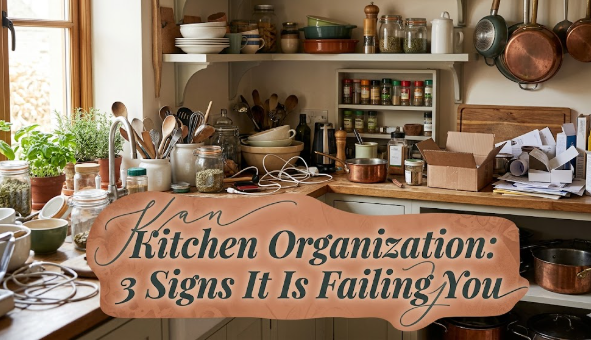
In a kitchen with four upper cabinets and two lower ones, category-based storage forces you to combine unrelated categories just to make the math work. Bakeware ends up sharing a cabinet with the blender. Spices sit next to canned goods because there’s no separate “spice cabinet” to give them. Once two or three categories get crammed onto one shelf, the entire point of categorizing disappears. You’re still digging, just through a more organized mess.
There’s a second problem that’s less obvious. Category sorting treats every item in a group as equally important, but they’re not. A muffin tin used three times a year and the skillet you reach for nightly are not the same kind of object, even though a strict category system files both under “cookware.” Frequency of use matters more than type of use once storage gets this limited.
Here’s where most people go wrong trying to fix it: they buy more bins. A bin doesn’t create cabinet volume, it just repackages the same amount of stuff into tidier-looking piles. The bin fills up, the crowding comes right back, and now there’s a bin to dig through on top of the shelf.
This kind of crowding is the question Tiny Kitchen Living hears about more than almost any single product. If you want the longer math on why cabinet space disappears faster than the cabinet count suggests, Why Does Cabinet Space Run Out Faster Than You Think walks through it in more detail.
- What Works Instead: Sorting by Frequency, Not Type
The alternative is to organize around how often you reach for something, not what category it belongs to. Give your most-used items, the everyday pan, the one good knife, the daily plate and bowl, the easiest spot to access. Rank everything else down from there. A roasting pan that only comes out for one holiday dinner a year doesn’t need its own labeled zone. It needs to be out of the way until November.
Category-BasedFrequency-BasedBest suited forKitchens with surplus cabinet volumeKitchens with 4 to 6 total storage spacesWhat determines placementType of item (cookware, spices, bakeware)How often the item gets usedDaily cooking speedSlower when one category spans several cabinetsFaster, since daily items share one reach zoneRarely used itemsOften stored at the same accessibility as daily itemsPushed to the back or top, out of the main zoneMixing categories in one spotAvoided on purposeExpected, and fine, in low-traffic zones
This is also where the right tool matters more than the right bin. A shelf riser solves a problem a drawer organizer can’t touch, and the reverse is true too, depending on whether the mess is stacked plates or scattered utensils. Shelf Risers vs Drawer Organizers: Which Helps More breaks down which one actually fixes which problem, since they get used interchangeably more often than they should.
- Making the Switch Without Tearing the Kitchen Apart
Switching systems doesn’t require emptying every cabinet in one weekend. A couple of weeks of paying attention does more good than a full teardown.
Notice what you reach for without thinking, for about a week. That’s the primary zone, no matter what category it technically belongs to.
Pull anything used less than once a month and move it to the highest shelf or the very back of the lowest cabinet.
Stop insisting one category stay fully intact if it’s competing with the daily zone for space. Split it. The everyday measuring cup stays close. The rest of the baking set can move.
Re-test for two weeks before buying any new organizers. Most of the “I need more storage” feeling is actually a placement problem, not a volume problem.
If spices are part of what’s crowding the daily zone, the fix usually isn’t a spice rack at all. How to Organize Spices Without a Spice Rack covers a few layouts that work better in cabinets too small for a rack to make sense in the first place.
- Applying This Cabinet by Cabinet
A single-cabinet kitchen usually has one cabinet doing double duty as a pantry and a cookware cabinet, which is exactly the kind of crowding category sorting can’t handle. Splitting that cabinet by frequency instead of type means the pasta and cereal eaten weekly sit at the front, while the bag of rice bought for one recipe and never finished again sits behind it. No separate pantry zone, no separate cookware zone. Just a front and a back.
Cabinet doors are wasted space more often than not, too. Mounting a thin rack on the inside of a door adds storage that doesn’t compete with anything else for room, which makes it a good landing spot for the small category-specific stuff, foil, wrap, lids, that doesn’t need daily access but also doesn’t deserve a whole shelf. Cabinet Door Shelving: The Trick Nobody Ever Uses covers how to mount one without it hitting the shelves when the door closes, which is the part people usually get wrong the first time around.
None of this requires perfect discipline forever. Frequency zones drift after a busy month and need the occasional reset, and that’s fine. The goal isn’t to lock everything in place once and never touch it again. It’s to stop sorting by what something is and start sorting by how often a hand actually goes looking for it. That one shift solves more crowding than any organizer on the shelf at the store. If any of this sounds familiar from other pieces on Tiny Kitchen Living, it’s because the constraint is almost never the lack of bins.
FAQs
Do I need to give up grouping spices together completely?
No. Grouping still makes sense for spices specifically, since most recipes call for several at once. The frequency principle just applies inside that group. Keep the three or four most-used spices at the front, and let the rest sit behind them instead of alphabetizing or sizing them into one uniform row.
What about kitchens shared with a roommate or partner?
Frequency zones get trickier with two people, since “used daily” means different things to each person. A shared zone for items both people grab constantly, plus one or two personal zones for things only one person uses, tends to work better than trying to merge two sets of habits into a single system.
How many zones does a one-cabinet kitchen actually need?
Two is usually enough. A front zone for anything touched weekly, and a back or top zone for everything else. A third zone in that little space tends to create more decision fatigue than it solves.
What about large items only used once or twice a year, like a turkey roaster?
These rarely belong in kitchen storage at all if there’s any alternative available. A closet shelf, under a bed, or a hall cabinet works better than giving prime kitchen real estate to something idle fifty weeks out of the year.
Should I buy organizers before or after rearranging?
After. Buying bins, risers, or racks before knowing which zone actually needs help usually means buying the wrong size or type, then rearranging the kitchen around the organizer instead of around how it’s actually used.