People keep asking for spice racks. I’ve been hearing the same request for over two decades. A client walks in with a Pinterest board full of those tiered wooden carousels and those little magnetic sets arranged artfully on white subway tile, and they say, “I just need a good spice rack.” And I understand the appeal. I genuinely do. But in a tiny kitchen, a spice rack is rarely the solution. Most of the time, it’s the problem reassembled in a different form.
Here’s what actually happens: the rack gets installed, everything looks great for about two weeks, then the same chaos rebuilds itself. Bottles crowd together, the jars in the back get forgotten, duplicates pile up because you can’t see what you have, and suddenly there are two half-empty jars of smoked paprika on the rack and zero cumin anywhere because you ran out and didn’t notice.
The problem was never a missing rack. The problem is that most people design their spice storage around how it looks, not around how they cook.
- Why the “Just Get a Spice Rack” Assumption Fails Small Kitchens
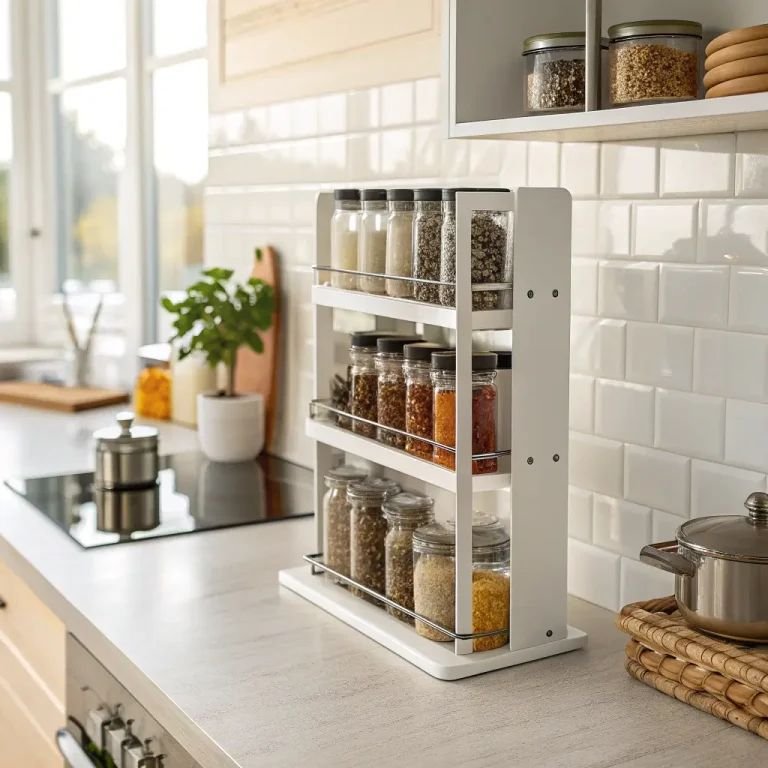
Counter-mounted spice racks are counterproductive the moment counter space is already scarce. In a 90-square-foot galley kitchen or a studio apartment with one strip of prep surface, you cannot give up eight to twelve linear inches to a rotating tower of jars. That counter needs to work three or four jobs at once: prep space, cutting board landing, coffee station, sometimes the only flat surface available when you’re plating something hot.
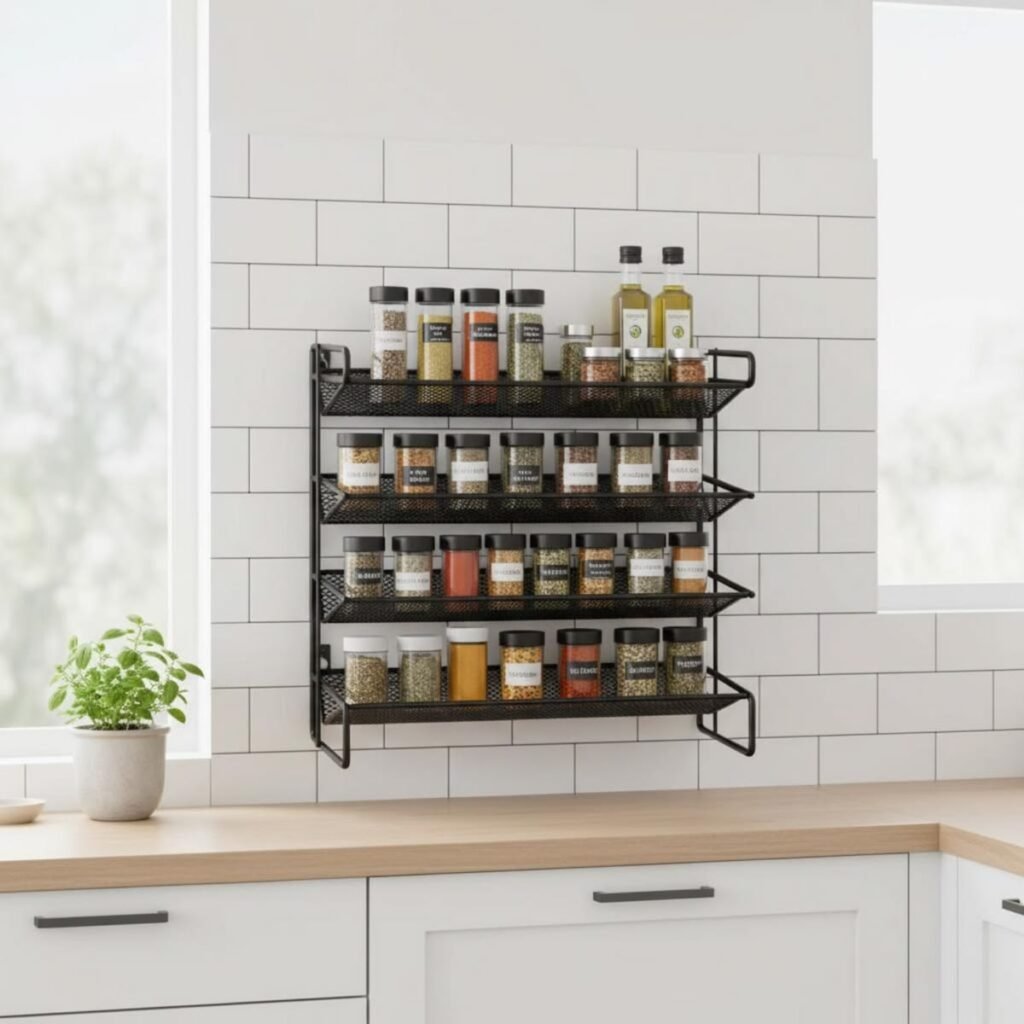
Wall-mounted racks look wonderful in design photos. They look considerably less wonderful when you’re renting and can’t drill into walls, when your lease prohibits permanent fixtures, or when the wall near your stove is already occupied by a range hood or breaker panel. Even the magnetic strip versions assume you have a metallic backsplash or a wall surface that’ll accept properly weighted anchors without crumbling. Many apartment kitchens, especially older builds, simply don’t.
There’s also the heat and light problem, and this one matters more than people realize. Spices stored above or beside the stove are exposed to sustained heat vapor and temperature fluctuation every single time you cook. Ground spices contain volatile aromatic compounds, terpenes, allyl sulfides in garlic-based spices, capsaicin-related compounds in chiles, and these break down faster under warmth. A rack right next to the burner is one of the worst storage environments you can create, and yet it’s where most spice racks end up because proximity to the stove feels logical.
So before spending another dollar on a storage product, the question worth asking is: what kind of storage actually fits the space and habits I have?
- Before You Buy Anything, Do This First
Every organizing project I’ve taken on over the years starts the same way, and it’s not with a shopping cart.
Pull everything out. Every jar, tin, paper packet, and unlabeled baggie. Lay them on the counter, the table, the floor if needed.
Now do three things in order.
Check dates. Dried spices don’t carry safety expiration dates, the FDA doesn’t require them, but most manufacturers print a “best by” date. Ground spices hold quality for roughly two to three years. Whole spices last three to four if stored correctly. That ground coriander from 2020 isn’t dangerous, but its flavor contribution to your cooking is close to nothing at this point.
Find the duplicates. A client I worked with in a 340-square-foot studio pulled out four separate containers of garlic powder. Four. She didn’t have a storage problem, she had a visibility problem. She kept buying because she couldn’t see what she already had, this is probably the single most common pattern I encounter. Duplicates are always a visibility failure, not a space failure.
Group by cooking behavior. Baking spices together. Everyday savory herbs together. Spice blends and rubs separately. This step feels tedious and most people skip it, but it’s the step that determines which storage solution actually makes sense for you. If 80 percent of what you cook uses the same six spices, your system should reflect that. The Tiny Kitchen Storage Solutions section of this site covers how this kind of behavioral grouping carries through to other pantry areas too.
Once everything is laid out, dated, de-duplicated, and grouped, you have an accurate picture of what you’re actually working with. From that point, the right system becomes much more obvious.
- Five Methods That Work When Counter Space Is Nonexistent
Here are the real options. The ones that hold up in actual small-kitchen conditions, not just in design renders.
Flat-laying jars in a drawer insert
If you have one shallow drawer, anywhere around 2.5 inches deep or more, you can lay spice jars on their sides and use a bamboo or acrylic insert to create separated rows. Open the drawer and every label is immediately visible. No rotating, no unstacking, no pushing things aside. This is the method I recommend most consistently for compact kitchens because it completely removes spices from counters, shelves, and cabinet doors and uses space you already have.
Standard grocery-store spice jars run about 2 inches in diameter. A basic 12-inch-wide drawer holds eight to twelve jars in two rows without crowding. For labeling, the Brother PT-D21 produces adhesive labels that adhere well to glass and handle kitchen humidity without peeling. Worth the $20 investment.
Wire rack on the inside of a cabinet door
The inside face of a cabinet door is one of the most consistently underused surfaces in a small kitchen. A wire rack with forward-facing lip pockets, either screw-mounted or adhesive-backed, holds twelve to eighteen small jars and uses zero shelf space. The critical measurement is door clearance: the gap between your shelf edge and the door when it’s fully closed. For most standard upper cabinets this is between 3 and 3.5 inches. Measure before purchasing anything. A quarter-inch difference determines whether the door will close cleanly.
Magnetic tins on the refrigerator side
If you have a metal refrigerator, a standard oven side panel, or even a metal cabinet surface near the stove, small magnetic spice tins with clear lids work genuinely well for your daily-use spices. Not for your entire collection, just the eight to ten jars you reach for most days. Standardized tins typically hold 2 to 3 tablespoons, which is enough for the spices you cycle through regularly. Round chalkboard stickers with a white oil paint pen, or printed waterproof labels from an online retailer, keep them looking clean rather than chaotic.
A tiered riser inside an existing cabinet
Not the countertop tiered rack. A riser placed inside an already-existing cabinet. A two-tier acrylic or bamboo step riser makes the back row of jars visible without you having to move anything. It requires no drilling, no adhesive, no modification of the space at all. It’s the lowest-cost fix on this entire list and works best in cabinets at least 12 inches deep with 8 or more inches of clear vertical height.
A pull-forward wire bin on one shelf
If you have one deep shelf or a small pantry cabinet, a single open-front wire basket containing all your spices is a system you can pull forward, browse, and push back. It’s not glamorous. But it works, it’s completely reversible, and it’s the right answer when every other approach feels like too much commitment for a rental. There are more solutions in this spirit over at Tiny Kitchen Hacks.
Quick-Reference Comparison: Which Method Fits Your Kitchen?
MethodMinimum space requiredRental-safe?Estimated costFlat drawer insertDrawer 2.5″ deep minimumYes$10 to $25Inside cabinet door rack3″+ door clearanceMostly (check adhesive type)$8 to $20Magnetic tins on fridge sideAny metal vertical surfaceYes$20 to $40 for a setTiered shelf riser in cabinet8″ height, 12″ depthYes$10 to $18Pull-forward wire binOne deep shelfYes$10 to $20
- Placement Logic: Where Things Go Is as Important as How They’re Stored
Good system, wrong location. That’s the pattern that undoes perfectly set-up storage more often than anything else.
The above-stove cabinet is the obvious choice and also one of the worst ones. It’s close to the cooking, which feels right. But sustained heat exposure from boiling water, sautéing, and especially high-heat roasting shortens the life of ground spices faster than most people account for. I’ve done informal comparisons with the same batch of ground coriander, one jar stored above the stove and one kept in a cool drawer across the kitchen. Three months later, the aromatic difference when you open each jar is noticeable. Not subtle.
Same problem with sunlight. A shelf near a window looks appealing, the jars catch the light nicely, but UV exposure degrades color pigments and volatile oils faster than heat in some cases. Red spices like paprika lose their color first. Green dried herbs fade and flatten. Cool, dark, and dry is the actual target, which is what a drawer, the inside of a cabinet door, or a pantry shelf provides.
And this is worth saying clearly: you don’t need all your spices in one spot. The ones you reach for every week belong in your most accessible location, closest to prep and cooking. The occasional-use spices, the whole star anise you bought for one recipe two years ago, the sumac you’ve used twice, those can live in a less prime location. Organizing by frequency of use is a principle we return to consistently at Tiny Kitchen Living, and applying it to spices specifically makes a real difference in how a tight kitchen flows day to day.
- The Pattern That Rebuilds the Same Mess Every Time
Buying the storage before deciding the system.
This is the most common mistake I see, and it’s a completely understandable one. Someone finds a beautiful flat-lay photo of 40 matching glass jars with bamboo lids and cork labels, ordered online, arranged by color on a perfectly lit shelf. They order the set. They spend a Saturday afternoon transferring everything and labeling neatly. Three months later the system has collapsed because it was built around an aesthetic, not around how that person actually moves through their kitchen on a Tuesday night.
Uniform jars have real advantages when the system is right for the space. They lay flat in drawers predictably, they look clean, they’re easy to label. But they also take more collective space than a mismatched collection, the transfer process takes hours, and if the jars are a smaller volume than the originals, you lose quantity without gaining organization.
The questions to ask before buying anything: How many spices do I actually use in a typical month? Do I prefer jars or tins? Which storage location is genuinely available to me? Can I drill, or do I need fully removable solutions? Answering those first means the product you eventually buy will work for your actual kitchen rather than someone else’s.
One more thing that rarely gets mentioned: buy smaller quantities of spices. A pound of smoked paprika from a warehouse store saves maybe a dollar and takes up cabinet space for three years. Smaller quantities bought more frequently from a local spice shop or a grocery bulk section are fresher, take up less room, and reduce the volume of inventory you need to manage. It’s a quiet efficiency that compounds over time. More on small-space shopping habits is over in the Tiny Kitchen Living Tips section if you want to go deeper on that.
A drawer insert and a purge. That’s where most people in a small kitchen need to start. Not a rack, not 40 matching jars, and definitely not the bamboo countertop carousel. Know what you have, store it where you can actually see it, keep it away from heat and light. Once that’s sorted, cooking in a compact kitchen gets noticeably easier, not because the space got larger, but because you’re not spending thirty seconds hunting for turmeric before the onions burn.
Frequently Asked Questions
Can I store spices in the refrigerator when cabinet space runs out?
Yes, with one condition: moisture management. When a cold jar is opened in a warm kitchen, condensation forms inside, which clumps ground spices and speeds up spoilage. Always store refrigerated spices in airtight containers and let them come to room temperature for a minute or two before opening. Red spices, paprika, chili powder, and cayenne, actually benefit the most from refrigeration because the cold slows the color and flavor degradation that heat and light cause over time.
What’s the cleanest way to label spices when switching to uniform containers?
A label maker is the most durable option for glass or tin. The Brother PT-D21 runs around $20 and produces labels that stick well to glass and hold up in a humid kitchen environment. Round chalkboard stickers with a white oil paint pen also look clean and are easy to redo if you change containers. Whatever method you use, include the date you filled the container alongside the name. That one detail will save you from keeping stale spices far longer than you should.
Is buying a full uniform jar set actually worth the effort?
Only if you have space for it and plan to maintain the system long-term. The real advantage of uniform jars is predictable sizing, which matters most in drawer storage. The disadvantages are the time investment in transferring everything, potential volume loss if the new jars hold less than your originals, and cost. If budget is limited, a $12 tiered riser inside a cabinet and a basic label maker will improve your daily experience more noticeably than 40 new jars will.
My kitchen has no drawers and no drillable walls. What options are left?
Magnetic tins on the refrigerator for the spices you use every few days, and a pull-forward wire bin inside a cabinet for the rest. If adhesive door racks are also off the table, a shallow open basket on whatever shelf you have, with everything visible and labels facing forward, is a real system. For more on working through this exact setup, see Kitchen With No Drawers: What Works Instead. Imperfect but functional. And in a tight kitchen, functional consistently beats beautiful occasionally.
How many spices does a compact kitchen realistically need to function well?
Fewer than most people currently have. The majority of home cooks draw on the same eight to twelve spices for most of what they make on a regular basis: salt, black pepper, garlic powder, onion powder, cumin, chili powder, some form of paprika, oregano or an Italian blend, maybe red pepper flakes and one or two others depending on the cuisines they cook most often. Keep those eight to twelve in your best, most accessible spot. Everything else can live somewhere secondary. A system designed for sixty jars is working against you if your actual rotation is fifteen.