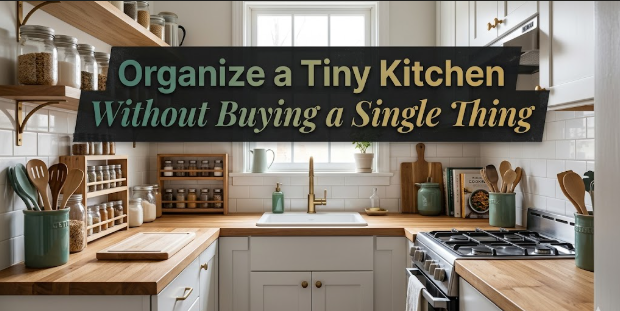
Most small-kitchen advice starts with a shopping cart.
Shelf risers. Stackable bins. A lazy susan for that corner cabinet you can never quite reach. A set of matching containers that will transform a 70-square-foot kitchen into something from a design blog. I write for Tiny Kitchen Living because small spaces deserve real solutions, and I’ve spent 24 years as a certified kitchen designer watching people try to buy their way out of problems that were never really about products. Some of those products genuinely help. But they’re often the third or fourth step, not the first.
What took me longer than it should have to say plainly: the majority of tiny kitchen problems are not solved by adding things. They’re solved by moving things. By looking honestly at what’s already there and changing how it’s used. You can do most of that work today, for nothing, and the result will feel just as significant as anything you’d order and wait two days for.
Sometimes more significant. Because nothing was wasted getting there.
1. Start With a Full Pull-Out, Not a Reorganization Plan
The instinct when a kitchen feels disorganized is to open a cabinet, look at the chaos, and start shuffling things around. Don’t do that. You’ll rearrange the problem rather than solve it.
Pick one cabinet. Pull everything out completely. Put it all on the counter or table. Every single item. Then stand there and actually look at the empty interior.
This is the step most people skip, and it changes everything about what comes next. When the cabinet is empty, you see its real dimensions for the first time. The depth that seemed unusable. The vertical gap between the fixed shelf and the cabinet ceiling. The width you’ve been underestimating because items were always stacked against the walls. I’ve done kitchen consultations where the homeowner has lived in the space for three years and has genuinely never seen their cabinet empty. The geometry is different in person than it is in your head, and that difference matters.
Now look at what’s on the table. You’ll find duplicates. Forgotten items. Expired things and packaging without contents and three items you bought replacements for because the originals were buried so far back you couldn’t find them. In almost every small kitchen I’ve worked with, the pull-out reveals that about 20 to 30 percent of what’s inside doesn’t need to return.
That’s your new storage space. No purchase required.
Do this one cabinet at a time, not all at once. One cabinet gives you a clear surface to work from, and it keeps the whole thing from becoming the kind of all-day project that gets abandoned at 2 p.m. with everything still on the floor.
2. Reorganize by Frequency, Not by Category
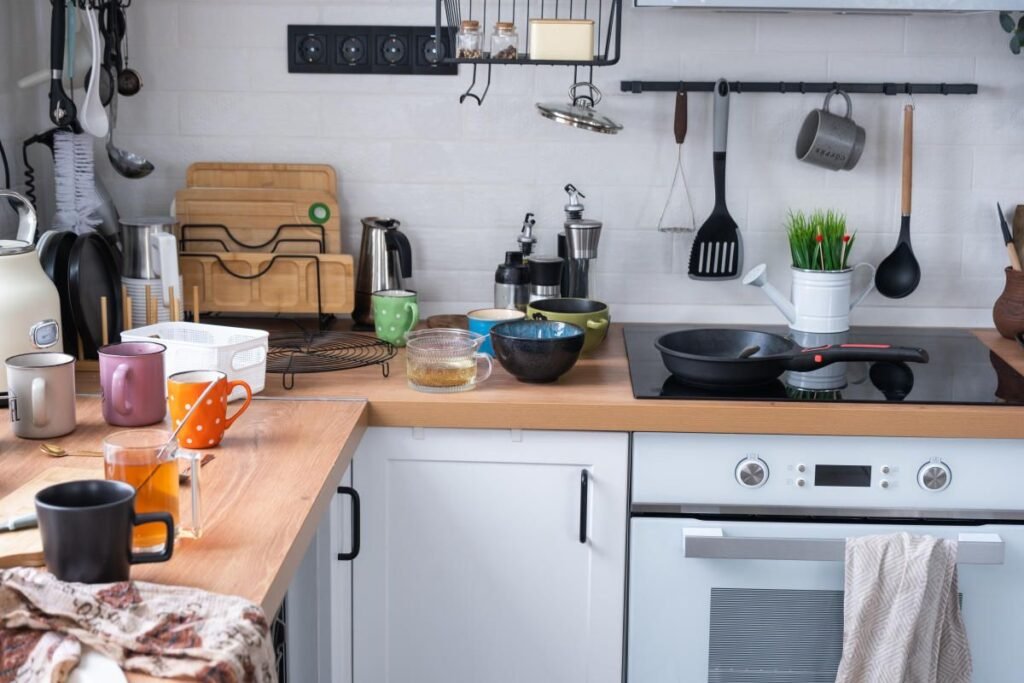
Most people fill cabinets back up the same way every time: like with like. All the baking supplies together, all the pantry staples together, all the spices in one place. This is tidy. It is also largely inefficient in a small kitchen.
Category-based organization assumes you have enough room to dedicate full zones to single purposes. Large kitchens can do that. A kitchen with three or four cabinet runs and a pantry can do that. A galley kitchen with eight linear feet of storage cannot, because every inch already does multiple jobs. When you organize by category, your daily-use items end up sharing shelf space with things you touch twice a year.
Organize by frequency instead.
Everything you reach for every single day belongs at eye level and within arm’s reach, in your most accessible cabinets. The one skillet you cook almost everything in, the olive oil, the salt, the wooden spoon that honestly never gets put away anyway — all of that belongs right there. Weekly items go in the next tier. Monthly or seasonal things move to the least accessible spots or out of the kitchen entirely.
No purchase. No hardware. A pure reorganization. And the daily experience of that kitchen changes in a way that feels disproportionate to how simple the shift actually was.
The habits that quietly consume counter space connect directly to this. When daily-use items have a defined, reachable home, they get returned there consistently. The counter clears itself, almost automatically, because there’s somewhere for things to go and getting them there requires no effort.
3. Reclaim Vertical Space Without Adding a Single Shelf
Standard wall cabinets are built for flexibility, not efficiency. They ship with one adjustable shelf in the middle, which creates two zones of roughly 12 inches each. Twelve inches is taller than almost everything you actually store.
Mugs are 4 inches tall. Most spice jars top out at 5 or 6 inches. Glasses might be 7 or 8. Every single one of those items sits inside a 12-inch zone with 5 to 8 inches of open air above it. Air that does absolutely nothing.
Before buying any organizer or shelf riser, check whether your shelves are already adjustable. In most wall cabinets made in the last 30 years, the shelves rest in pin-hole tracks on the interior side panels and can be repositioned without any tools at all. Move a shelf down to fit what’s actually stored on it. If your mugs are 4 inches tall, a shelf height of 5 to 6 inches gives you functional clearance, and the space above it becomes a new zone entirely.
You may not have a spare shelf panel to add, but check before assuming you don’t. Many cabinets come with an extra panel stored flat at the top of the cabinet or tucked inside a base cabinet the previous tenant never noticed. It’s there more often than you’d expect.
Spice organization is a perfect example of wasted vertical space that gets fixed by repositioning, not purchasing. Spice jars are nearly identical in height. If they’re competing for shelf space with tall vinegar bottles and a stack of takeout containers, they disappear into the back. Repositioning one shelf to create a spice-height zone — without buying a rack, without drilling anything — changes how quickly you can find and reach what you need in a way you feel every single time you cook.
For older kitchens with shelves that genuinely can’t be moved, the vertical-space fix looks different but still works. Group items by height on each shelf. Short items together, taller items together. You’re not creating new space, but you’re reducing the visual chaos enough that the cabinet functions better, and you stop reaching past items to find the thing hiding behind them.
4. The Drawer Audit Almost Nobody Does
Drawers are where kitchen organization quietly gives up.
I’ve seen this so many times. A client reorganizes every cabinet carefully, and there’s still one junk drawer absorbing everything that doesn’t have a home. Then it overflows. A second drawer starts filling the same way. Two of the kitchen’s five drawers are doing no real work, because they never got the same attention the cabinets did.
The problem is always the same three populations: things used regularly in cooking, things that drifted in from other rooms and never left, and things kept out of vague obligation. Pull each drawer completely, same approach as the cabinets. Lay everything on a flat surface. Separate it into three piles — used in cooking, rarely or never used, belongs somewhere else. That third pile typically contains rubber bands, mystery keys, expired coupons, dead pens, and takeout napkins nobody chose to throw away. Remove all of it from the kitchen.
What’s left is probably less than you expected. In a tiny kitchen, you likely don’t need four utensil drawers. You may need one genuinely organized drawer and one repurposed for something more useful, like cloth napkins, small appliance cords, or the items that need a home but don’t have a cabinet that makes sense.
Before buying drawer dividers, check whether things already in the kitchen can work temporarily. A small container from under the sink, a repurposed takeout box, a piece of cardboard cut to size. Test the zone layout first. If it holds without buying anything, it holds.
5. The Reason Most Reorganizations Don’t Last
Here’s the specific failure pattern I see most often after a small-kitchen reorganization, and it isn’t buying the wrong bins.
People do a thorough pull-out. They make good decisions. They put things back in a sensible, intentional order. Two weeks later, the kitchen is mostly back to its original state, because the system required everyone in the space to remember how it works, and one person didn’t.
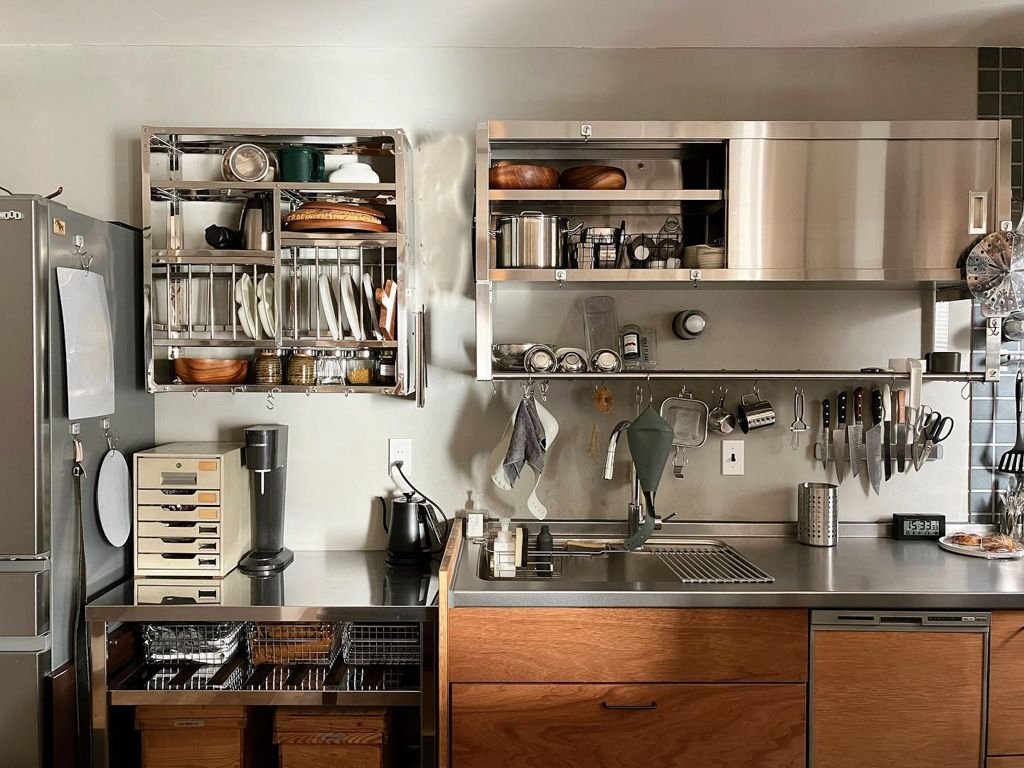
Small kitchen organization only holds when the logic is self-evident. If putting something back requires any decision-making, it won’t be put back correctly under pressure or distraction. The structure should be obvious to anyone who opens a drawer cold, without needing to be told the system. When it is, the kitchen maintains itself with almost no effort. When it isn’t, it erodes.
This is why elaborate organizational structures often fail in small spaces. The space doesn’t have room for the complexity. At Tiny Kitchen Living, the premise behind all of this is that small kitchens ask you to be deliberate — not elaborate.
Simple wins. Every time. And when in doubt, the simpler version is almost always the better one.
A comparison worth keeping:
| What Most People Do | Why It Breaks Down | What Actually Holds |
|---|---|---|
| Organize by category (all baking together, etc.) | Requires dedicated zones a tiny kitchen doesn’t have | Organize by frequency: daily items nearest, rarely-used items farthest |
| Store pot lids stacked on top of pots | Creates a demolition project every morning | Stand lids vertically in a separate zone, or hang inside a door |
| Keep everything food-related inside the kitchen | Every cubic inch goes to storage; nothing is left for function | Move seasonal and rarely-used equipment out of the kitchen entirely |
| Assume fixed shelves are permanent | Work around an obstacle that may not be real | Check for adjustable shelf pins before buying any organizer |
| Fill drawers until full, then overflow to the counter | Drawers become unusable; counter fills as a spillover | Keep one drawer for daily-use tools only, never at capacity |
FAQs
Q: I’ve reorganized my tiny kitchen twice and it always falls back to chaos within a month. What’s going wrong?
The system is probably too nuanced for daily use under real conditions. If putting an item back requires any decision-making — which shelf, which zone, which container — it won’t be put back correctly when someone is in a hurry or tired. Simplify until the right home is completely obvious without thinking. One clear purpose per zone, nothing ambiguous, nothing that requires remembering a rule someone else set up.
Q: What do I do with equipment I use occasionally but not often enough to justify prime cabinet space?
Move it out of the kitchen entirely if there’s anywhere else it can go. Under-bed storage, a shelf in a nearby closet, a rolling cart parked in a hallway. The kitchen doesn’t have to hold everything you own that relates to cooking. It just has to hold what you use regularly. Occasional equipment can come in when it’s needed and return to secondary storage when it isn’t. That swap system works better than most people expect.
Q: My kitchen has no drawers at all. Does the drawer audit apply to me?
The specific steps don’t, but the principle does. If there are no drawers, your equivalent zones are probably a utensil crock on the counter and a base cabinet that’s functioning as a catch-all. Apply the same audit to those: pull everything, sort it into piles, remove what doesn’t belong, rebuild with only what’s earned its place. If you’re working in a kitchen with no drawers at all, there’s a full breakdown of what actually works in those spaces that goes into more detail.
Q: How do I stop the kitchen from slowly reverting after I’ve reorganized it?
Photograph each organized cabinet and drawer before you close it. Not for any public purpose — just as a personal reference. If the space starts drifting back toward disorder, the photo shows you what the target state actually was. It’s a small habit that works better than it has any right to.
Q: Is there any kitchen where the no-purchase approach genuinely won’t work?
Yes. A kitchen where the actual volume of items — after a full pull-out, honest editing, and removing everything that doesn’t belong — still physically exceeds what the cabinets can hold. But this is genuinely rarer than people assume. More often, the kitchen has enough capacity, it’s just being used inefficiently. Do the complete pull-out of every cabinet and drawer, remove what shouldn’t be there, and then see what’s left. If it doesn’t fit, there’s a real volume problem, and that’s when products and additional storage make sense. If it does fit — which it usually does — the space was always enough. And if you want to think about how to structure that storage before going further, the one-cabinet pantry system breakdown is a useful starting point.
The kitchen you need probably already exists behind the current configuration of it. The pull-out reveals what’s actually there. The frequency reorganization makes the space work the way it’s used. The adjustable shelves give back inches you thought were gone. None of that costs anything except a few hours and the willingness to put everything on the counter and look at it directly.
And when you’re ready to take the next step, the small kitchen storage ideas worth testing in 2026 we’ve compiled at Tiny Kitchen Living are a good place to continue from there.