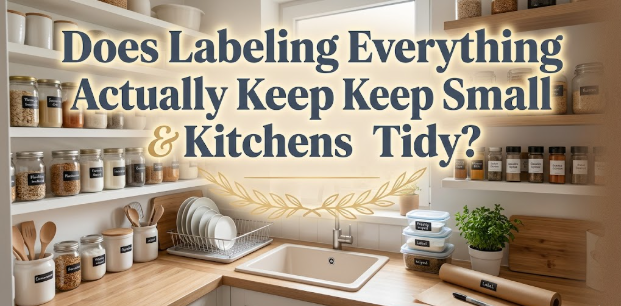
Walk through any small-kitchen account online right now and you’ll see some version of the same setup: glass jars in a perfect row, every one wearing the same handwriting-style label. I started noticing this pattern with clients around five years ago, right when the labeling trend really took hold, and I kept running into the same assumption from people who’d done it. They believed the label was what created the order. In a one-bedroom apartment kitchen I worked on last year, the owner had labeled every single jar in her pantry and was still losing track of what she actually had, because the shelves underneath the labels hadn’t changed at all.
That’s really the question worth asking before anyone buys a label maker. Does labeling change how a kitchen functions, or does it just make disorganization look tidier for a few weeks?
1. The Trend Got Bigger Than the Problem It Solves
Labeling exploded alongside the broader pantry-makeover content boom, and somewhere in there it got tangled up with organizing itself, as if they were the same task. They’re not. Organizing is about deciding where things live based on how often you use them and how much room you actually have. Labeling is just a notation system on top of that decision. If the decision underneath is wrong, a label doesn’t fix it. It just documents the mistake more clearly.
I’ve sat in enough client kitchens to see this play out the same way each time. Someone relabels a cabinet that was never going to work as pantry storage in the first place, because the corner is too deep to reach into, or the shelf is too narrow for anything but spice jars. The label looks great in a photo. Three weeks later nothing is where the label says it should be, because the storage spot fought against the habit the whole time.
2. Where Labels Genuinely Earn Their Keep
This isn’t an argument against labeling, and it’s one of the more common questions that comes up through Tiny Kitchen Living consultations. Used in the right spots, labels solve a real problem, and I’d never tell a client to skip them entirely.
They matter most when the contents aren’t visually obvious. Baking soda and baking powder look nearly identical in a clear jar, and so do several flours once they’re decanted. A label removes the guessing, especially for someone who didn’t do the original decanting. Shared kitchens benefit the same way. A roommate or partner who wasn’t there for the sorting needs the same shortcut you already carry in your head. And anything used rarely, like a spice you reach for twice a year, is worth labeling because you genuinely will forget what it is by the time you need it again. If you’re sorting out your own spice setup, How to Organize Spices Without a Spice Rack gets into which ones actually need a tag and which don’t.
Here’s where people usually go wrong with this part: they label for clarity, then immediately undermine it by relabeling constantly. Brands change packaging, you switch from store-brand rice to a different one, and the new bag doesn’t match the old label. Once updating the label becomes its own recurring task, the system has started working against you instead of for you.
3. Where Labels Just Add Noise
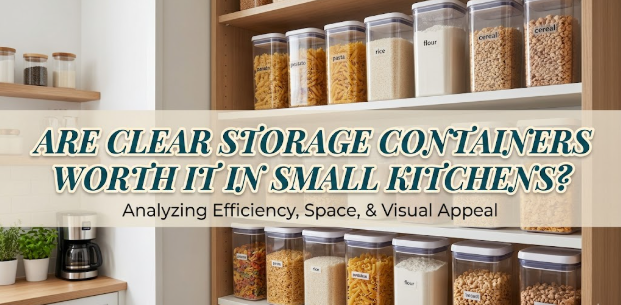
A clear jar with rice in it doesn’t need a label that says rice. You can see the rice. That sounds obvious written out, but it’s one of the most common things I find myself removing during a redesign, stacks of labels on containers where the contents were never in question to begin with.
Most of this comes down to aesthetics rather than function, and there’s nothing wrong with wanting a kitchen to look a certain way. But it’s worth being honest about which goal you’re actually solving for. A single-person household with stable habits and a predictable grocery list usually doesn’t need much labeling at all, because the person doing the cooking already knows where everything is. The labels in that case are decoration, not a system. And decoration is fine, as long as you’re not paying for it in maintenance time later.
4. The Storage Decision Underneath Still Does the Work
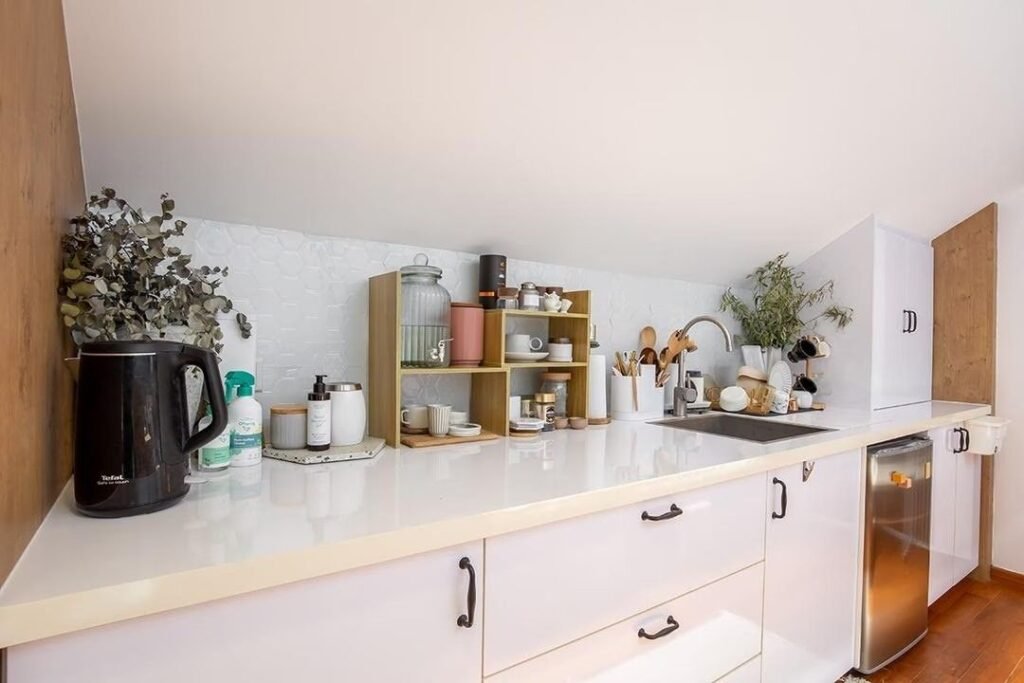
If I had to rank what actually keeps a small kitchen functional, placement and frequency of use sit well above labeling. Things you reach for daily belong somewhere you don’t have to think about, ideally at eye level or in the first few inches of a drawer. Things you reach for once a month can live in the back corner, label or no label, because you’re not fighting muscle memory to get to them.
This is the part of the conversation that gets skipped in a lot of small-kitchen advice, because a labeled pantry photographs better than a discussion about drawer depth and shelf height. If your storage is already fighting you, no amount of labeling fixes that. Shelf Risers vs Drawer Organizers: Which Helps More is a better starting point than a label maker if your cabinets feel chaotic no matter what you try. And if you’re working with bulk goods or a deep pantry cabinet, One Cabinet Pantry System: How to Build It walks through the layout decisions that matter before a single label gets applied.
I keep coming back to this idea on Tiny Kitchen Living because it shows up in nearly every consultation I do. People ask how to organize before they’ve decided what actually goes where, and the labeling question almost always arrives before the storage question, when it should really arrive after.
5. A Short Test Before You Reach for the Label Maker
Before labeling anything new, I have clients run through a short check. It’s not complicated, but it catches most of the wasted effort I see.
| Ask yourself | If yes | If no |
|---|---|---|
| Can you tell what’s in this container without opening it? | Skip the label | Label it |
| Will more than one person in the household use this item? | Label it | Optional |
| Do you use this item less than once a month? | Label it | Skip the label |
| Does the packaging or contents change often? | Use a removable label, not permanent | Either works |
| Is the real issue where this item is stored, not what it’s called? | Fix the storage first | Label away |
That last row is the one most people skip past, and it’s usually the most important one on the list.
If you want a wider look at how this fits into the rest of a small kitchen’s layout, Small Kitchen Storage Ideas Worth Testing in 2026 covers a handful of changes worth trying before investing in a full labeling system.
My own kitchen has maybe six labels in it total, mostly on bulk bins where the brand on the bag wouldn’t survive the move into a jar. Everything else, I just know where it lives, because the spot makes sense for how I actually cook. That’s the version of “organized” I want every Tiny Kitchen Living reader to walk away with: not a kitchen that looks finished in photos, but one that still makes sense to use after the label gun goes back in the drawer.
Frequently Asked Questions
Do I need an actual label maker, or will tape and a marker get the job done? Tape and a marker work fine for almost everyone. A label maker is worth it mainly if you’re labeling dozens of items at once or want a more uniform look, but it doesn’t change how well the system functions.
What’s the one item people overlabel the most? Clear glass jars with whole grains or pasta, almost every time. The contents are already visible, so the label is usually solving a visual preference rather than an actual identification problem.
Should I label the inside of cabinet doors, not just containers? That’s worth doing if multiple people share the kitchen and zones aren’t obvious yet, like which shelf holds baking supplies versus everyday dishes. Once everyone’s used to the layout for a few weeks, those door labels usually come down.
How often will I need to update labels once they’re up? For anything tied to a specific brand or package, expect to touch them up a few times a year as products change. For generic categories like rice or sugar, almost never.
Is there a cheaper option than the matching glass jar look that still keeps things organized? Yes. Repurposed jars with a plain sticker label do exactly the same job functionally. The matching aesthetic is a style choice, not a requirement for the system to work.