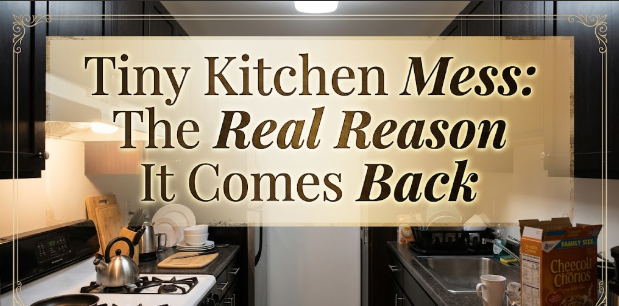
The most consistent thing I heard from clients in the years before I started writing about small-space design was this: “I finally got it organized. I just have to keep it that way now.”
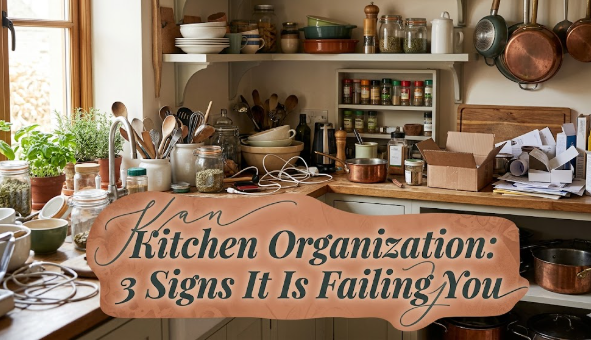
And then a few weeks later, same story. Counter piled up. Drawer won’t close. That vague, defeated feeling that the kitchen has gotten away from them again.
Not because they stopped caring. They hadn’t. The kitchen reverted because the root cause was never touched. What got fixed was the surface. The mess came back because the system underneath it was still broken.
1. The Belief That’s Keeping You Stuck
Almost everyone treats a messy small kitchen as a personal failing. They cleaned it, it got messy, therefore they are the kind of person who can’t maintain an organized space. That’s the story.
But a kitchen doesn’t stay clean because the person inside it is disciplined enough. It stays clean because every item in it has a place that’s easy to access, easy to return to, and genuinely makes sense for how that person actually lives.
When those places don’t exist, or when they exist but are too inconvenient to use consistently, things pile up. That’s not a character flaw. That’s friction.
In a small kitchen, the margin for error is almost nonexistent. There’s less counter space, fewer cabinets, less room to absorb the daily chaos of cooking and shopping and living. A storage system that barely works in a larger kitchen completely falls apart in a studio. The mess that shows up two weeks after a thorough cleaning isn’t a relapse. It’s the system telling you something specific.
2. What Small Kitchens Actually Train You to Do
I’ve spent a long time watching how people move through kitchens, and this is what small ones do consistently: they train you to put things down rather than put them away.
Here’s how it works. A cabinet is overstuffed. Opening it takes effort, a lid falls, something shifts, you spend thirty seconds reorganizing just to pull out one pan. Your brain registers that. Next time, you leave the pan on the counter instead. Not laziness. Risk management.
A drawer sticks, or it’s packed so full that nothing inside is findable, so you stop relying on it. Things migrate to surfaces. One thing becomes five things.
Every time putting something away costs more effort than leaving it out, the brain makes a quiet choice to leave it out. That happens dozens of times a day in a small kitchen, and it happens faster than you notice. By the end of the week, the counter is full again.
This is what I mean by friction. It’s the actual enemy, and it’s invisible until you know to look for it. Over at Tiny Kitchen Living I’ve covered the specific habits that quietly destroy counter space and most readers recognize themselves in at least three of them immediately. The recognition is useful. Those habits are rational responses to a kitchen that was never set up to support them.
3. The Three Patterns That Make Mess Permanent
There’s rarely one thing. In nearly every small kitchen I’ve analyzed, the same three patterns show up, and they reinforce each other.
The undesignated landing zone. Every kitchen needs a place for in-transition items. A spatula between uses. A measuring cup before it gets rinsed. A grocery bag that just came in. When that space doesn’t exist on purpose, the entire counter becomes the landing zone. And “temporary” in a small kitchen becomes permanent very fast.
This one is solvable with almost no money and no reorganization. One small tray, one cleared section, one designated spot where in-use items are allowed to live. Not “keep the counter clean” but “these things go here and nothing else does.” The brain needs something concrete to work with.
Floating items. These cause more mess per item than almost anything else. A spare bag that doesn’t belong anywhere. A gadget that was a gift and has no established home. A pot lid that fits two different pots. These items migrate from surface to surface because there’s no correct place for them, and they haven’t been dealt with yet.
A floating item is a clutter anchor. Other things accumulate around it. One floating item becomes a pile.
Re-entry failure. This one surprises people when I name it. Things come into the kitchen from outside: mail that got set down, a phone charger, a laptop that came in during cooking. When those things don’t return to their original home, the kitchen absorbs them. And now the space is smaller than it was before.
Here’s a plain comparison of what holds versus what doesn’t:
| Kitchen Setup | What Happens Over Time |
|---|---|
| Every item has a specific, accessible home | Surfaces reset quickly; cleaning takes minutes |
| Storage is full with no spare capacity | New items pile up because there’s nowhere to put them |
| No intentional landing zone | The whole counter becomes a temporary zone |
| Floating items without a home | Other clutter clusters around them |
| Putting things away is hard or inconvenient | Things stay out; cycle repeats regardless of effort |
Not one row in that table is a willpower problem. Every single one is a design problem.
4. What Actually Breaks the Cycle
Another round of decluttering isn’t the answer. Or it’s not the complete answer. What breaks the cycle is removing the friction that makes leaving things out easier than putting them away.
Start with the one cabinet or drawer you avoid most. Not the most cluttered one. The one you avoid. Ask why. Is it hard to reach? Overfull? Does it hold things you use every day right next to things you’ve used twice since 2022? Those are specific, solvable problems.
Clear it by half. Put what you reach for regularly at the front or at eye level. Make it so effortless to put things back that you do it automatically, the way you turn off a light when you leave a room. That’s what you’re going for.
Then watch where things pile up. The pile near the sink. The thing that keeps ending up on the edge of the counter. Those spots are symptoms. They’re telling you either that the item has no real home, or that its home is too inconvenient to use. Neither of those is a personal failing.
The counter clearing strategies I’ve tested across different small kitchen layouts all land on the same finding: you don’t clear a counter by removing things from it. You clear it by making the alternative to the counter genuinely easier. That’s a different problem to solve.
One thing I’d suggest to anyone frustrated by a kitchen that keeps reverting: spend a week just watching. Don’t fix anything yet. Notice where things land, which storage you avoid, which items float. After seven days, you have a real map of the friction points. That map will tell you more than any organizational system or bin set can.
And if storage capacity is the genuine limiting factor, which it often is in studio apartments, the storage ideas I tested through 2026 include options that are actually sized for tiny spaces, not just marketed as such. The difference matters more than people realize.
The kitchen isn’t going to stay perfectly clear. That’s not a realistic goal for someone who cooks regularly in a small space, and honestly, anyone who says otherwise has either never lived in one or they’ve made peace with cooking very little. The real goal is a kitchen where the average day doesn’t leave behind chaos. Where a reset takes five minutes. Where you don’t dread the space.
That’s achievable. But it comes from fixing what was never working, not from deciding to try harder against a system that was broken to begin with. The tiny kitchen problems that most people dismiss tend to have the same root as the mess problem: the kitchen was set up for a different kind of space, and nobody ever adjusted it.
Fix the system. The discipline part gets much, much easier after that.
FAQs
Why does my kitchen get messy again just days after I cleaned it? Cleaning addressed the result, not the cause. If nothing changed about where things live or how easy it is to put them back, the same friction points will recreate the same mess on the same timeline. Fast reversion is actually useful data. It tells you the system has a specific high-friction point, not that you lack follow-through.
Is there one area in a small kitchen that causes the most mess? Almost always the counter directly adjacent to the sink or stove. These are the highest-traffic zones, so anything without a clear home drifts there first. If those two spots are consistently messy, look at what’s landing there. Either it has no home, or the home it has is inconvenient enough that you’ve stopped using it.
Does having less stuff actually solve the problem for good? Partially. Decluttering creates room, and room reduces friction, and lower friction makes putting things away easier. But if the storage system itself is awkward, disorganized, or poorly matched to what you actually cook, less stuff alone won’t hold. You need both: fewer items and a better system for the ones that remain.
What’s the single highest-impact change in a tiny kitchen? Designating an intentional landing zone. One tray, one cleared section of counter, one bowl near the sink where in-use and in-transition items are allowed to live. When that exists, the rest of the counter has a fighting chance because the brain has somewhere specific to direct things instead of defaulting to “anywhere.”
Why do items without a home cause so much more mess than the things I use every day? Because items you use daily have a home they return to. Items without a home stay out because there’s no obvious place they belong, and things naturally accumulate around them. One floating item becomes a pile anchor faster than almost anything else in a small kitchen. Deal with them first and you’ll notice an immediate difference.
For more on how storage decisions shape the daily experience of a small kitchen, the full archive at Tiny Kitchen Living covers most of what comes up in this space, organized by topic.