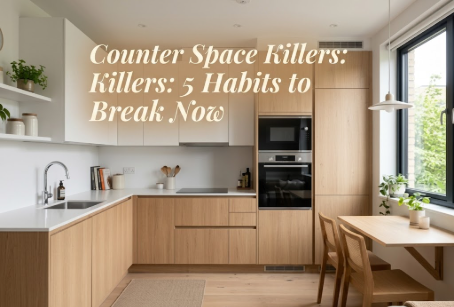
The sentence I hear most often when I sit down with someone for a small kitchen consultation is some version of “we just need more counter space.” After 24 years of kitchen and bath design, I can usually tell within the first five minutes whether that’s actually true. Most of the time, it isn’t.
The counter space exists. The habits are eating it.
What happens in nearly every small kitchen I walk into is this: people accumulate a set of routines that quietly consume their workspace, and because those routines happened gradually, nobody noticed them becoming a problem. The air fryer appeared. Then the knife block. Then the mail that was “just temporary.” Then the drying rack that was supposed to be away when it wasn’t in use. And now the counter is gone, not because the kitchen is too small, but because a handful of specific habits colonized it.
Here at Tiny Kitchen Living, the whole point is finding what actually moves the needle in a tight kitchen. These five habits are where I’d start.
1. Treating Appliances Like Permanent Residents
The coffee maker earns its spot. Probably the toaster too, if you’re using it every morning without exception. But the air fryer that comes out on Fridays? The stand mixer that makes three appearances a year, at holidays and birthdays, because it’s “too heavy to move”? Those are not residents. They’re taking up counter real estate that your cutting board and prep work need.
The thinking error that drives this habit is that people confuse how much they value an appliance with how often they actually reach for it. A stand mixer is genuinely wonderful. It’s also 18 inches wide and 14 inches tall, and the average household uses it maybe twice a month. Giving it permanent counter space for those two sessions means the other 28 or 29 days your workspace is smaller than it has to be.
The rule I give everyone starting a small kitchen refresh: if an appliance doesn’t get touched at least three times a week, it does not get counter real estate. The air fryer goes in the lower cabinet. The slow cooker goes on the accessible pantry shelf. They come out when they’re needed and go back when they’re done, same as every other tool in the kitchen.
And the stand mixer question. I know. It’s heavy. Moving it feels like a commitment. But a pull-out shelf at counter height inside a base cabinet, or a shelf in the lower portion of a pantry column, solves this almost entirely. The mixer comes forward to the edge, you use it, you push it back. That’s 40 seconds of effort in exchange for 18 inches of unobstructed prep surface the rest of the time. Worth it, without question.
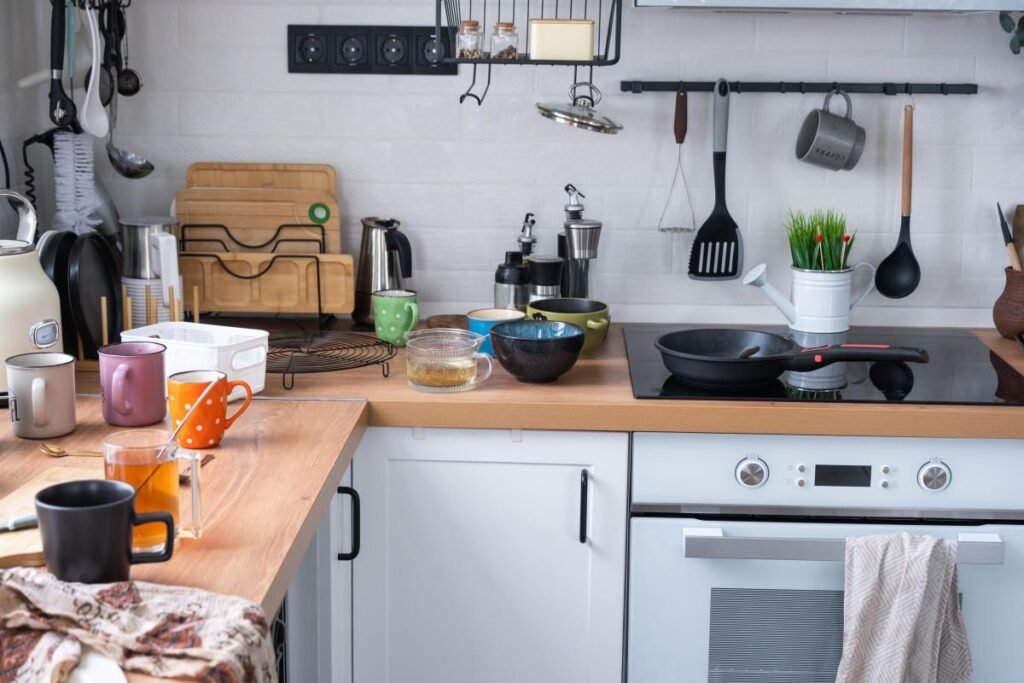
2. Letting the Counter Become the House’s Default Filing System
The keys. The mail. The sunglasses. The phone charger that migrated from the bedroom. The vitamins that were supposed to be temporary, placed on the counter three months ago on a Tuesday, and somehow never made it back to the bathroom cabinet.
I call this horizontal drift, and it shows up in every small kitchen I’ve ever consulted on, regardless of layout, income level, or how recently the space was organized. Counters are flat, convenient, and close to the door, which makes them the natural landing strip for everything a household accumulates through the day. In a large kitchen, this is manageable. In a small one, it’s the difference between a workspace and a surface you eat standing next to.
This habit doesn’t have a product solution. It has a system solution. Mail needs a home that is not the counter, whether that’s a wall-mounted slot near the entryway, a small basket on a nearby shelf, or a dedicated drawer. Keys go on a hook. The charger goes in a drawer. If you’ve tried creating these alternate homes before and the counter keeps filling back up, the problem is almost always convenience. The counter wins because it requires zero effort. The redirect needs to be just as easy, or the drift resumes within a week.
What I tell clients is to treat the counter the way they treat a cutting board mid-prep. You wouldn’t set a stack of mail on your cutting board while you were working. The counter is a workspace. Once that framing sticks, the accumulation becomes harder to ignore.
3. Buying Tools That Were Designed for a Bigger Kitchen
This is often a good-intentions problem, not a carelessness one. The beautiful 18-inch slab cutting board that photographed so well online. The knife block holding 12 slots when you actively use three knives. The over-door pot rack sized for a farmhouse kitchen with eight-foot ceilings. These things look right in the right space, and they quietly absorb square footage in the wrong one.
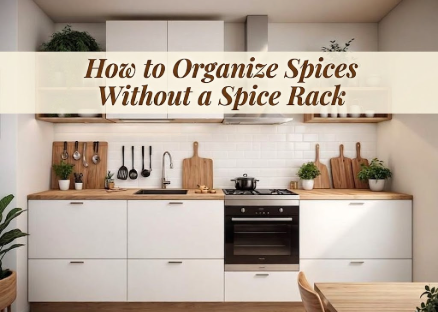
Counter tools should scale with the kitchen. A 12-by-9-inch cutting board handles 90 percent of home prep tasks and uses a fraction of the surface a larger board claims. A wall-mounted magnetic knife strip clears the knife block entirely and makes knives faster to access, not slower. For anyone also sorting out the spice situation alongside their prep zone, the strategies overlap more than people expect, and we’ve covered both in detail in how to organize spices without a spice rack.
The permanent dishing rack is the single biggest space offender in this category by a significant margin. A standard drying rack takes 18 to 24 inches of counter, which in a small kitchen can represent half of one entire counter run. People leave it out because it’s in daily use. That logic makes sense on the surface, but it doesn’t account for what that permanence is costing the rest of the workspace.
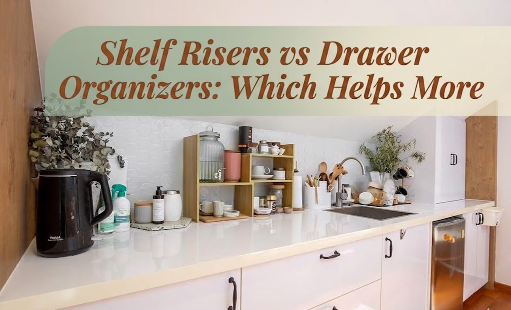
Two options that actually hold up in practice: a collapsible rack that folds flat and goes under the sink between uses, or an over-sink rack that moves the drying zone above the basin and out of the counter equation entirely. The over-sink option sounds simple and it is, mostly, but the execution details matter. I looked at exactly how these hold up in real small-kitchen conditions in whether over-the-sink shelving is actually worth buying if you want to go deeper on that choice before committing to one.
4. Using the Counter as Overflow Storage When the Cabinets Don’t Work
This is the habit underneath the other habits. It’s also the one people rarely identify clearly, because it doesn’t look like a habit. It looks like the kitchen being too small.
When the cabinets aren’t functioning well, the counter absorbs the overflow. The bread stays out because the cabinet that should hold it is too crowded to close properly. The olive oil lives on the counter because accessing the correct cabinet requires moving three other things first. The blender stopped being put away after someone reorganized the pots and the door stopped closing flush.
The counter isn’t the problem in those cases, it’s the symptom.
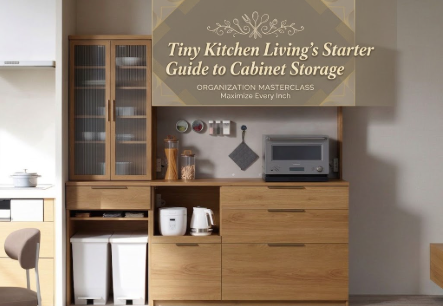
Fixing this one means going into the cabinets, not just clearing the surface. Most small kitchens I walk through are losing 20 to 30 percent of their actual cabinet capacity to dead zones: the unreachable back half of a deep shelf, the too-high top shelf in a wall cabinet where nothing quite lands correctly, the corner unit that swallows items and returns them weeks later. We went into exactly why this keeps happening in why does cabinet space run out faster than you think, and the core finding is that the cabinets aren’t actually full. They’re just inefficient.
A simple audit before buying any organizers: open every cabinet and ask two questions. Does this item have a clear, logical home in here? And can I get to it without displacing something else first? Every “no” is a dead zone, and dead zones are what’s feeding the counter overflow. Fix those, and the counter problem often resolves on its own without any further intervention.
5. Ignoring the Walls While the Counter Quietly Fills
In two-plus decades of kitchen and bath design, I have not once walked into a small kitchen where the walls were being fully used. Not once. What I consistently find instead is a backsplash with nothing mounted on it, dead air above the upper cabinets, an empty side wall beside the stove or refrigerator. And directly below all that unused vertical space, a counter buried under things that could easily live above it.
Walls in a small kitchen are a second counter. Vertical, accessible, and usually free.
A magnetic knife strip mounted on the tile backsplash removes the knife block from the counter in about ten minutes of installation. A mounted rail system with S-hooks takes care of utensils, small tools, and measuring cups without occupying any horizontal surface at all. A wall-mounted shelf positioned at eye level next to the stove can hold cooking oils, the three spices you grab every day, and the paper towel roll that’s currently consuming eight to ten inches of counter that it doesn’t need to.
But the objection I hear most reliably is aesthetic. People picture cluttered walls and decide they don’t want that. And they’re not wrong to want clean-looking walls. The distinction worth making is that intentional wall storage and cluttered wall storage are two entirely different things. Three hooks chosen to match the cabinet hardware, a single knife strip in a finish that coordinates with the faucet, one compact shelf at the right height: these read as considered, not desperate. The counter below them looks significantly calmer than it did before, which is the whole point.
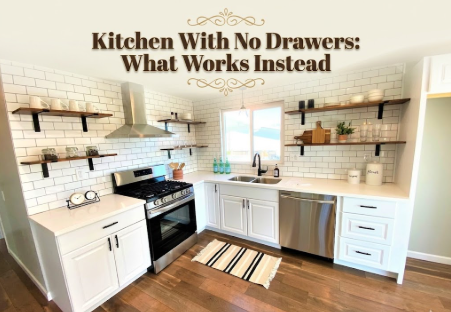
Renters who can’t drill into walls have more workable options than most people assume. Tension-mounted rails, command-strip hooks rated for kitchen weight, adhesive magnetic strips on tile backsplashes. There’s a thorough breakdown of wall-compatible solutions, including several that don’t require hardware, in what works instead of drawers in a kitchen that has none, and most of the same approaches apply directly here.
All 5 Counter Space Killers at a Glance
| Habit | What It Looks Like | The Fix |
|---|---|---|
| Appliances as permanent residents | Air fryer, stand mixer, blender living out full-time | Apply the 3x-per-week rule; anything used less often goes in storage |
| Counter as household drop zone | Mail, keys, chargers landing and staying | Intercept with hooks and baskets near the point of entry; convenience decides the habit |
| Tools scaled for a bigger kitchen | 18-inch cutting board, 12-slot knife block, permanent drying rack | Right-scale tools; magnetic knife strip; collapsible or over-sink rack |
| Counter absorbing cabinet overflow | Bread, oils, and appliances with no cabinet home | Audit the cabinets first; find and fix dead zones before clearing the counter |
| Empty walls while the counter fills | Bare backsplash, unused side walls beside stove or fridge | Mounted rail, magnetic strip, and one well-placed shelf handle most daily-use items |
The Habit Loop Most People Miss
Counter space isn’t something you recover once and keep forever. It’s something you maintain by making the right behavior easier than the wrong one.
The appliances go back into storage after each use. The mail has an interception point before it reaches the counter. The knives live on the wall and come down when they’re needed. The drying rack folds and goes away. None of these are significant changes, they’re just consistent ones, and consistency is the part that actually matters here.
At Tiny Kitchen Living, I keep coming back to this category of small-kitchen fix because it genuinely requires no renovation, no significant budget, and no special tools. Just a clear-eyed look at where the habits formed and a slightly different default to replace them. These five are a useful starting point for most kitchens. Fix even three of them and the counter usually looks like a different space.
FAQs
Which of these habits is worth addressing first if I only have an afternoon?
The appliance habit, by a clear margin. Clear anything you don’t touch at least three times a week off the counter and find it a cabinet home. This recovers more surface faster than any other single change, often 12 to 18 inches or more, and it costs nothing. The rest can be addressed in phases.
I’ve cleared my counter before and it’s always full again within ten days. What am I missing?
Almost certainly the cabinets. When storage elsewhere isn’t functioning well, the counter absorbs the overflow without anyone quite deciding to put things there. Before your next clear-out, read through why does cabinet space run out faster than you think and address any dead zones first. Clearing the counter without fixing the underlying storage is a cycle, not a solution.
Can a renter realistically use wall space without drilling?
Yes, more than most people expect. Command hooks rated for kitchen use, tension-mounted rails, and adhesive-backed magnetic strips handle lighter items on tile and many wall finishes without any hardware. You’ll have some weight limits, but the range of what works without drilling is broader than most renters are told when they sign a lease.
Does switching to a collapsible drying rack actually hold up to daily use?
For most households, yes. The models worth buying have steel or stainless frames rather than plastic hinges, and those hold up to daily folding and unfolding for years without issue. The critical step before purchasing is confirming the collapsed dimensions actually fit your cabinet, because the variation between models is larger than product photos usually suggest.
How do I keep the drop zone habit from coming back after I’ve broken it?
The counter wins by default because it requires zero effort. To break the cycle permanently, the alternative needs to be just as convenient. A key hook positioned right beside the door, not across the room, will catch the keys every time. A mail slot within arm’s reach of where you walk in stops the drift before it lands. When the redirect is genuinely easy, the habit changes without requiring discipline to maintain it.
The full archive at Tiny Kitchen Living covers the specific, practical side of small kitchen living that most general design advice skips: storage without renovation, organization that stays organized, and cooking in spaces that weren’t designed to be cooked in. A good place to keep exploring.