Early in my career I talked a client into buying three sets of wire shelf risers for her cabinets when what she actually needed was a drawer divider system for two deep drawers under her counter. I was thinking vertically because that’s how most small-kitchen advice is written, and it cost her about sixty dollars and a wasted Saturday before we figured out the real problem. That mistake taught me something I still use on every tiny-kitchen consult: the question isn’t “risers or organizers,” it’s “where is your specific clutter actually living.”
That’s the question this whole article is really about.
- What Shelf Risers Are Actually Solving
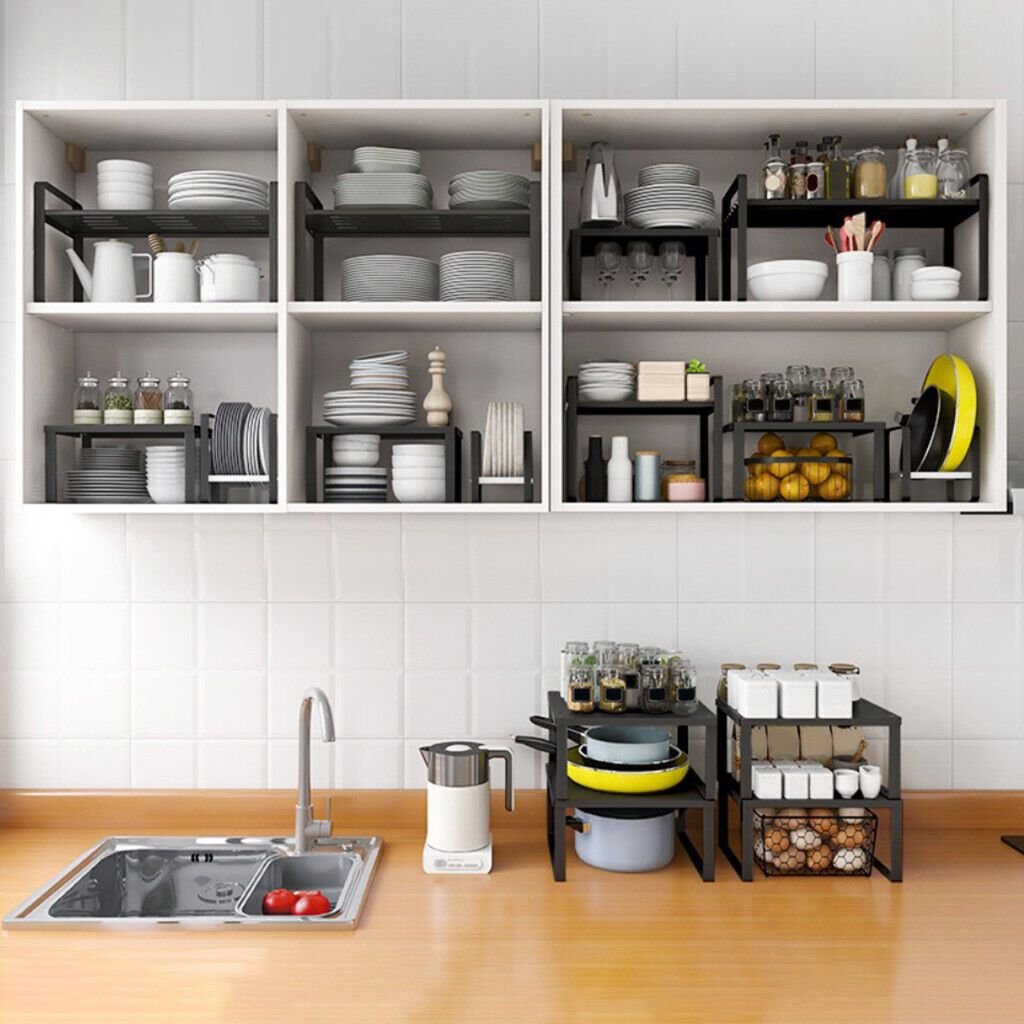
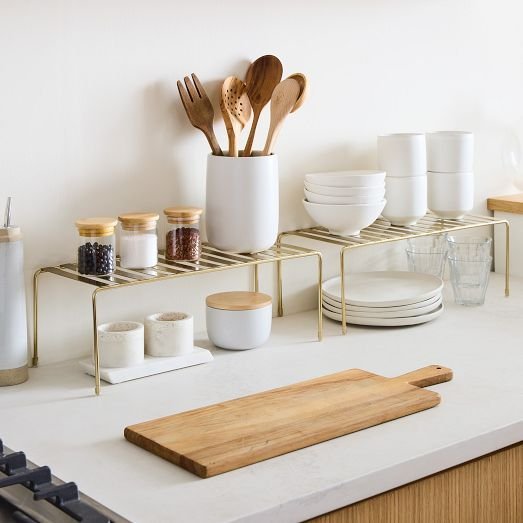
Shelf risers exist because cabinet shelves waste vertical air. A standard 30-inch upper cabinet has somewhere between 9 and 12 inches of dead space above your plates or canned goods, and a riser turns that dead space into a second usable shelf. They’re the right tool when your problem is stacking, not sorting. If you’ve got mismatched mugs stacked four high and constantly toppling, or a shelf of canned tomatoes where you can never see what’s behind the front row, a riser fixes that immediately.
What risers don’t do is help you find things. They add a layer, but they don’t separate categories the way a drawer system does. I’ve seen plenty of tiny kitchens at Tiny Kitchen Living readers send in where someone bought risers expecting them to solve a “I can’t find my spices” problem, and the spices were still a jumbled mess, just now on two shelves instead of one.
- What Drawer Organizers Are Actually Solving
Drawer organizers solve a completely different problem: chaos within a single space. A junk drawer isn’t messy because it lacks height, it’s messy because a spatula, three rubber bands, a flashlight, and your takeout menus are all touching each other with no boundaries. Organizers, whether they’re expandable bamboo trays or custom-cut foam inserts, create those boundaries.
This matters more in tiny kitchens than in large ones, and here’s the part people miss. In a large kitchen, you can dedicate an entire drawer to spatulas and another to whisks. In a 60-square-foot galley kitchen you might have exactly two drawers total, so every inch inside them has to multitask. A good organizer lets one drawer hold five categories of small tools without them becoming a single pile the second you slide it open.
- Where People Usually Get This Decision Wrong
The mistake I see constantly, and the one I made myself, is treating this as a binary choice when it’s really a mapping exercise. People walk into a kitchen store, see a riser on sale, and buy it because it photographed well in a magazine. Then they get home and realize their actual clutter problem was never on a shelf to begin with, it was in a drawer the whole time.
The fix is simple but takes ten honest minutes. Open every cabinet and drawer in your kitchen and ask, for each one, “is this space wasted vertically, or is it crowded horizontally.” Wasted vertical space wants a riser. Crowded horizontal space wants dividers. Most small kitchens have both problems in different spots, which is why the “which one is better” framing is a little bit of a trap. It’s rarely an either-or.
- Side-by-Side: When Each One Actually Wins
SituationBetter ToolWhyPlates or mugs stacked too high to grab safelyShelf riserAdds a usable second tier without new cabinetsJunk drawer with mixed small itemsDrawer organizerCreates boundaries between categoriesCanned goods you can’t see behind the front rowShelf riser (or a tiered can rack)Brings the back row into viewUtensil drawer with everything sliding togetherDrawer organizerKeeps tools from migrating and tanglingSpice cabinet shelf with dead air above the jarsShelf riserDoubles shelf capacity for short jarsDeep drawer storing pots, lids, and pansDrawer organizer (divider style)Stops nesting and lid-hunting
- A Few Things Worth Knowing Before You Buy
Buy risers with adjustable feet if your cabinet shelves aren’t perfectly level, which in older apartments they often aren’t. A riser with fixed legs on an uneven shelf will rock every time you reach for something, and that’s how plates end up broken.
For drawer organizers, measure the drawer’s actual interior depth before ordering anything, not just the width. A lot of studio apartment drawers are shallower than people expect, and an organizer that’s even half an inch too tall will keep the drawer from closing flush. I’d also gently push back on buying a single rigid tray for an oddly shaped drawer. Expandable or modular dividers cost a little more but they adapt if you move apartments, which, if you’re living in a tiny kitchen, you probably will at some point.
And one habit worth building regardless of which tool you choose: reassess every six months. Tiny kitchens accumulate gadgets fast, and the organizer that fit your drawer perfectly in January can be cramped by summer.
If you’re working through a full small-kitchen reset rather than just this one decision, a few related reads worth bookmarking: why cabinet space disappears faster than you’d expect, what to do when your small kitchen doesn’t have a pantry at all, our walkthrough on organizing spices without a dedicated spice rack since that problem came up earlier in this piece, and a look at whether over-the-sink shelving is actually worth buying if you’ve still got wall space near the sink doing nothing.
Frequently Asked Questions
Can I use both shelf risers and drawer organizers in the same kitchen?
Yes, and honestly most tiny kitchens need both. They solve different problems, so using one doesn’t replace the need for the other if you have both kinds of clutter.
Do shelf risers work in cabinets with adjustable shelf pegs?
Generally yes, as long as there’s enough clearance between the riser’s top and the shelf above it. Measure that gap before buying, since some upper cabinets in older buildings have less vertical clearance than newer builds.
What’s a cheap way to test if I even need a drawer organizer?
Empty the drawer onto your counter and sort everything into rough groups before putting anything back. If the groups naturally take up distinct zones, you likely need dividers. If it’s one undifferentiated pile, a tray system will help more than a rigid divider.
Are bamboo organizers better than plastic ones?
Bamboo tends to hold up better over years and doesn’t develop the cloudy scratches plastic does, but it costs more and isn’t expandable in the way some plastic modular systems are. For a rental kitchen you might leave soon, plastic modular trays are usually the more practical pick, an idea we get into more in [our renter-friendly storage roundup].
Do I need different risers for plates versus cans?
Not strictly, but a flat riser works better for plates and bowls while a tiered, angled riser tends to work better for cans since it tilts labels toward you. If your cabinet has both, a couple of inexpensive tiered racks usually beat one universal riser trying to do everything.
If you’re trying to decide between the two for your own kitchen this week, start with the ten-minute audit in section three before you buy anything. It’ll save you the sixty dollars I cost my client all those years ago.