Almost everyone who reaches out to me through Tiny Kitchen Living starts with the same theory: the kitchen would behave if it just had better bins. More baskets, matching containers, a few shelf risers, a label maker put to good use on a Saturday afternoon. It’s a tidy theory, and I get the appeal. It turns a behavior problem into a shopping trip.
The bins do get bought. They get filled with real enthusiasm. And almost without fail, somewhere around the two week mark, half of them are empty again, or stuffed with whatever didn’t have an obvious home, or quietly relocated to the hall closet because nobody had the patience to keep sorting under time pressure. The kitchen drifts back to where it started, just with more plastic involved.
After 24 years of kitchen and bath design, most of it in spaces smaller than people would like, I’ve stopped believing storage is the actual problem here. The real issue is that most organizing systems get built around what a cabinet looks like empty, not around what a person actually does at 6 p.m. on a Tuesday when dinner needs to happen and three other things are competing for attention.
1. Why Most Organizing Systems Quietly Fall Apart by Week Two
Week two isn’t really a coincidence. That’s roughly how long a new routine can run on willpower before the original habit tries to reassert itself, and if the new system takes more steps than the mess did, the old habit wins nearly every time.
The flaw I see most often is over-categorization. A drawer gets divided into six tidy little zones: spatulas here, whisks there, peelers in their own tray. It photographs beautifully right after setup. But six categories means six decisions every time someone reaches into that drawer, and most people are reaching for it while something is actively boiling over two feet away. Nobody sorts a spatula into its correct compartment under those conditions. They drop it wherever it lands, and the system starts losing ground from day one.
Cabinet space disappears faster than most people expect in the first place, and why cabinet space runs out faster than you’d think is worth understanding before redesigning anything inside it. Once the available space and the system stacked on top of it stop matching each other, the whole thing is running on borrowed time. It just takes a couple of weeks for the mismatch to show up.
2. Build Zones Around What You Actually Do, Not What the Cabinet Suggests
Before buying anything, spend three or four days noticing where things land when you’re not thinking about it. Where does the coffee scoop end up after you use it. Where do the dish towels actually pile up, not where you’d like them to. Which cabinet door do you open on muscle memory alone, without looking. That pattern tells you more than any organizing theory does, and the system needs to work with it instead of against it.
Tools help once the pattern is clear, but the tool has to match the zone it’s solving for. A shallow drawer near the stove wants something different than a deep, awkward cabinet by the sink, and treating them the same is a quiet source of friction. I’ve gone deeper on choosing between shelf risers and drawer organizers depending on which kind of clutter you’re actually dealing with, since the wrong tool in the right spot causes nearly as much trouble as no tool at all.
Group by task, not category. Everything for making coffee belongs within arm’s reach of the machine, including the mug, even if that means the mug leaves the rest of the dishware behind. Everything for plating dinner lives near the stove, even if it breaks up a matching set someone gave you as a gift. It looks slightly less tidy in a photo. It survives an actual Tuesday.
3. The Systems That Hold Up, and Why
Not every organizing approach fails at the same rate, and not every kitchen needs the same fix. Here’s roughly how the common approaches tend to perform once the initial motivation wears off.
| System Type | Looks Like at Setup | Where It Usually Breaks Down | What Makes It Last |
|---|---|---|---|
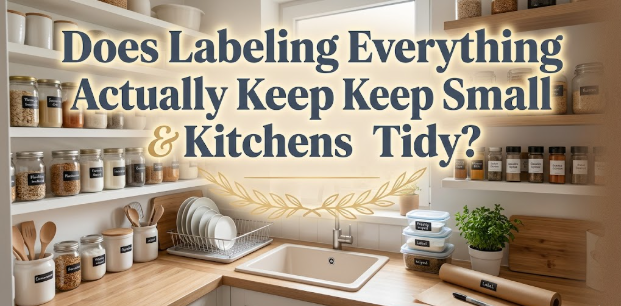
| Matching labeled bins for everything | Tidy, color coded, very photogenic | Too many categories to keep up with under time pressure | Save labels for items that genuinely get mixed up, like spices or baking supplies |
| Drawer dividers by tool type | Clean separation, satisfying to look at | Doesn’t account for which tools get used daily versus rarely | Daily tools go in the front row, everything else behind |
| Vertical risers and stackers | Makes immediate use of empty vertical space | Items toward the back become invisible and get rebought | Reserve risers for things used at least twice a week |
| One flexible catch-all spot | Looks slightly unfinished, almost too simple | Rarely breaks down, this is usually the one that survives | Works because it has no rules to maintain |
That last row tends to surprise people. A single, somewhat chaotic drawer for the things that don’t have an obvious home, the wine key, a stray collection of rubber bands, the one weird gadget nobody can categorize, often outlasts far more sophisticated systems built around it. Giving the miscellaneous stuff a home, any home, removes the exact friction point where most systems quietly fail. The mess just needed somewhere to go that wasn’t the counter.
4. Where People Usually Go Wrong
The mistake I run into constantly isn’t a lack of effort. It’s organizing for how the kitchen looks at 10 in the morning instead of how it actually gets used at 6 in the evening.
People buy containers sized for what’s on the shelf at the store, not for what needs to fit inside their own cabinet. A container that’s half an inch too tall to stack under the shelf above it gets shoved sideways within a week, and the whole row collapses into the kind of clutter the container was supposed to prevent in the first place.
Counters cause their own version of this problem, and it usually has less to do with what’s happening inside the cabinets and more to do with a handful of habits quietly claiming space day after day. If you’ve spent any time on Tiny Kitchen Living, you know I’m skeptical of treating counter clutter and cabinet disorganization as the same issue. They’re related, but the fixes are different, which is exactly why I broke down the habits that eat counter space on their own.
And one I see often enough to call out by itself: organizing every cabinet to look uniform, same containers, same spacing, same labels throughout the kitchen. It reads well in a photo and it’s almost always the wrong call in a small kitchen, where a cabinet next to the oven and a cabinet under the sink are being asked to do two completely different jobs.
5. The One Habit That Keeps a System From Sliding Back
Even a well-matched system drifts a little over time. Things get put back two inches off from where they belong, a new item joins the household without an assigned spot yet, and a month of small drift adds up to something that starts to look like the old chaos again.
The fix isn’t a bigger overhaul. It’s a five minute pass once a week, usually right before trash day in my own kitchen, where you put back the handful of things that have wandered and decide, quickly, where the one new item actually belongs. That’s the whole habit. No deep clean, no full reset, just enough maintenance to stop the drift before it turns into a redesign project.
If you’re still figuring out the rest of your setup and want more to test before committing to anything permanent, there’s a broader list of small kitchen storage ideas worth trying that I put together for Tiny Kitchen Living, several of which pair well with whatever zone system you land on here.
The kitchens that stay organized past week two are rarely the ones with the most product in them. They’re the ones where someone spent a few days actually watching how they cook before deciding where anything should live. That part never shows up in a before and after photo. It’s the part that actually holds.
Frequently Asked Questions
Do I need new containers before I fix how my kitchen is organized?
Not at first. Notice the real problem for a few days before spending anything. Most kitchens already own enough jars, trays, and containers to solve a good chunk of the issue, they’re just sitting in the wrong cabinet.
How long before a new system stops feeling like extra work?
Plan on three to four weeks of consistently putting things back in the new spot, even when it’s inconvenient. The first two weeks are the hardest because the old habit hasn’t faded yet. After that it tends to click.
Should every cabinet have a label?
No. Labels earn their place where items genuinely look alike, baking ingredients, spices, dry goods in similar containers. Labeling everything adds visual clutter and one more step that gets skipped under time pressure, which defeats the point.
What’s the biggest difference between a kitchen that stays organized and one that doesn’t?
It’s rarely the amount of storage available. It’s whether the system matches how that specific person actually cooks. The same layout can work beautifully in one household and fall apart completely in another.
Is it worth hiring someone to help organize a small kitchen?
It can speed things along, especially for spotting blind spots in how the space gets used day to day. But the core ideas here don’t require a professional to apply. They require a few honest days of observation and a willingness to make changes that don’t necessarily look impressive in a photo.