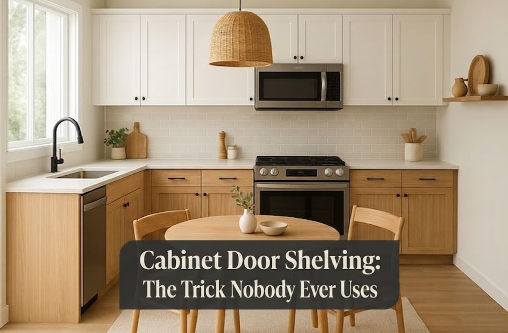
Open ten kitchen cabinets in a row and nine of them show you the same thing: a door swinging open onto a flat slab of nothing, doing absolutely no work for the kitchen behind it.
That blank space is square footage. And in a tiny kitchen, square footage you’re not using is square footage you paid for and then quietly ignored for years.
Most people who try to fix this reach for the same product: a wire basket that hooks over the top of the door. It works, sort of. But it’s not actually the best version of this idea, and almost nobody uses the version that works better. That’s what this one is about.
1. Why Cabinet Doors Are the Most Wasted Space in a Small Kitchen
Cabinet doors get treated as a barrier, not a surface. You open them, you reach past them, you close them. The interior face of that door sits there doing nothing for the entire life of the cabinet, which is a strange waste in a kitchen where every other square inch is already fighting for a job.
In a full-size kitchen, that waste is annoying. In a small one, it’s a real loss. A standard cabinet door is somewhere between 12 and 24 inches wide and runs most of the height of the box behind it, which means you’re looking at one to three square feet of completely unused vertical surface, multiplied by every cabinet in the room. I’ve measured kitchens where that adds up to more usable storage than an entire upper cabinet. It’s one of the reasons cabinet space disappears faster than people expect, even in kitchens that looked reasonably sized on the floor plan.
The wire-basket-over-the-door trick has been around for decades and it does solve part of this. But it has a structural flaw nobody talks about: it hangs off the top edge of the door, which means it adds bulk right where the door swings closest to its neighbor, and it only really works on cabinets tall enough and deep enough to swallow the extra inches without banging into the shelf behind it.
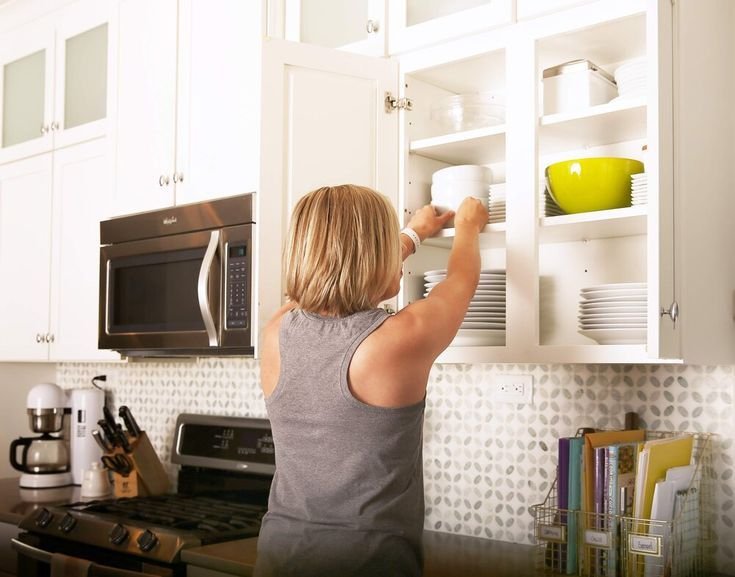
2. The Actual Trick: Low-Profile, Direct-Mounted Shelving
Here’s the version that actually solves the problem instead of half-solving it. Instead of a basket that hangs over the door, you mount slim, flat shelving units directly onto the interior face of the door panel itself, using either adhesive-backed standoff brackets or small screws into the door’s inner frame.
The difference sounds minor. It isn’t. A direct-mounted unit sits almost flush against the door, often less than an inch of total depth, instead of three or four inches hanging off the top edge. That means it clears the cabinet shelf behind it on doors where a hanging basket never would, and it can run nearly the full height of the door instead of stopping a third of the way down.
This is the part most people skip entirely, because the products marketed for “cabinet door storage” are almost always the hanging-basket style. The flush-mount racks exist, they’re just usually sold as bathroom or pantry organizers rather than kitchen cabinet hardware, so they don’t show up when someone searches for a kitchen fix. I point clients toward them constantly at Tiny Kitchen Living, and the reaction is almost always some version of “wait, that’s allowed?”
It is. You’re just attaching hardware to a door instead of a wall, which means the rules around weight and clearance matter more, not less.
3. What to Measure Before You Buy Anything
This is the step that determines whether this trick works or turns into a returned Amazon box. Measure these four things before you order anything:
Door height and width, obviously, but specifically the usable interior face, not the outer dimension. Frame-and-panel doors lose a half inch or more around the edges to the raised profile.
Clearance between the closed door and the nearest shelf or stored item directly behind it. This is the one people skip, and it’s the one that actually fails the project. Put a tape measure in there with the door shut and write the number down.
Hinge type and clearance. Overlay hinges sit mostly hidden and rarely interfere. Inset and some European cup hinges protrude further into the cabinet interior, and a rack mounted too close to that hinge cup will hit it every time the door closes. Check this one with the door open and closed, not just open.
Door material and thickness. Adhesive mounts hold fine on painted wood and most laminates. They tend to fail faster on textured or matte finishes, and on doors near a dishwasher or sink where steam and humidity get into the adhesive over time. If that’s your situation, go with a screw-mounted bracket instead, even though it’s a few more minutes of work.
| Door Situation | Best Mount Type | Watch Out For |
|---|---|---|
| Standard overlay hinge, dry location | Adhesive standoff or screw-in | Easiest case, few restrictions |
| Inset or European cup hinge | Screw-in only | Hinge cup clearance, measure with door closed |
| Near dishwasher, sink, or steam | Screw-in only | Adhesive fails faster in humid air |
| Rental, no drilling allowed | Tension rod or strong adhesive hooks | Lower weight capacity, recheck adhesion monthly |
| Thin or laminate door | Lightweight adhesive only | Screws can split thin door cores |
4. What Belongs on a Cabinet Door Shelf, and What Never Should
This is where door shelving earns its place, or doesn’t, depending on what you put on it.
It’s genuinely excellent for anything flat, light, and used often: spice jars, foil and wrap boxes, small cutting boards, cleaning sprays under the sink, pot lids that never have a real home anywhere else. If you’ve been hunting for a way to organize spices without buying a dedicated spice rack, this is one of the cleaner answers, since it uses space you’re already paying for instead of adding a new footprint to the counter or cabinet floor.
It’s a poor choice for anything heavy, tall, or breakable. Glass jars, cast iron, a stack of canned goods, anything that could shift when the door swings shut a little too fast. A door is not a wall. It moves, sometimes quickly, and gravity doesn’t care that the item balanced fine when you set it there.
A reasonable rule of thumb: if you wouldn’t want it falling on your foot, it doesn’t go on a door shelf.
5. Where This Usually Goes Wrong
The single biggest mistake is mounting the bracket before checking hinge clearance with the door fully closed. People measure with the door open, everything looks fine, and then the rack clips the hinge cup the first time the door swings shut. Always do the final check closed, not open.
The second mistake is overloading a single shelf because the first few items fit easily. Most adhesive mounts are rated for a modest amount of weight, and people keep adding “just one more thing” well past that point. Check the rating on the hardware itself, not your gut sense of how heavy it looks.
And the third, smaller but common: mounting the lowest shelf so close to the bottom of the door that it collides with whatever sits on the cabinet’s floor, a trash can, a pull-out bin, a stack of cutting boards. Leave at least an inch of clearance below the lowest shelf and check it with the door open and shut before you commit to the final position.
If your kitchen is one of the many built with no drawers at all, door shelving becomes even more valuable, since it’s recovering storage from a cabinet that might otherwise only hold a single deep, disorganized pile.
This isn’t a fix for every kitchen. A cabinet with a tight, shallow interior and an inset door might genuinely not have the clearance to support it, and no amount of clever hardware changes that. But for the majority of standard overlay cabinets sitting in small kitchens right now, doing nothing with that door is the actual waste, not the hardware needed to fix it.
The next time you swing open a cabinet and the back of that door just sits there, blank, you’ll probably look at it differently.
Frequently Asked Questions
Will this work on every cabinet door in my kitchen?
No, and that’s fine. It works best on standard overlay-hinge doors with at least three quarters of an inch of clearance behind the closed door. Inset doors and very shallow cabinets need a closer look before you buy anything.
How much weight can a door-mounted shelf actually hold?
Less than people expect, and the exact number is printed on the hardware itself, not a universal figure. Treat it as a home for light, frequently used items rather than heavy storage, and you won’t be disappointed.
Will adhesive mounts damage my cabinet finish?
On painted or laminate doors, properly applied adhesive mounts rarely cause damage if removed carefully. Matte and textured finishes are more prone to leaving a mark, so a screw-in bracket is the safer call there.
What’s better, this or shelf risers inside the cabinet?
They’re solving different problems, not competing with each other. Door shelving recovers space that was empty to begin with, while shelf risers reorganize space you already had. Most small kitchens end up using both.
Can renters do this without drilling into the cabinet?
Yes, with strong adhesive mounts or tension-style brackets rated for cabinet use. Just plan on checking the adhesion every few weeks, since rental-grade cabinet finishes vary a lot in how well they hold.
For anyone tackling a kitchen with bigger structural gaps than a missing shelf, the breakdown on what to do when a small kitchen has no pantry at all is worth reading next.