Every client I sit down with in a small kitchen remodel makes the same assumption. More cabinets. That’s the answer. If they just had two more doors, one more wall unit, maybe a tall pantry column squeezed into the corner, everything would finally fit. I’ve heard this across 24 years of kitchen and bath design, and honestly, I can finish the sentence before they do.
The problem? The assumption is almost always wrong.
What’s running out isn’t cabinet space. It’s usable cabinet space, and that distinction completely changes how you fix it. When you’re working with a studio apartment kitchen or a galley layout with eight linear feet of storage and nowhere left to expand, this matters more than most people realize.
1. The Real Problem Isn’t What You Think It Is
Standard base cabinets are 24 inches deep. This has been the industry default for decades. Most people reach in and comfortably access the first 12 to 14 inches. Everything behind that point becomes what I call the deposit zone — a place where items migrate slowly over months and years until nobody can remember putting them there.
A mixing bowl from 2020. Three takeout lids with no matching containers. A duplicate box grater.
Wall cabinets tell the same story with a different shape. The typical wall cabinet ships with one adjustable shelf in the middle, creating two zones of roughly 12 inches each. That sounds reasonable until you realize that almost nothing you actually store is 12 inches tall. Mugs are 4 inches. Spice jars are 5 inches. A rice cooker might be 8. Every item is sitting in a zone built for something taller than it is, and the gap above it — that entire column of open air — goes completely unused.
The cabinet isn’t full. The organization inside it is just fighting the geometry.
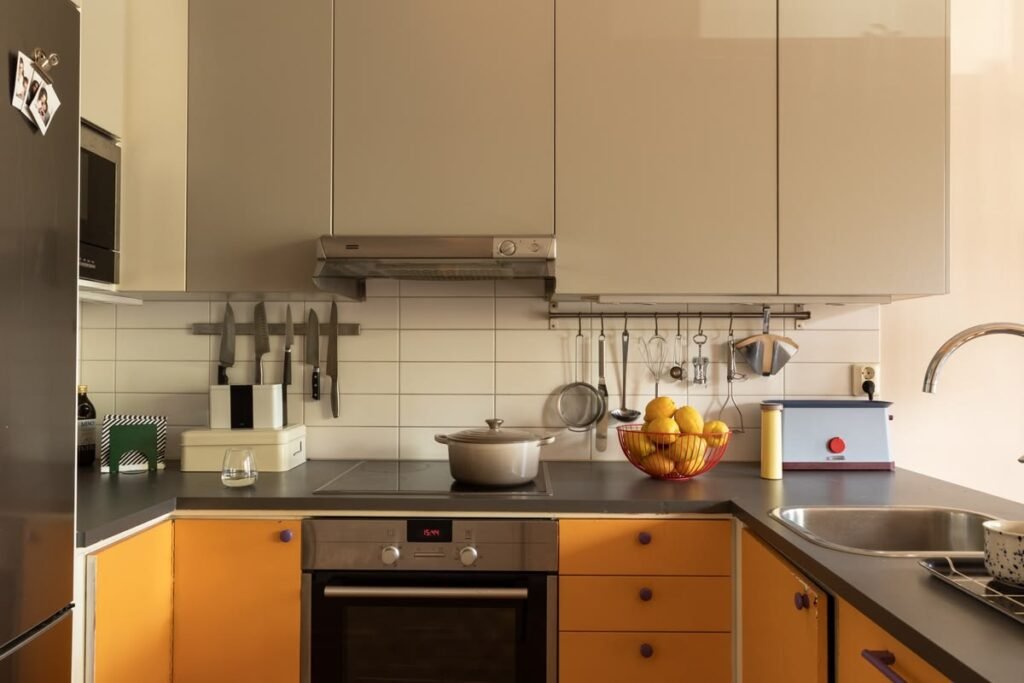
2. Where Your Cabinet Space Is Actually Going
I want to be concrete here, because “organize better” is the kind of advice that sounds helpful and accomplishes nothing.
Corner cabinets are the single biggest loss. In any L-shaped or U-shaped kitchen layout, the corner base cabinet can account for 8 to 12 square feet of floor space. And in practice, somewhere between a third and half of that space is never meaningfully accessed. Whether you have a lazy susan that rotates awkwardly around a fixed shelf post or a blind corner where pull-out hardware doesn’t extend fully, the rear section of that cabinet functions as dead storage. I’ve opened blind corner cabinets during initial consultations and pulled out items the homeowner genuinely didn’t know they had, because the originals had been pushed back, forgotten, and replaced with new purchases at the store.
Vertical space is being wasted in almost every wall cabinet. A 5-inch spice jar sitting on a 12-inch shelf is wasting 7 inches of vertical clearance above it. Multiply that across four to six wall cabinets and you’re losing what amounts to an entire extra shelf run’s worth of storage in the vertical dimension alone.
Cabinet door interiors are real estate that almost nobody uses. The inside surface of a cabinet door is a flat vertical plane. In a small kitchen, mounting a rack there for foil, parchment paper, spice packets, or cleaning supplies adds usable storage without changing a single shelf inside.
And then there’s the stacking problem, which is honestly the one I see most often. People stack the way groceries come out of a bag: pots nested inside pots, sheet pans thrown in sideways, lids balanced on top of everything. Every time you need the item at the bottom, you dismantle the whole tower. That friction discourages putting things back in place. The cabinet gets messier over time. It feels fuller than it actually is, and the cycle keeps repeating without anyone quite noticing how it started.
| Cabinet Zone | How Most People Use It | What Actually Works |
|---|---|---|
| Back half of base cabinet | Forgotten overflow | Sliding organizers or roll-out pull-outs |
| Top wall cabinet shelf | Rarely touched | Seasonal items only, labeled bins |
| Corner base cabinet | Rotating confusion or dead space | Full-access lazy susans or hinged pull-outs |
| Inside cabinet doors | Nothing | Door-mount racks for foil, wraps, spice packets |
| Under the sink | Crowded pile with no structure | Tiered risers, tension rods for spray bottles |
| Narrow cabinets under 9 inches wide | One cutting board or empty | Vertical file dividers for trays, sheet pans, lids |
3. Why Small Kitchens Break Standard Storage Logic
Most cabinet storage advice was written for kitchens with enough square footage to have dedicated zones. A baking area. A coffee station. A prep counter with its own cabinet run. You see this in design guides constantly, and in a 90 or 120 square foot kitchen it makes no practical sense.
Small kitchens don’t get zones. They get one cabinet that has to serve three purposes at once, which is exactly why storage systems designed for larger spaces so often fail the people who need them most. The logic doesn’t transfer.
What actually works in a small kitchen is what I think of as use-frequency stacking. The things you reach for every single day belong at eye level and within arm’s reach. Items you use maybe once a week go to lower shelves or to the backs of upper cabinets. Seasonal tools and rarely-used equipment get relocated entirely, whether that’s a high shelf, under-bed storage in another room, or a rolling utility cart parked in a nearby hallway.
This isn’t minimalism. It’s access design. When the things you need most are the things you can reach first, the cabinet doesn’t feel chaotic even when it’s genuinely full. The physical experience of working in that kitchen changes.
That’s something we come back to constantly at Tiny Kitchen Living, because once you understand that cabinet space is a frequency problem as much as a volume problem, the solutions start to make sense in a different way.
4. Practical Changes That Actually Reclaim Space
I’m not going to give you a list of twenty things. Most people read a list of twenty things and act on zero of them, the overwhelm arrives before the first cabinet opens. So: four moves, in roughly this order, with the highest payoff for the effort.
Start with a full pull-out of one cabinet at a time. Not to reorganize immediately. Just to see what’s actually in there, and what the empty interior actually looks like. You’ll find duplicates. You’ll find expired things. And you’ll notice, maybe for the first time, the real dimensions of the cabinet, including how much vertical air there is above everything stored in it. This alone shifts how people approach filling it back up.
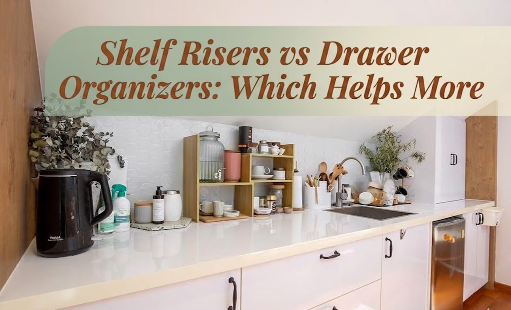
Add shelf risers to any cabinet holding short items. Mugs, spice jars, small cans, glasses. These sit in 12-inch shelf zones at 4 or 5 inches of height and waste all the clearance above them. A chrome or coated shelf riser, the kind that creates a second tier within the same shelf bay, runs about $12 to $18 and requires no installation whatsoever. Across four wall cabinets, that kind of addition can reclaim what amounts to two full shelves of accessible storage.
Assign one cabinet to vertical-only storage. Sheet pans, cutting boards, pot lids, baking mats. These are the items that create chaos when stacked flat. A vertical file-style divider inside a base cabinet solves this almost entirely. You can retrieve a single sheet pan without disturbing anything beside it, lid retrieval stops being a full excavation, and a cabinet that used to frustrate you every morning becomes one you can open without a second thought. The change is small but the daily impact is genuinely significant.
Treat the inside of cabinet doors as a storage surface. The under-sink cabinet is the best place to start. Without a built-in shelf, that space defaults to a cluttered pile around a drain pipe. A two-tier under-sink riser with adjustable legs can turn it into organized, accessible storage. Most models are completely freestanding, no drilling required, which matters if you’re renting.
Where People Get This Wrong
The most common mistake isn’t buying the wrong organizers. It’s buying organizers before doing the pull-out.
Someone sees a set of stackable acrylic bins on a website. They imagine how orderly the result will look. They buy the bins. Then they try to fit their actual items into a system built around dimensions they guessed and a collection they hadn’t fully inventoried. The bins are the wrong width. The lids don’t work with what they own. The whole project goes back into the cabinet in more or less the same configuration as before, just with the addition of plastic and a smaller checking account.
Figure out what you have, what you use, and what your actual cabinet interior measures. Then buy things.
The other pattern I see regularly: people put real effort into the cabinet in front of them and leave the one above the refrigerator and the one they can’t reach without stepping on the counter completely untouched. I understand that impulse, I do. But those aren’t dead zones. They’re archive zones. Treating them deliberately, with labeled seasonal bins or rarely-used appliances stored intentionally, frees up the everyday cabinets in ways that actually change the morning experience.
Cabinet space doesn’t run out. It gets mismanaged. Gradually, quietly, in ways that feel permanent until you look at them directly.
And that’s the idea behind everything at Tiny Kitchen Living: small kitchens ask you to be more deliberate. Not more resigned.
FAQs
Q: How do I know if my cabinets are actually full or just disorganized?
Pull everything out and put it on a flat surface — counter, table, floor, wherever you have room. If the items don’t cover every inch of that surface, the cabinet isn’t truly full. Most people are genuinely surprised by how much space opens up once they see the empty interior clearly. The organization, not the volume, is almost always the issue.
Q: What’s the most effective low-cost product for gaining cabinet space?
Adjustable shelf risers. They cost $12 to $18 each, require no tools, and can double the usable storage in any cabinet holding items shorter than the shelf clearance, which is most wall cabinets in most kitchens. In 24 years of working with kitchen storage, the shelf riser is the best dollar-per-inch-gained solution I’ve come across, and it’s also the most underused.
Q: Should I replace my base cabinet shelves with pull-out drawers?
If the budget is there, yes. Deep base cabinets with fixed shelves waste a significant portion of their depth because of the reach problem. Roll-out trays installed inside a base cabinet run $80 to $200 depending on width, but they make the full 24-inch depth genuinely accessible. In a small kitchen, that kind of access change has outsized impact compared to what it costs. If your kitchen has no drawers at all to work with, the same roll-out logic still applies, just mounted as an add-on rather than a built-in.
Q: My counter space is almost nonexistent too. Does that affect how I should think about cabinets?
It does, and they’re connected. When counter space is very limited, cabinets become temporary parking spots for items in transit and things waiting for a surface. That’s a flow problem more than a storage problem, and it usually means you need a defined staging area somewhere just outside the kitchen. A narrow console, a rolling cart in a hallway. Address the counter bottleneck and the cabinet situation often improves almost automatically.
Q: I rent and can’t drill or modify anything. Are these solutions still usable?
Most of them, yes. Shelf risers, freestanding under-sink shelves, vertical cabinet dividers, and tension-mounted door racks all work without any drilling or permanent installation. If you want to share what you’re working with, we’re happy to help think through what fits your specific situation, just head over to our contact page.