A client of mine asked me this exact question while standing in her 340 square foot studio, holding a bag of rice she had nowhere to put. She’d already given up on finding a pantry. What she wanted to know was whether a rolling cart could do the job instead, or whether she was about to spend money on something that would just become another thing cluttering her floor.
I get this question more than almost any other when I’m working with small kitchen layouts. So let’s actually look at it honestly, because the answer isn’t a flat yes or no. It depends on what you’re storing, how much of it, and how disciplined you’re willing to be about maintaining it.
1. Why Tiny Kitchens Lose This Fight First
Pantries are one of the first things sacrificed in small floor plans. Builders prioritize counter space and a working triangle between sink, stove, and fridge, and a dedicated storage closet just doesn’t fit the math in a 400 square foot unit. I’ve seen this pattern repeat across dozens of studio and one-bedroom layouts. The kitchen gets a few upper cabinets, maybe two lower ones, and that’s it.
What happens next is predictable. Dry goods end up wherever there’s an inch of space. Cereal boxes on top of the fridge. Canned goods in a bedroom closet. It’s not that people are bad at organizing, it’s that there’s genuinely nowhere for these items to live. On Tiny Kitchen Living we talk a lot about this exact gap, because it’s the single biggest complaint I hear from readers who’ve moved into older buildings or converted spaces.
A rolling cart enters the conversation because it’s mobile, it’s modular, and it doesn’t require permission from a landlord to install. That last part matters more than people think.
2. What a Rolling Cart Can Actually Hold
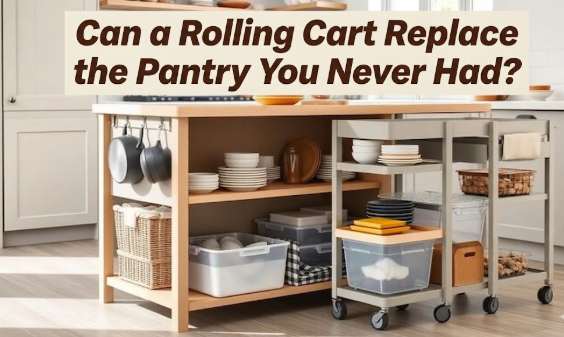
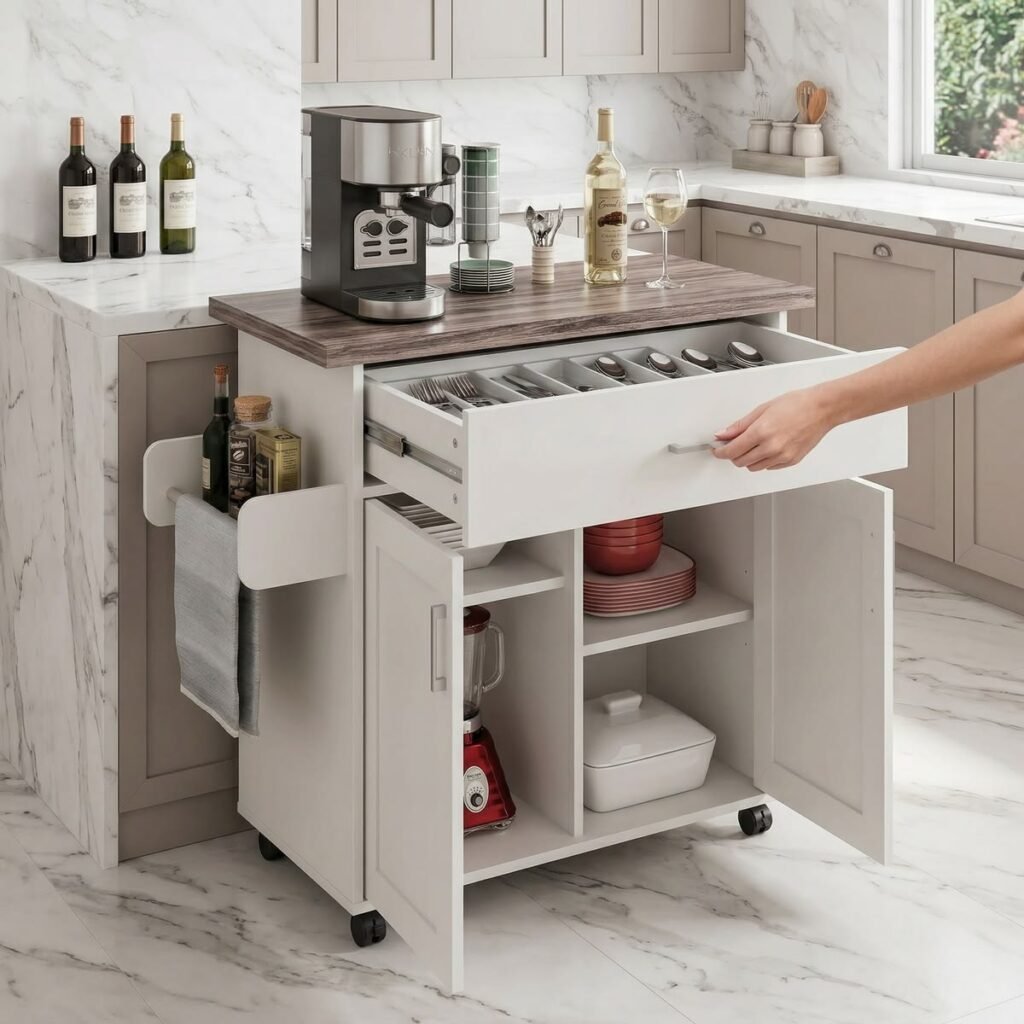
Here’s where I want to be specific instead of vague, because this is where a lot of advice online gets lazy. A standard three-tier bar cart, the kind most people picture, holds maybe 15 to 20 pounds per shelf depending on the frame material. That’s enough for canned goods, boxed pasta, and a few jars, but it is not a substitute for a six-foot-tall pantry closet.
A heavier-duty utility cart with a steel frame can handle 40 to 50 pounds per shelf, and that changes the equation considerably. Suddenly you’re talking about a cart that can hold a 20-pound bag of flour, a case of canned tomatoes, and your small appliances without sagging.
| Feature | Rolling Cart | Built-In Pantry |
|---|---|---|
| Average capacity | 3-4 shelves, varies by weight rating | Full closet depth, often 5+ shelves |
| Mobility | Goes anywhere with floor clearance | Fixed location |
| Installation | None required, fully renter-friendly | Often requires construction |
| Visibility of contents | Open, easy to scan at a glance | Often dark, requires a light or flashlight |
| Cost range | $40-180 for most models | $800+ for built-in cabinetry |
| Weight limit per shelf | 15-50 lbs depending on build | Not typically a concern |
This is the comparison I walk clients through before they buy anything. A cart wins on flexibility and cost. A built-in pantry wins on raw volume. Neither one is universally better, it depends entirely on what’s going into it.
3. Where a Cart Actually Beats a Built-In Pantry
I’ll say something that might sound counterintuitive coming from a kitchen designer: a rolling cart sometimes organizes better than a fixed pantry, simply because everything on it is visible. Walk-in pantries and tall cabinets create dead zones where food gets shoved to the back and forgotten until it expires. A cart doesn’t have that problem because there’s no “back” to hide things in.
If your kitchen has no pantry at all, the cart also solves a problem most people don’t think about until they’re mid-recipe: proximity. You can roll it next to the stove while you’re cooking, then push it back against a wall when you’re done. Try doing that with a built-in cabinet.
Mobility also matters for renters who move every year or two. A cart comes with you. Cabinetry doesn’t. I’ve had readers tell me the cart was the one piece of kitchen furniture that survived three apartment moves intact, which says something about durability when you buy the right one.
And if you’ve already maxed out your cabinet space, a cart gives you square footage that didn’t exist before, just by using floor space that was sitting empty next to the fridge or at the end of a counter run.
4. Where People Usually Get This Wrong
The most common mistake I see is buying a cart based on looks rather than weight capacity. Those thin-wire bar carts that look beautiful in photos are not built to hold a 25-pound bag of dog food and three cans of beans. They bow, they wobble, and eventually they fail. Check the manufacturer’s weight rating per shelf, not just the total weight rating for the whole unit, because those numbers are often very different.
The second mistake is treating the cart as a catch-all instead of assigning each shelf a job. Top shelf for everyday dry goods, middle for canned items, bottom for heavier bulk purchases. Without that structure, a cart becomes just as chaotic as the random shelf-stacking it was supposed to replace.
And one I see constantly: nobody thinks about what happens to open bags and boxes on an exposed cart. Without containers, you’re inviting pantry moths and stale crackers within a few weeks. A cart with no doors needs airtight bins more than a closed cabinet ever did.
5. Setting One Up So It Actually Works
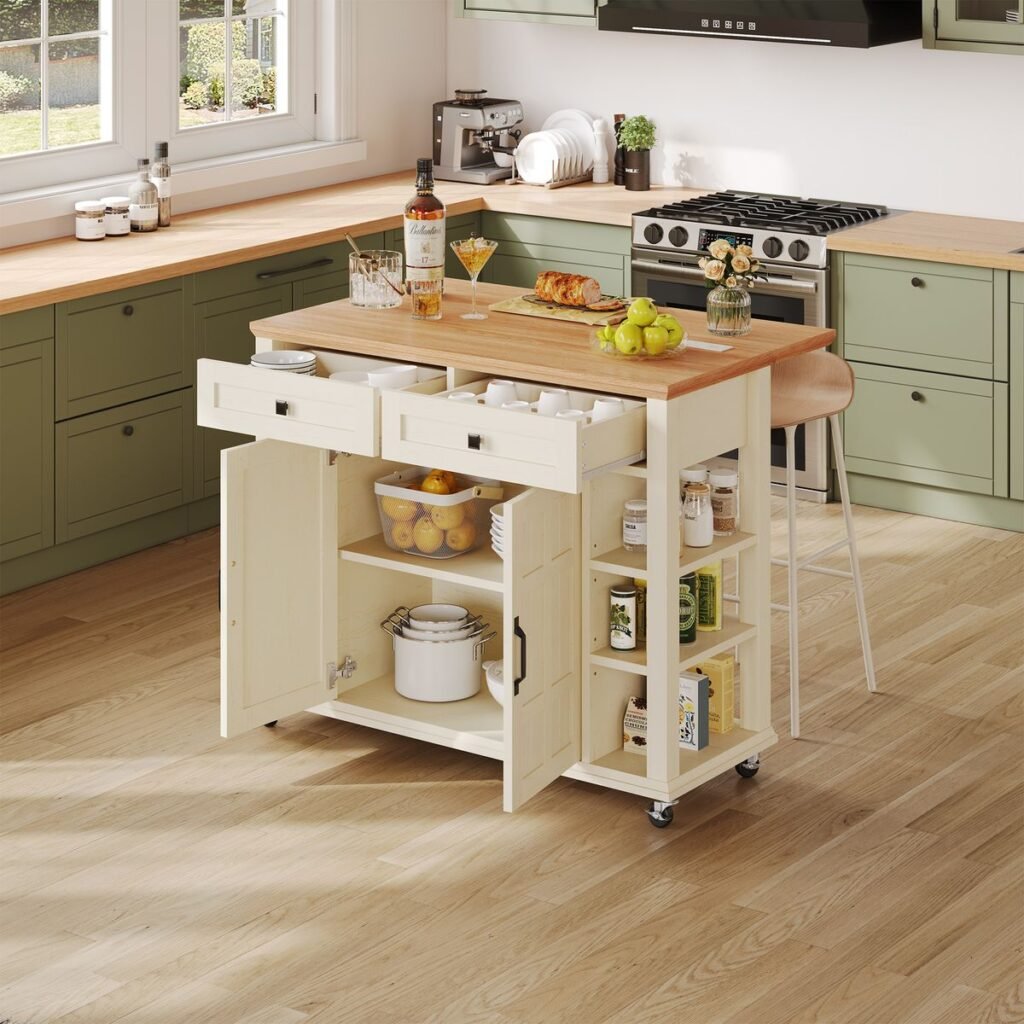
Measure your gap before you shop. Most studio kitchens have somewhere between 10 and 16 inches of usable floor space next to the fridge or at the end of a counter run. Bring that number with you, because a cart that’s two inches too wide will block a walkway every single day.
Go for a model with locking wheels. This sounds minor until your cart rolls into the middle of your kitchen during an earthquake drill or just from someone bumping it while reaching for a pot.
Use clear, airtight containers on the open shelves rather than leaving boxes and bags as they came from the store. If you’ve struggled with spice storage specifically, a narrow cart positioned near the stove can double as that solution too, since spice jars are light and don’t strain the weight rating at all.
Assign zones and stick to them. Heavy items on bottom for stability, lighter and more frequently used items higher up where you can actually see them without bending down.
A cart isn’t a pantry. It never will be one in the strict sense. But for a huge number of small kitchen setups, it ends up doing more of the job than people expect, mostly because it’s flexible in a way fixed storage can’t be. I’ve watched clients go from frustrated to genuinely organized within a weekend, just by giving every shelf a purpose instead of letting it become another flat surface to pile things on.
FAQs
Can a rolling cart really replace a full pantry in a studio apartment?
For most single-person or two-person households, yes, especially when paired with whatever cabinet space already exists. It won’t match the volume of a true walk-in pantry, but it can cover daily dry goods, canned items, and small appliances comfortably.
What’s the weight limit before a cart starts to sag or tip?
This depends entirely on the build. Wire-frame carts often max out around 15-20 pounds per shelf, while steel utility carts can handle 40-50 pounds. Always check the per-shelf rating, not just the total weight capacity listed on the box.
Should I get a cart with drawers or open shelves?
Open shelves are easier to scan and keep food visible, which helps prevent waste. Drawers are better for smaller items like utensils or spice packets that would otherwise slide around on an open shelf. Many people end up wanting one of each.
How do I keep food fresh on a cart without doors?
Airtight containers are non-negotiable here. Anything left in its original bag or box on an open cart is exposed to air, light, and pests in a way a closed cabinet would prevent.
Where should the cart go when it’s not in use for cooking?
Pick one consistent spot, ideally somewhere it doesn’t block a walkway or a cabinet door. Carts work best when they have a permanent “home” position and only get pulled out temporarily during meal prep.
If you’re still working out where things should live once the cart is set up, the shelf risers versus drawer organizers comparison on the site goes into that next layer of organizing in more detail.