Every organizer you bring into a small kitchen costs you something the packaging never mentions: space it doesn’t actually give back. I’ve sat with clients a year after a big organizing haul and watched them stare into their own cabinets like they belong to someone else. More bins. Less clarity. That’s the trade nobody warns you about when the product photos look this satisfying, and it’s the single most common mistake I see in kitchens under 80 square feet.
1. The Math Nobody Does Before Buying a Bin
A bin has walls. A tray has a lip. A stackable riser has the little legs that hold it up off the shelf below. None of that is storage, it’s structure, and structure eats cubic inches that used to hold food or pans. I’ve measured drawers where a tiered organizer looked beautiful in the listing photo and quietly removed close to a quarter of the drawer’s actual capacity once you accounted for the dividers themselves.
That’s not a reason to never use organizers. It’s a reason to do the math before you click buy. If a cabinet is already running tight, which happens faster than most people expect once a second person moves in or a hobby brings home new gear, adding a container without checking what it displaces just moves the overflow somewhere else. Usually onto the counter.
2. What Organizers Actually Take From You
Beyond the physical inches, every new bin creates a decision. Where does this category live now. What used to share that shelf. Do I remember the new home three weeks from now when I’m putting groceries away half asleep. Multiply that by six or eight organizers bought in one weekend, and you’ve built a system that only the person who installed it can actually use without thinking.
This is where I see people go wrong most often: they buy the organizers before they’ve sorted anything. A matching set of bins shows up, gets filled with whatever was nearby, and the kitchen looks tidy for about a month. Then the original sorting logic gets forgotten, items start going wherever there’s room, and the bins themselves become clutter, just expensive clutter that’s harder to get rid of because it was a purchase. Sorting and purging has to happen first. The containers are the last step, not the first one, and that single ordering mistake is responsible for most of the “why does my organized kitchen feel messier than before” emails I get.
A reader once asked me why her pantry felt smaller after she’d spent a weekend on it with risers and labeled bins. It wasn’t smaller. It was just full of containers holding less food per square foot than the shelf had held on its own, plus a layout she hadn’t actually tested by cooking dinner with it yet.
3. A Quick Reference for What Organizers Actually Cost You
| Organizer type | Typical space it occupies | Worth it when | Usually not worth it when |
|---|---|---|---|
| Stackable bins | 10-20% of shelf depth | Cabinet is deep and items get lost in the back | Shelf is already shallow or short on height |
| Tiered shelf risers | 15-25% of vertical space | Items are stacked and hard to see, like canned goods | You only have a handful of items in that category |
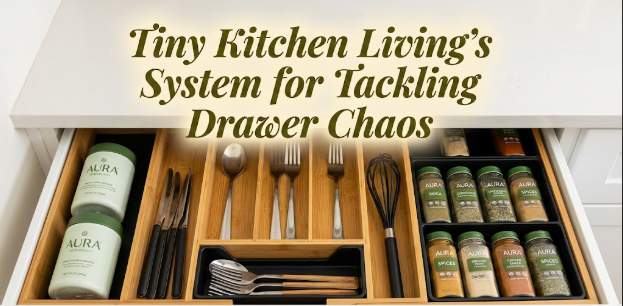
| Drawer dividers | Minimal, but fixed layout | Utensils or tools genuinely get tangled | You’d need to redo the layout every time your tools change |
| Lazy susans | Up to 30% of usable footprint in corner cabinets | Deep corner cabinet with no other access | Cabinet is shallow enough to reach without one |
| Door-mounted racks | Adds capacity but reduces door clearance | Spices, foil, small bottles you reach for often | Door already hits the counter or another cabinet when open |
4. A Better Way to Decide What Earns Cabinet Space
Before any organizer comes into the kitchen, I ask three questions, and I’d ask anyone reading this to do the same. First, has this specific access problem actually happened, not theoretically, but in the last month. Second, will this product reduce the cabinet’s raw capacity by more than the access problem it’s solving. Third, can one organizer hold one category cleanly, or will it end up as a junk drawer with a nicer name.
If a reader is working through cabinet space at all, it’s worth starting with why cabinet space runs out faster than people expect, because most organizer purchases are really a response to that underlying math, not a fix for it. And before buying a set of either, it’s worth comparing shelf risers against drawer organizers directly, since they solve different problems and people often buy the wrong one for their layout.
5. When an Organizer Actually Earns Its Place
None of this means organizers are a bad idea across the board. A riser in a deep upper cabinet that’s currently a black hole for canned goods genuinely earns its space, because the alternative is forgotten food and duplicate purchases. A drawer divider for knives and peelers genuinely earns its space, because loose blades in a drawer are a real safety problem, not a cosmetic one. The pattern with the organizers that actually work long term is that they’re solving something you’ve already lived with and found annoying, not something you’re anticipating might be annoying someday.
That distinction is the whole article, honestly. Buy for a problem you have. Skip the one you might have. If counter space keeps disappearing no matter how much cabinet organizing happens, the issue usually isn’t a missing bin, it’s a handful of daily habits worth breaking first, and no amount of cabinet tidying fixes a counter problem.
And if the kitchen has gone past organizers entirely and into “there’s barely a pantry here,” the fix looks different again. A reader dealing with that exact situation might get more out of building a one-cabinet pantry system than out of another trip to the container aisle.
I tell clients at Tiny Kitchen Living the same thing every time this comes up: sort first, live with the gap for a week, then buy exactly one thing to fix exactly one annoyance. Repeat that as needed. It’s slower than a weekend overhaul and it’s the only version that still makes sense six months later.
Frequently Asked Questions
Are matching bin sets ever worth the money? Sometimes, but only after you know what’s going in them. Buying a matching set first and sorting into it later is how mismatched categories and wasted bins happen.
What’s the one organizer most tiny kitchens actually need? A drawer divider for sharp tools, in most cases. It solves a real safety and access issue and rarely costs meaningful capacity.
Can a lazy susan make a corner cabinet worse? Yes, if the cabinet is shallow enough to reach into normally. The turntable itself takes up height and footprint that a shallow cabinet can’t spare.
How do I know if I have too many organizers already? If you can’t remember where a category lives without opening two or three containers to check, that’s the sign. The system has gotten more complicated than the mess it replaced.
Should I organize before or after decluttering? After, always. Organizing tools applied to clutter just makes tidy-looking clutter. Decide what stays first.
If you want to keep working through this room by room, the rest of the archive is sitting at the Tiny Kitchen Living sitemap, organized by topic rather than by publish date.