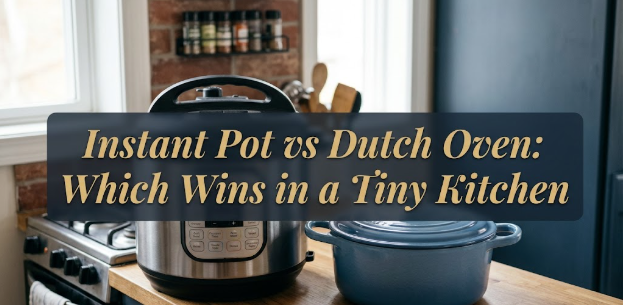
The Instant Pot takes up the space of a large pot and promises to replace six appliances. The Dutch oven takes up the same space and does three of those six jobs better. That difference is everything when you’re working with four lower cabinets and a counter that disappears the second you put anything down.
I’ve had this conversation more times than I can count over twenty-four years in kitchen design. Someone’s moving into a smaller place, or they’ve been in a studio for years and finally want to stop fighting the same storage battles every week. They’ve heard both options pitched as the one pot that solves everything. They want to know which one actually does.
There’s no single answer that fits every situation, but there is a framework for getting to your answer pretty quickly. So let me walk through what each of these actually offers, what it costs you, and where people tend to go wrong with both.
1. The Storage Reality Nobody Mentions First
Before cooking performance, storage footprint matters. People skip this part because it feels obvious, and then they’re surprised when a 6-quart appliance doesn’t fit where they planned.
Both the Instant Pot and a standard 5.5 to 6-quart Dutch oven take up roughly the same shelf space in a cabinet, somewhere around 13 to 14 inches in diameter and 10 to 12 inches tall with the lid on. So if you’re expecting one to be clearly more compact, that’s not how it plays out.
What’s different is what comes with them.
The Instant Pot has a power cord. Which means it either lives on the counter near an outlet or you’re dealing with the cord every single time you pull it out. It also has a sealing ring that needs to come off and dry between uses, and that ring holds onto odors in a way that genuinely bothers a lot of people. The Dutch oven has no accessories, no cord, nothing stored separately from the pot itself.
| Instant Pot (6 qt) | Dutch Oven (5.5 qt) | |
|---|---|---|
| Cabinet footprint | ~13-14 in wide, ~10 in tall with lid | ~12-13 in wide, ~9 in tall with lid |
| Extra storage needs | Cord, sealing ring, condensation catcher | None |
| Counter access required? | Yes, needs outlet nearby | Stovetop only |
| Weight | 11-12 lbs | 11-15 lbs (enameled cast iron) |
| Oven-safe | No | Yes, up to 450-500°F typically |
That cord detail sounds minor and isn’t. If the only accessible outlet near your cooking area is behind a shelf or across the room, the Instant Pot becomes a project every time you want to use it, and it stops feeling convenient fast. This is the kind of thing that falls under what I’d call counter space killers, habits and objects that gradually claim territory they never needed to claim. Counter Space Killers: 5 Habits to Break Now is worth reading before you decide where this pot lives.
2. Where the Instant Pot Earns Its Cabinet Space
Here’s what the Instant Pot genuinely does well in a tiny kitchen.
Speed on long-cook ingredients is real and consistent. Dried beans that would take ninety minutes simmering on the stove are done in twenty-five under pressure. A beef brisket or pork shoulder that needs four hours in a Dutch oven braises in ninety minutes in the Instant Pot. If you batch cook on weekends or meal prep during a short window of time, that compression matters more than it might seem.
The set-it-and-leave-it function is also real. Load it, set the timer, and walk away without worrying about boiling over or watching the simmer. The Dutch oven won’t do that. If you’re cooking unattended, the Instant Pot is the more forgiving tool by a significant margin.
And for people working with a single burner setup, having a second cooking vessel that runs independently from the stove can actually open up your workflow in ways that a traditional pot can’t. The kinds of one-pot weeknight meals where this pays off are the same ones covered in 7 One Pot Meals for Studio Kitchen Nights.
Where it falls short is searing. Technically you can sauté in an Instant Pot, but the stainless inner pot doesn’t get hot enough, fast enough to build a real crust on meat. Braises where the protein is properly seared first will taste noticeably different from ones where it goes in raw, and that step is one the Dutch oven handles much better. People also consistently overestimate how much the rice cooker and yogurt maker modes will get used. Most clients I’ve talked to after six months have stopped using those functions entirely.
3. What the Dutch Oven Does That Nothing Else Can Replicate
The Dutch oven’s core advantage is that it moves from stovetop to oven without any friction at all, and it performs both jobs at a level the Instant Pot simply doesn’t reach.
Searing in enameled cast iron behaves differently from searing in other materials. The heat retention is the reason. When cold meat hits a properly preheated Dutch oven, the temperature doesn’t drop enough to steam the surface, and that’s what gives you the crust. You sear on the stovetop, add your braising liquid, put the lid on, and slide the whole thing into a 325-degree oven. No transferring, no second vessel, no extra washing at the end.
The bread-baking advantage is one people don’t always anticipate when buying a Dutch oven for savory cooking. A covered Dutch oven at 450 degrees creates a steam environment that replicates a commercial bread oven, and the difference in crust and crumb from bread baked on a sheet pan is noticeable. For anyone who bakes even occasionally, this alone can justify the pot.
But, and this is where the Dutch oven stops being the obvious answer for everyone, it requires your attention. A four-hour braise means being near the kitchen, checking liquid levels, adjusting the temperature partway through. The Instant Pot is doing all of that regulation for you. If active cooking isn’t your style, or your schedule doesn’t allow it, the Dutch oven’s strengths won’t get used because you’ll stop reaching for it when anything ambitious comes up.
It’s also heavy. A full 5.5-quart enameled cast iron pot can hit fifteen pounds. Pulling that off a high shelf on a Tuesday night after work is not a neutral experience, and that’s worth being honest about before it ends up stored somewhere inconvenient.
4. The Practical Decision
If you’re picking one, here’s the honest breakdown.
You probably want an Instant Pot if you meal prep dried legumes and grains on a weekly basis, you leave food cooking while you’re not home, you don’t use your oven regularly, or you’re cooking mostly for one and want speed and convenience without standing over the stove.
You probably want a Dutch oven if you cook braised dishes and care about the sear, you bake bread or casseroles, you have a reliable oven setup, or you want something that will last decades without a single component needing replacement.
Now, the mistake I see constantly in clients who’ve set up small kitchens over the years, and I mean constantly, is that they’ve kept both. The Dutch oven came first. The Instant Pot arrived as a birthday gift or a holiday impulse buy. Now both are living in the same cabinet, neither one fully earning its place because each covers the other’s weak spots on paper and they’ve built a justification for everything. That’s the sunk-cost cabinet, and it’s genuinely one of the most common versions of a small-kitchen storage problem I run into.
Tiny Kitchen Living exists partly to challenge that logic. One good pot is almost always the better answer than two decent ones competing for shelf space, and the underlying reasoning behind that is worth understanding before you decide. Why One Good Pot Beats a Full Cookware Set in Small Spaces works through the math directly.
Pick the one that matches how you actually cook. Not how you cooked in a bigger kitchen. Not how you plan to cook once things slow down. How you cook on a Tuesday night when you have forty minutes, low counter space, and limited patience for something fussy.
And if the honest answer to that question reveals that the other pot is already the one gathering dust in your current cabinet, that’s useful information too. Most people already know which one they really use. They just need permission to act on it.
Frequently Asked Questions
Can the Instant Pot fully replace a Dutch oven?
Not quite. Pressure cooking, slow cooking, and sautéing are all available in the Instant Pot, but the sear you can develop in a Dutch oven on a properly hot stovetop is different in texture and flavor from what the Instant Pot’s sauté mode produces. Oven use is completely off the table with the Instant Pot, so anything requiring a high-heat finish, like braised short ribs with a caramelized crust or no-knead bread, won’t happen there.
Are they actually the same size? I assumed the Instant Pot was smaller.
They’re close. A 6-quart Instant Pot and a 5.5-quart Dutch oven are within an inch or two of each other in most dimensions. The bigger storage difference isn’t the pot itself, it’s the accessories. The Instant Pot comes with extra components that need to live somewhere, and the Dutch oven doesn’t.
Is the Instant Pot worth it for someone cooking alone in a studio?
It can be, if you genuinely meal prep and use the pressure function regularly. The issue is a pattern I see often: a solo buyer uses it for rice and eggs for the first month, then starts to underuse everything else, and ends up with a large appliance taking up cabinet space for occasional convenience. If that sounds plausible for your habits, a smaller saucepot and one good skillet might serve you better overall.
Which one is better for soups and stews?
Both handle soup and stew well. The Instant Pot gets there faster. The Dutch oven tends to produce slightly richer results in anything where sautéing aromatics first or searing meat contributes depth to the finished dish. For a quick weeknight soup, the Instant Pot wins on time. For something you want to taste like it cooked all afternoon, the Dutch oven wins even if the active time was only two hours.
Do I need to season an enameled cast iron Dutch oven?
No. Enameled cast iron, which is what most Dutch ovens sold by mainstream brands use, doesn’t require seasoning. The enamel surface handles heat distribution and prevents sticking without ongoing maintenance beyond normal washing. Raw cast iron does require seasoning and periodic re-oiling, but most people shopping for a Dutch oven for a small kitchen are looking at enameled versions, and that distinction is worth knowing before you buy.
For more on the workflow patterns that make a small kitchen feel manageable versus constantly frustrating, Tiny Kitchen Cooking Problems Nobody Warned You About covers the side of this that goes well beyond which pot you own.