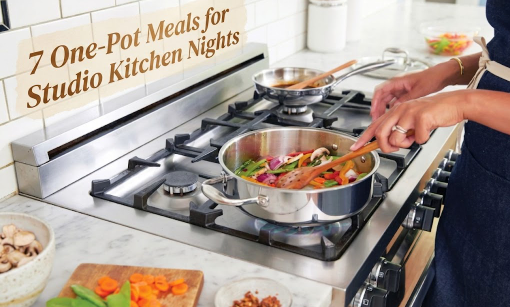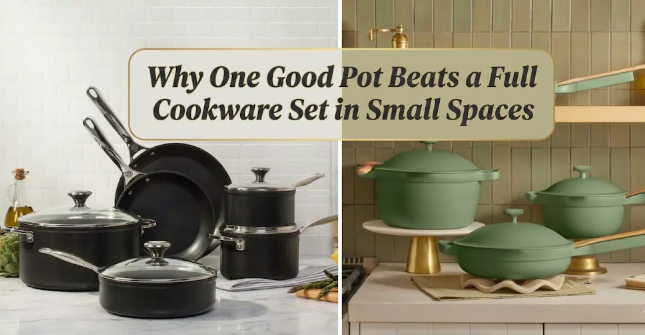
I’ve lost count of how many design clients show me a cabinet stacked with a twelve-piece cookware set, several pieces still wearing the sticker from a holiday sale. Two pots get touched every week. The rest just sit there, taking up the one resource a small kitchen can’t manufacture more of: space. That’s the misconception I run into constantly in tight kitchens, the idea that more pots and pans somehow means more cooking capability. In a kitchen with five or six cabinets total, it almost always works the other way.
- The Set Mentality Doesn’t Hold Up at This Scale
A cookware set is designed to be sold, not used. Manufacturers bundle a saucepan you’ll reach for weekly with a double boiler insert you’ll touch twice a year, because the bundle photographs well and the price per piece looks like a deal. None of that math changes once the box gets opened in a sixty square foot kitchen. What changes is how fast the cabinets fill up with things that aren’t earning their square footage. This is the core problem Tiny Kitchen Living keeps circling back to: storage math, not storage gadgets.
I tell clients to do the inventory test before we even talk about solutions. Pull every pot and pan out, line them up on the counter, and be honest about which ones got used in the last month. Most people are down to two or three pieces doing all the real work within about ninety seconds of looking at their own counter. And that’s usually the moment the conversation shifts, from how to cram more cookware into less cabinet, to what one excellent piece could replace.
- What a Single Pot Actually Has to Do
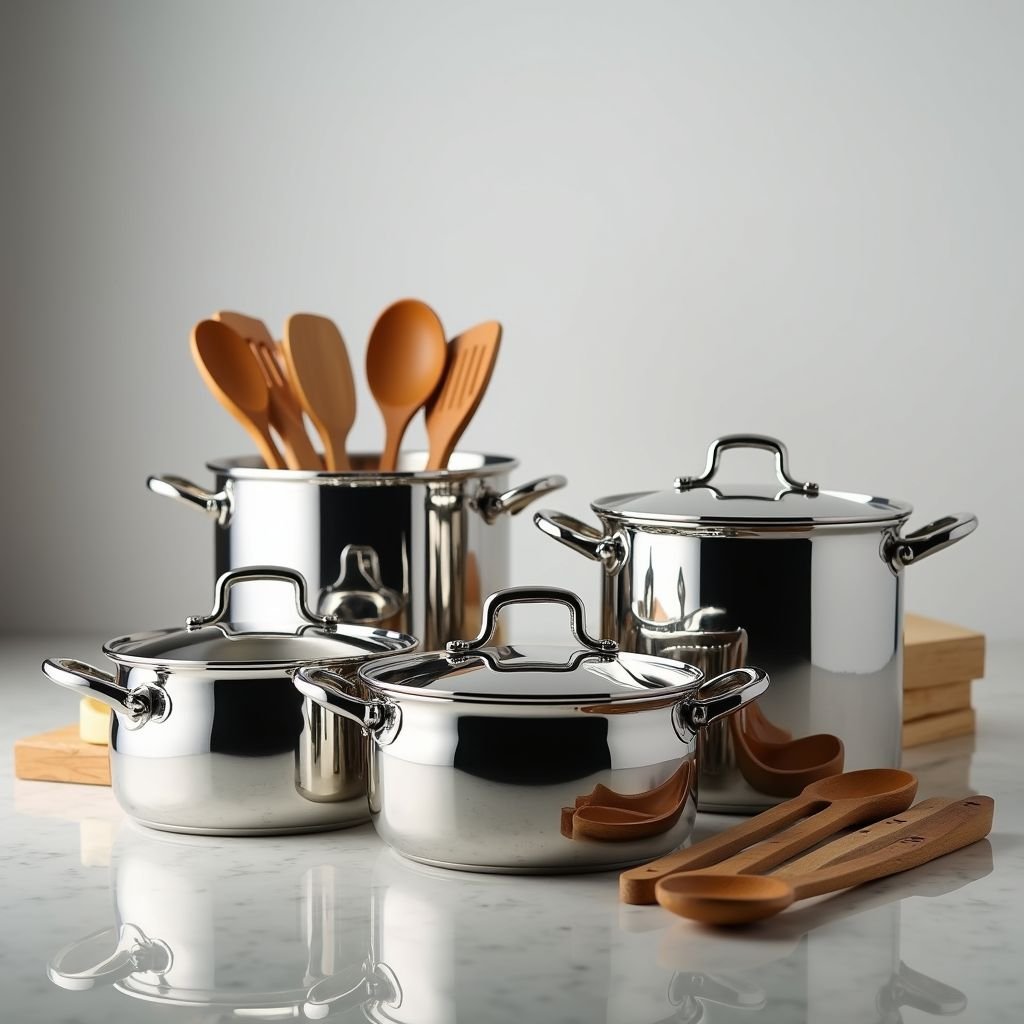
This only works if the pot earns it. A single pan replacing a full set needs to handle more than one job, and handle each job well enough that you’re not shopping for a backup six months later.
The shortlist I give clients looks like this. It needs to go from stovetop to oven without a second thought. It needs enough volume to cook for the number of people actually living in the home, not the number of people who might visit twice a year. And it needs a surface that handles searing, simmering, and the occasional rescue of something that’s started to stick. A 5 to 6 quart enameled cast iron Dutch oven checks all three boxes for most households I work with. A 3 quart stainless saucier does the same for people who cook lighter, faster meals and want one pan that goes from sauce to sauté without a swap.
What it should not be is the cheapest nonstick pan on a department store shelf. Nonstick coatings degrade, can’t go under a broiler, and don’t sear anything worth searing. That’s a pan you’ll be replacing in eighteen months, which defeats the entire point.
- The Storage Math Nobody Runs Before Buying
Here’s the part that gets skipped in almost every kitchen consultation I’ve done. Nobody calculates the actual cabinet inches a cookware set demands until it’s already sitting in the kitchen and something has to give.
SetupPiecesApprox. Stacked HeightCabinet Footprint12-piece cookware set1222 to 28 inchesFull lower cabinet, sometimes two1 Dutch oven + 1 sauté pan29 to 11 inchesHalf of one lower cabinet1 versatile pot only15 to 7 inchesOne shelf
That gap between row one and row three is the difference between a kitchen with room for a pantry shelf and one without. If cabinet space already feels tight in your kitchen, it’s worth reading why does cabinet space run out faster than you think before adding anything new to it.
- Choosing the One Pot Worth Keeping
Material matters more than brand name here. Enameled cast iron holds heat evenly and goes from stovetop to a 450 degree oven without complaint, which makes it close to a do-everything pot for braises, soups, beans, and the occasional loaf of bread. Stainless steel with a thick aluminum core is lighter, heats faster, and handles sauces and quick sautés better than cast iron does. Carbon steel sits somewhere between the two and rewards people willing to maintain it properly.
Size is where people get it wrong most often. A single person cooking mostly for themselves rarely needs anything bigger than 3 quarts. A household of three or four usually lands around 5 to 6 quarts. Buying the largest size available because it seems versatile just means storing more pot than you’ll ever fill, and that empty volume still has to live in your cabinet whether you use it or not.
Once you’ve settled on the pot, the next question is where it lives. A heavy Dutch oven on a high shelf is a hazard waiting to happen, and burying it in a deep cabinet behind baking sheets just means you’ll stop reaching for it. That’s exactly the kind of decision shelf risers vs drawer organizers, which helps more was written to walk through, and it’s worth a look before you decide on this pot’s permanent home.
- Where This Plan Usually Falls Apart
The mistake I see most often isn’t choosing the wrong pot. It’s buying the right pot and then refusing to get rid of the set still sitting behind it. People keep the old cookware “just in case,” and the just in case never arrives. Six months later the new pot is doing all the work and the old set is still eating the exact cabinet space it was supposed to free up.
The second mistake is buying the one great pot and then slowly replacing everything it was supposed to consolidate with new specialty pieces anyway. A wok for stir-fry. A small saucepan for oatmeal. A grill pan for the one summer cookout a year. Each purchase feels small and reasonable on its own, but the cabinet doesn’t see it that way. If counter and cabinet clutter is a recurring fight in your kitchen, counter space killers, 5 habits to break now covers a few of the patterns that quietly cause this.
- A Practical Way to Test This Before You Commit
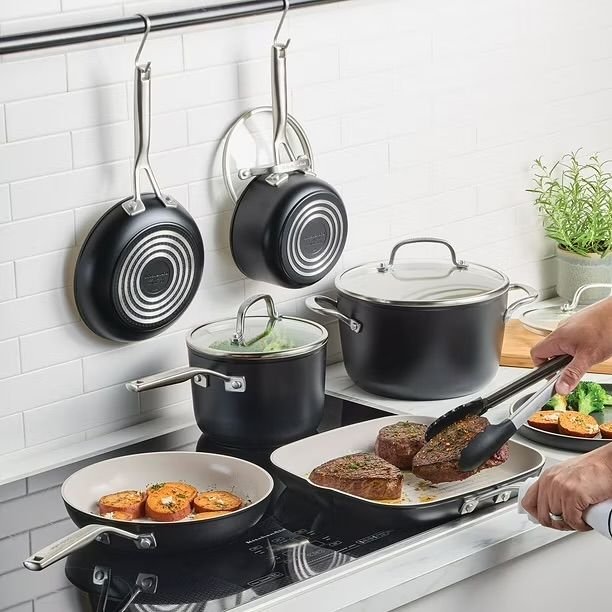
You don’t have to take my word that one pot can replace a set. Box up everything except your two or three most-used pieces for two weeks and put the box somewhere mildly inconvenient, like the trunk of your car or a closet you rarely open. If three weeks pass and you haven’t gone digging for anything in that box, you already have your answer. That’s usually all the proof a client needs, and it costs nothing but a little patience.
There’s no version of a small kitchen where a full cookware set quietly earns its space back. At some point the one good pot just keeps winning, and the set becomes something you mean to deal with eventually. That’s the conversation Tiny Kitchen Living tends to have with people more than any other, not how to organize more cookware, but how much of it actually needs to be there in the first place.
Frequently Asked Questions
Is enameled cast iron worth the higher price for someone who barely cooks?
If you’re cooking three or four times a week at most, a mid-range 5 to 6 quart enameled Dutch oven from a reputable brand will outlast cheaper cookware by years and handle nearly everything you’ll need. It’s a fair trade for someone who wants one pot they won’t think about replacing.
What if I genuinely need a second pan for eggs and quick sautés?
That’s reasonable, and it’s the one piece I’ll usually approve as an addition. A 10 inch stainless or carbon steel skillet alongside one larger pot covers nearly every meal a small household cooks, without sliding back into full-set territory.
Can I get away with just a cast iron skillet instead of a pot with sides?
For some cooking styles, yes, but a skillet can’t hold soup, stock, or anything that needs to simmer for an hour. If your meals lean toward braises, grains, or anything liquid, the taller sided pot earns its keep more than the skillet does.
How do I know if my current cookware set is actually holding me back?
Pull everything out of the cabinet it lives in and time how long it takes to find your most-used pot. If it’s buried under four pans you don’t touch monthly, the set is costing you more in daily friction than it’s giving back in options.
Is it worth replacing nonstick pans with cast iron in a studio apartment?
For the heavy lifting, yes. Keep one small nonstick pan if eggs are part of your routine, since cast iron takes longer to get right for that specific job, but the rest of the nonstick collection can go.
Small kitchen storage ideas worth testing in 2026 has a few more approaches if this is the first time you’re rethinking what actually belongs in your cabinets.