I was reading through kitchen layouts in a Japanese housing guide a few years ago, the kind of dense, practical publication that measures life in tatami mats and square footage per occupant, and I came across something that stopped me mid-sentence. The average apartment kitchen listed for a family of three was 38 square feet. Annotated with pride. Not as a limitation, but as a design feature.
Thirty-eight square feet.
I’ve designed pantry alcoves larger than that. I’ve had clients apologize for kitchens that were twice the size. And here was a layout built for a working family, three people, daily cooking, no apology anywhere in the document.
What stopped me wasn’t the number. It was the photo beside it: a counter holding nothing but a dish drying rack and a small pot. Two burners. No rack of gadgets, no spice carousel. And a meal, full and composed and genuinely beautiful, being assembled from ingredients prepped on that counter.
I started paying a lot more attention after that.
- The Myth That’s Keeping American Cooks Stuck
The belief I hear most often from clients in a small kitchen redesign goes something like this: real cooking requires real space. A full range, an oven, a stretch of counter that lets you set out ingredients and work without everything crowding each other. That belief isn’t unreasonable. It’s how most American cooking culture was designed and marketed, and if you grew up watching cooking shows filmed in 500-square-foot television kitchens, you absorbed a certain scale as normal without ever being told you were doing it.
Japan operates on entirely different assumptions.
The typical apartment kitchen in Tokyo doesn’t have an oven. Two burners is the standard configuration. Counter depth in many installations runs about 22 inches, slightly narrower than the American base cabinet standard, and working surface in length might measure four feet total. Some layouts measure less. And inside these kitchens, home cooks produce broths built over several hours, grilled fish that required real technique, layered dishes with multiple components assembled and timed across two burners with no room to spare.
The small kitchen is not the obstacle in Japanese home cooking. It never was.
What I kept coming back to in my reading was this: Japanese kitchens are small by design, not default. The constraints aren’t accidental. They shaped the cuisine, the equipment, the pantry logic, and the daily cooking habits of millions of people across generations. That’s a fundamentally different thing from the American experience of a small kitchen, which tends to feel like a compromise, something to mentally apologize for before a dinner party.
At Tiny Kitchen Living, the whole premise is that small kitchens can work, genuinely work, if you understand what “working” actually requires. Japan’s answer to that question is worth taking seriously.
- What a Japanese Kitchen Actually Looks Like
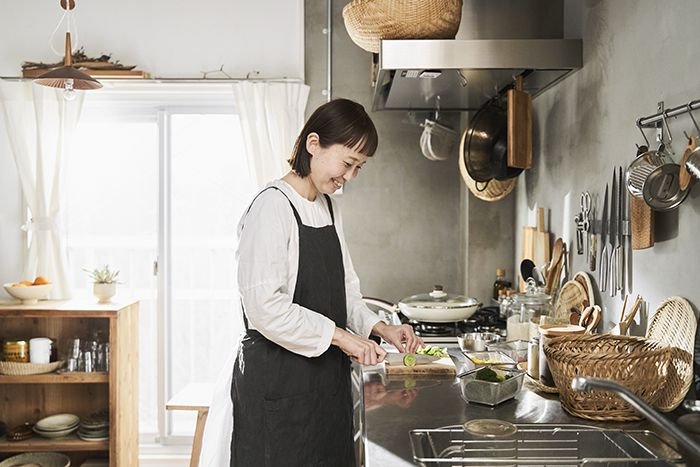
There’s a term in Japanese architecture, nLDK, that describes the layout of an apartment. The n stands for number of bedrooms; LDK stands for living, dining, kitchen, all in one connected area. A 1LDK in Tokyo often means a combined living-dining-kitchen space of around 200 to 250 square feet total. The kitchen portion of that, carved out with a counter and usually separated by a half-wall or peninsula, is where the actual cooking happens.
Two gas or IH burners. A fish grill built into the range, not a separate appliance. Just a drawer-style unit that sits directly below the burners and functions as a broiler for fish, chicken, and vegetables. Small sink. Under-sink storage. Sometimes one narrow cabinet, sometimes a freestanding unit called a shokki todana, a tableware shelf, positioned in the adjacent dining area to hold dishes and pantry essentials.
No dedicated pantry. Usually no wall cabinets above the counter. Refrigerators are smaller than American models by a significant margin, typically two to three cubic feet for a family, which means shopping more often and storing less at any given time.
Sit with that last point for a moment. A refrigerator sized for a family that holds two to three cubic feet. In American terms that’s closer to a dorm fridge. And yet families cook from it daily. Because the shopping rhythm supports it. Because the pantry logic is built around it. Because the whole system was designed to function together, rather than assembled piece by piece through decades of convenience decisions.
That integration is the part I think gets lost when people try to borrow Japanese cooking principles without understanding the ecosystem behind them.
- The Ingredient Philosophy That Changes Everything
Here’s what I’ve come to believe is the actual lesson, the one that doesn’t make it into most write-ups about Japanese kitchen efficiency: it isn’t about the equipment. It’s about the pantry.
Japanese home cooking runs on a small number of condiments and flavor bases that do an enormous amount of work. Soy sauce, mirin, sake, rice vinegar, dashi (a quick stock made from kelp and dried fish that takes under twenty minutes), white and red miso, sesame oil, rice. That’s essentially the backbone for the majority of Japanese home dishes. You don’t need a shelf of single-use spice jars. You need those eight or nine things, well chosen, and you build flavor by combining them in proportions rather than by adding more ingredients to the list.
This is fundamentally different from how American home cooking typically works. Most home cooks maintain a pantry that’s broader but shallower: lots of specific items bought for specific recipes, many of which see use twice and then sit for a year. The physical footprint of that pantry is large compared to what it actually produces.
The Japanese approach is narrower but deeper. Each condiment does more. Dashi shows up in soup, in simmered dishes, in dipping sauces, in the liquid for cooking rice in certain preparations. Miso functions as marinade, as soup base, as seasoning for stir-fries, as a glaze for grilled items. The pantry is smaller because the ingredients are more versatile, not because the cooking is simpler.
For anyone trying to bring this logic into a small kitchen at home, the first move isn’t buying a Japanese condiment. It’s asking which of the things currently in your pantry you actually reach for regularly, and which ones are duplicating a function something else already handles. We’ve covered what a workable one-cabinet pantry system can look like, and the thinking there connects directly to this approach. Also worth reading if you’re rethinking how condiments and spices physically live in a small space: organizing spices without a spice rack covers the practical mechanics of paring down and reorganizing from scratch, and the overlap with Japanese pantry logic is considerable.
- What the Japanese Kitchen Teaches About Equipment
The cooking tools common in Japanese home kitchens are worth listing, not because you should buy all of them, but because the list itself communicates something.
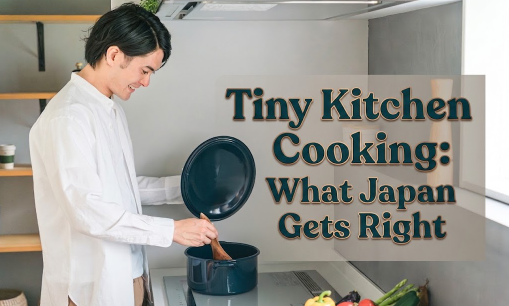
A good knife, usually a santoku or nakiri. A rice cooker. One heavy pot for simmered dishes, typically clay or enameled cast iron. A small tamagoyaki pan, the rectangular one used for rolled egg. A bamboo steamer or a steamer insert that fits the heavy pot. The fish grill already integrated into the range.
That’s largely it. And those tools handle an enormous range of cooking.
The rice cooker is the piece that changes the two-burner calculation most. In a Japanese kitchen, rice is made daily, often twice, and the rice cooker handles it without occupying a burner. This frees both gas rings for everything else. A two-burner setup can run a full, complete meal because one dedicated appliance is managing the foundation dish without competing for the stove.
Cooking ElementTypical American ApproachJapanese Home ApproachHeat source4 burners plus oven2 burners plus fish grill drawerRice cookingStovetop pot, uses a burnerDedicated rice cooker, off the stove entirelyProtein methodOven roasting, pan searingStovetop simmer, fish grill, steamerFlavor buildingMultiple spices added throughout cookingDashi/soy/miso base built once, adjusted at the endPantry size30 to 50+ items stocked at once8 to 12 core items, restocked frequentlyCounter setup during cookingAppliances running, prep happening mid-cookClear surface, everything prepped before stove goes onStorage philosophyAppliances live on the counter for convenienceAppliances stored away, pulled out per use
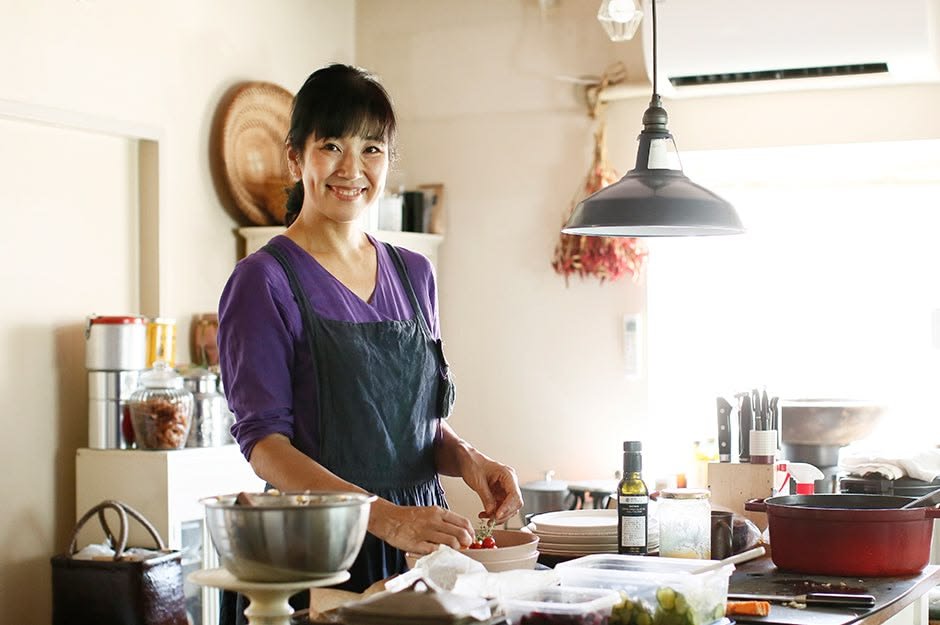
That last row is the one I return to most. Japanese cooking culture has a deeply practical version of what I think of as prep-before-cook discipline. Everything is measured, cut, and organized into small bowls or arranged on a plate before the burner comes on. This isn’t an aesthetic borrowed from food television. It’s functional necessity when you have one foot of working space and two burners that demand constant attention the moment they’re lit.
The connection to counter clarity is direct, and what Tiny Kitchen Living keeps returning to is that cooking habits and storage habits aren’t separate problems. They run on the same surface, literally. If you’re working on reclaiming counter space before you can even think about cooking differently, the habits that consume counter in the first place are worth addressing first, and we went through the five most common in counter space killers worth breaking now.
- Where People Go Wrong When They Try to Copy This
The most common mistake I see when someone decides to cook more like a Japanese home cook is that they start by shopping. They go to a Japanese grocery store and come home with mirin, dashi granules, three types of miso, a nakiri knife, and a rice cooker. New tools. New condiments. And then they open all of it in exactly the same kitchen, with exactly the same habits, and the cooking isn’t different because the thinking isn’t different.
The pantry logic doesn’t transfer automatically, it only works if you’re simultaneously clearing out what it’s replacing. Adding eight Japanese pantry items to an already full shelf doesn’t give you a leaner kitchen. It gives you a more crowded one with a Japanese section added to the right side.
And the prep discipline, which is honestly the bigger shift, requires a cleared counter before it can happen at all. You cannot set out small prepped bowls of ingredients if your cutting board is competing for space with the toaster oven and the drying rack and the mail that arrived Thursday and hasn’t moved. The method requires the surface, the surface requires the habits. That’s the actual sequence.
There’s one more thing that usually gets missed. Japan’s shopping frequency is what makes the small-refrigerator, small-pantry model work. Japanese home cooks typically shop every one to two days, or stop at a market on the commute home. That rhythm is what makes a compact refrigerator viable. If you’re shopping once a week and trying to store seven days of fresh ingredients in a small fridge, you’ll run out of room and blame the kitchen for a mismatch that’s actually in the timing.
None of this means you need to shop daily. But knowing why the system works in Japan before taking pieces of it home helps you adapt those pieces intelligently rather than importing them wholesale and wondering why the result feels off.
If you’re evaluating what’s worth changing in your own small kitchen setup this year, small kitchen storage ideas worth testing in 2026 covers practical adjustments that support this kind of cooking without requiring a complete overhaul in one afternoon.
The kitchen Japan designed for constraint works because every element inside it was chosen specifically for that constraint. A two-burner cook can make extraordinary food. The question is whether the space, and the habits around it, are set up to let them.
FAQs
Can I really cook full Japanese home meals on just two burners?
Yes, and the rice cooker is what makes the math work. With rice handled off the stove, two burners can run a protein, a simmered vegetable dish, and miso soup simultaneously. Most Japanese home meals are built on exactly that framework. The critical piece is having everything prepped before the stove turns on, because there’s no realistic way to chop and simmer and stir on two burners at the same time.
What’s the simplest starting point for cooking with a Japanese pantry approach?
Replace before you add. Before buying mirin or dashi, audit what’s already in your pantry and identify which items you reach for regularly versus which ones were purchased for one recipe and have barely moved since. The Japanese pantry works because each item pulls weight across multiple dishes. Adding more items without removing less-used ones misses the point entirely and just expands the footprint.
Do Japanese home cooks actually use mise en place?
The concept is the same but it’s never called that at home. It’s simply how cooking starts: everything cut, measured, and arranged in small bowls or on a plate before the stove is touched. In a space where both burners require attention once they’re lit, there’s no practical way to be chopping and simmering at the same time. The prep comes first, completely, every time. It becomes habit quickly because the alternative doesn’t really work.
What size rice cooker makes sense for a tiny kitchen?
A 3-cup model (measured in uncooked rice) is the standard for one to two people and compact enough to store in a lower cabinet between uses. Models in that range measure roughly 8 by 10 inches and weigh around five pounds. That’s manageable to move in and out of a cabinet daily. The 10-cup models designed for larger families are a different object entirely and not what most Japanese apartment kitchens use.
Is a Japanese fish grill necessary, or is there a substitute?
A broiler does most of what an integrated fish grill does. If your oven has a broiler setting, you have the functional equivalent for fish, chicken thighs, glazed vegetables. The dedicated fish grill matters in Japanese kitchens specifically because many apartments have no oven at all. If you have a broiler, use it. A separate countertop appliance for this function isn’t necessary unless you’re genuinely working without any oven access.
For more on building the storage foundation that supports efficient cooking in a tight space, Tiny Kitchen Living’s starter guide to cabinet storage is a good place to begin.