Counter space is not what makes a cook good. That belief is extremely common, and it’s wrong.
I’ve been designing kitchens for 24 years. In that time I’ve watched people hold off on cooking projects, simplify recipes they actually wanted to make, and genuinely feel embarrassed about their kitchens, all because they had limited prep surface and believed that was the real obstacle. Meanwhile, I’ve also spent time studying how professional cooks operate in conditions that would make most studio apartment kitchens look generous. Food truck galleys. Ghost kitchen stalls in converted warehouses. Catering setups built in hotel corridors with folding tables standing in for everything that should be there by rights.
Those cooks weren’t slow. They weren’t working around their space. And the reason came down to one idea they’d absorbed that most home cooks never get taught.
- The Myth That Professional Always Means Spacious
Walk through any serious food media and the kitchen images are generous. Islands the size of dinner tables. Multiple prep zones. A landing surface for every appliance and a dedicated zone for every task. That version of professional cooking exists, but it’s one version, and it’s not even the most common one.
Ghost kitchens have multiplied significantly in urban markets over the past several years. Many of them are just a commercial range, a two-foot prep area, and whatever vertical storage fits on the walls. No dining room, no front-of-house, no extra real estate. Food trucks run full service menus in galleys where two cooks standing side by side fills the entire floor plan. Catering teams set up in loading docks, back corridors, and church fellowship halls that were never meant for real cooking. Line cooks in urban restaurants often share a single prep surface smaller than a standard desk.
These are not exceptions to how professional cooking works. They’re a substantial portion of how it actually happens.
And here’s what I’ve noticed across all of those environments: the cooks working well in tight conditions have stopped treating the missing counter as a problem that needs solving before cooking can start. They built their method around what’s there, not what isn’t.
That shift is where the actual instruction lives. Not in any specific tool or product. In the framing.
- What “Setting Up a Station” Actually Means in Practice
The word used in professional kitchens is station. Most people have heard it. Fewer understand what it means in real practice, and the gap between the word and the actual discipline is exactly where small-kitchen cooking tends to fall apart.
Setting up a station is not laying everything out. That’s a common misread, and it’s the one that causes the most trouble.
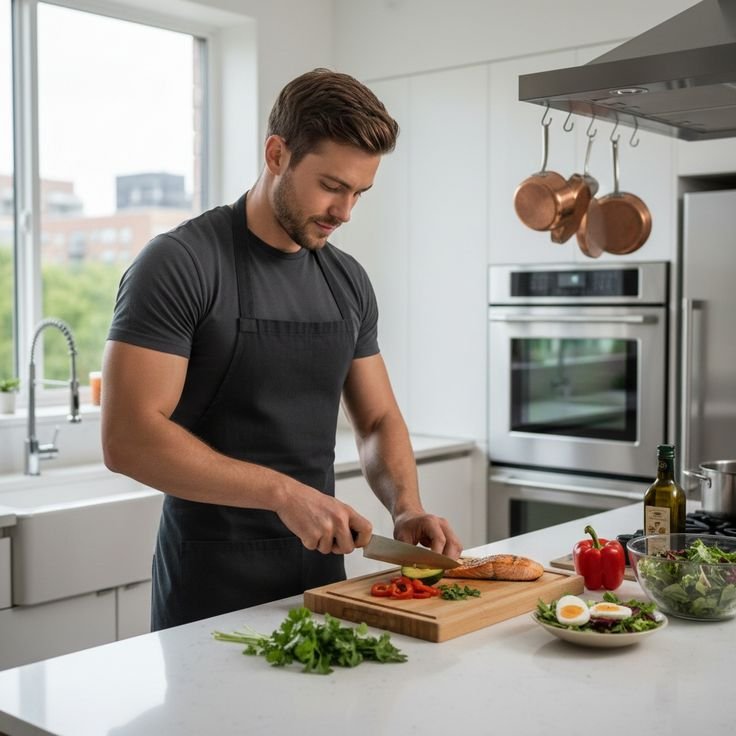
A station is a small, deliberately arranged zone that holds only what’s needed for the current task, staged in the order it will be used. Cutting board centered. Prep bowls positioned to receive finished items. Scrap bowl within reach. The knife where the hand naturally falls. Nothing else on the surface until it has a job to do right now.
Everything resets after each task completes. Not at the end of the cooking session. After each step.
This is the practice that home cooks almost never develop, and it’s the one that changes everything in a tight kitchen. The surface isn’t a place where work happens around slowly accumulating clutter. It’s a resource that gets managed, refreshed every few minutes, kept functional throughout the session rather than gradually consumed by it.
I’ve written about counter clearing at Tiny Kitchen Living as an ongoing habit rather than a pre-cooking ritual. The station mindset extends that same idea directly into the cooking process. The counter isn’t cleared once and then slowly reclaimed by scraps and tools. It stays open because the method requires it to.
- What Mise en Place Gets Wrong in Most Explanations
Every piece of cooking content mentions mise en place. Prep your ingredients before you start. Have everything ready to go. Good advice, both of those things.
But the second half of the idea gets cut, and it’s the half that matters more in a small kitchen.
Mise en place is French for “everything in its place.” The placement part. That’s where the real discipline lives for anyone cooking with one continuous foot of prep room.
In a commercial kitchen with limited workspace, setting up mise en place also means deciding where each bowl sits relative to the cutting board, what order items are staged in, and what stays completely out of the way until that exact stage of the recipe arrives. The minced garlic sits in front because it goes in first. The herbs wait in a small bowl to the side. The protein stays on a plate near the stove, not in the middle of the prep zone, because it won’t be touched for another eight minutes.
For a home cook, this becomes one practical question asked before anything comes out: what do I need for the first five minutes? That’s what gets staged. Everything else stays in the cabinet, the fridge, the bag it came in, until it’s time.
Tools follow the same logic. A chef’s knife that’s done cutting goes to the sink or the board’s edge. It doesn’t sit sideways across the board taking up space it doesn’t need anymore. A measuring cup that’s been emptied moves off the main zone. The surface stays open for what’s next, not crowded with what’s already finished. If you’re sorting out where tools go when they’re not in active use, that’s a closely related question that comes up constantly in discussions of kitchens that have no drawers and the solutions overlap more than you’d expect.
- The Approach Side by Side
Here’s what the difference actually looks like as behavior, not just principle:
SituationTypical Home Cook ApproachProfessional ApproachBefore cooking startsPulls all ingredients and most tools out at onceStages only what’s needed for the first task; everything else stays putCutting and preppingLeaves cut items on the board while continuing to prep other thingsMoves finished items into prep bowls immediately; board stays clearScraps and trimmingsLet pile up at the board edgeSmall bowl on the board corner catches scraps continuouslyBetween cooking stagesWalks away or starts the next thing; surface stays occupiedResets the workspace while something simmers or roastsFinished toolsSpatulas, knives, spoons stay near the panEach tool returns to the sink or a hook right after it’s doneWorking with multiple componentsSpreads everything across available surface at onceFinishes one component completely, clears, then starts the next
None of these require more space. Each one is a different sequence applied to the same surface.
The rolling cart conversation comes up regularly at Tiny Kitchen Living. A cart can genuinely add a work zone where none existed, but whether one actually replaces what’s missing in a given kitchen depends heavily on the habits built around it. A second surface managed the same way as the first one doesn’t change much. The method has to come first.
- Where This Falls Apart at Home
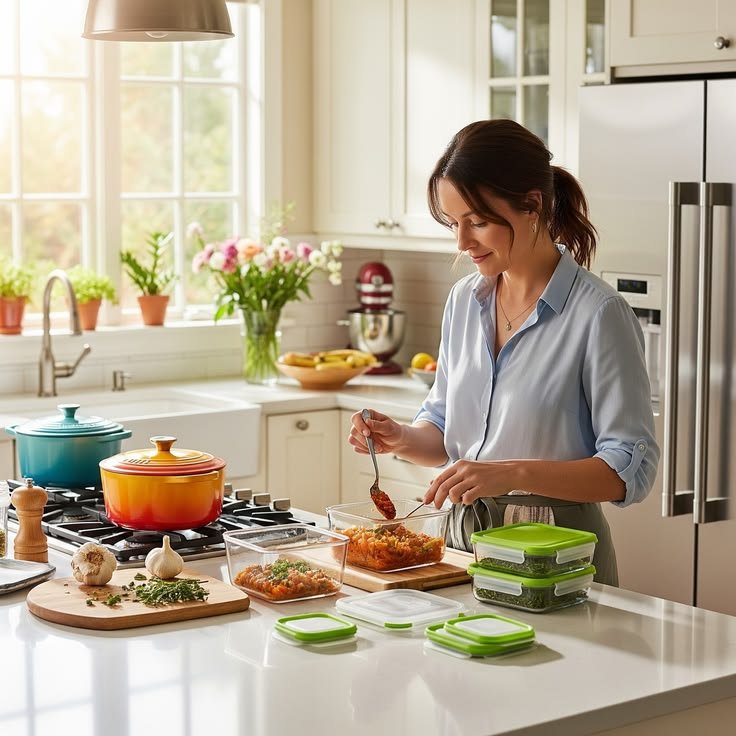
The most common failure when people try to apply this approach is doing it halfway. They set up the station, stage only what they need, feel organized for the first two minutes. Then they stop clearing.
Scraps pile up at the board edge. The finished cutting board stays occupied while they’re standing at the stove. A spatula and a pair of tongs accumulate near the pan and don’t move. Five minutes into cooking, the setup is gone and they’re back to working around a crowded surface rather than inside a clear one.
The station only works if it resets. That’s not optional.
The second place it breaks down is prep timing. Mise en place works when prep happens before cooking starts, which is harder than it sounds on a weeknight when the kitchen is still set up from the morning. In a small kitchen, the reset from the last meal to the next one is part of the practice. A dirty board that never got cleared, tools that aren’t back where they belong, a sink that’s full before you’ve started cooking, all of these eat into the station before it even gets going.
And then there’s tool accumulation mid-cooking. In a kitchen with generous counter space, leaving a wooden spoon, a spatula, and a pair of tongs near the stove during dinner prep is a minor inconvenience nobody notices. In a kitchen where the prep zone and the stove zone are six inches apart, those three tools have just absorbed a meaningful percentage of the working surface. Returning each tool immediately after its job is done is a habit most home cooks haven’t needed to build before. The habits that specifically eat counter space in small kitchens cover this pattern in detail, because tool accumulation is one of the quieter offenders on that list.
- The Principle Behind All of It
Professional cooks who work well in tight conditions have absorbed one idea most home cooks haven’t encountered as a stated concept: surface is time.
Every inch of counter occupied by something finished, something idle, or something that could be elsewhere is a micro-delay built into the process. A board full of scraps means stopping to clear it before the next task starts. Tools left near the pan mean working around them. Prep bowls that haven’t moved mean the board is functionally half the size it looks. None of these delays is serious on its own. But they compound, and in a small kitchen they compound faster because the margins are narrower to begin with.
Managing surface as an active resource, rather than a static background, changes how the kitchen functions. Not because the space gets larger. Because the space that exists gets used with more precision.
This idea runs through most of what we cover at Tiny Kitchen Living on cooking and storage in tight spaces. The kitchen you have is the kitchen you’re cooking in. That’s not a consolation. It’s the starting point. And the question is always how to work inside it well, which turns out to be mostly a question of method, not square footage.
FAQs
Can I actually use my stovetop as prep surface when burners aren’t in use?
Yes. When burners are cold and not needed, the stovetop is a flat surface like any other. Professional cooks in tight environments use it routinely between cooking stages. The practical limits are what you’d expect: nothing heat-sensitive near a warm element, and the surface needs to be clear before any burner turns on. A sheet pan laid flat across two unused burners adds a surprising amount of working real estate when you need a quick extra zone.
What cutting board size actually works best in a very small kitchen?
Not the largest one available. A board that spans the full counter eliminates the space you need for prep bowls and immediate transfer, which is the whole point of the system. A medium board, roughly 12 by 18 inches, combined with a small scrap bowl positioned in one corner, outperforms a large board in a tight kitchen almost every time. The board needs to leave room for the process, not just the cutting.
How do professional cooks handle dishes and tools mid-cooking when there’s no room to set things down?
They don’t let them accumulate. Anything finished and not immediately needed moves to the sink, not the counter edge. In tight professional environments, the sink becomes a staging zone for done items during cooking, not just a cleanup area at the end. Keeping one side of the sink deliberately clear and available throughout the cooking session is a direct practice from food truck and ghost kitchen operations.
Does prepping everything before cooking actually save time, or does the setup eat the savings?
The prep takes the same amount of time regardless. The cooking takes less, and more importantly it stays on track. In a small kitchen, getting interrupted mid-recipe because a surface is occupied or an ingredient isn’t where you expected it costs more per minute than it does in a generous kitchen. The savings are real, they’re just less visible because they show up as problems that don’t happen.
What about single-burner cooking? Can you make a real meal that way using this approach?
Yes, but it requires sequencing rather than simultaneous cooking. Start with anything that needs long unattended time and can hold its quality while warm: grains, beans, braised proteins. Then move to shorter-cooking items in order. Finish with anything that should be fresh off the heat. The method is to plan the meal backward from what needs the most time, then cook forward in a single chain. It takes deliberate thought the first few times. After that it becomes the natural way to approach any single-burner session without feeling like you’re compromising.
More on storage, organization, and cooking in tight spaces at Tiny Kitchen Living.