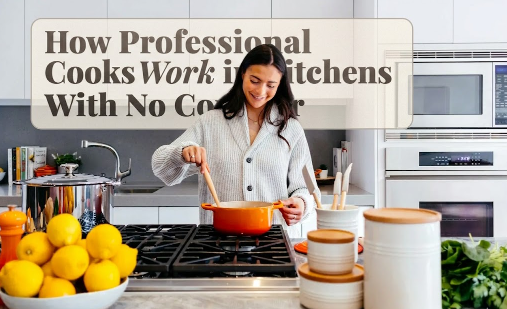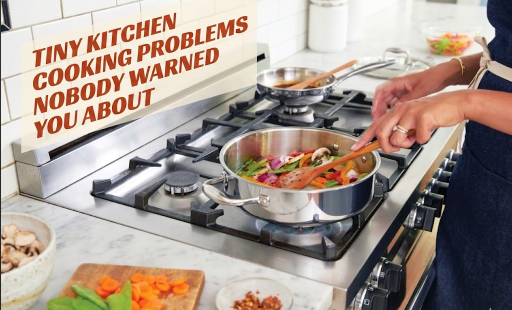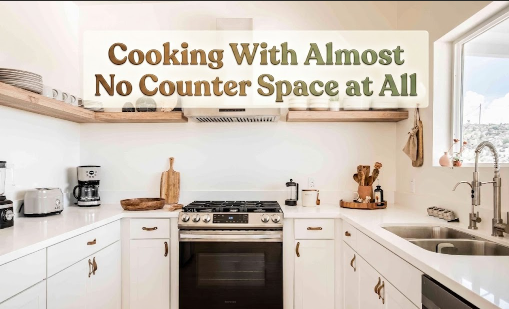
You can cook a full meal in forty-two inches of total counter space. I know because I’ve helped someone do it.
She was a client in a studio in Brooklyn, and she was not willing to downgrade her cooking routine just because the kitchen was small. What she was willing to do was change how she worked in it. That turned out to be the only thing that actually mattered.
Most advice around tight kitchens focuses on storage. Finding vertical space, using cabinet organizers, stacking things more efficiently. That advice isn’t wrong. It’s just aimed at the wrong problem. Storage holds your things. Workspace is where cooking happens. When you run out of counter space, you don’t have a storage problem. You have a workflow problem.
And the way you fix a workflow problem is by changing the workflow.
- What’s Actually Happening to Your Counter Before a Meal Starts
The first thing I look at during a small kitchen consultation is the counter before anything’s been touched. Not the cabinets. Not the pantry situation. The surface itself, right now, mid-week, in normal use.
What’s sitting on it?
In most small kitchens, the answer is: more than you’d think. A coffee maker. A toaster or toaster oven. A drying rack that never fully dries because it’s wedged against the coffee maker. A knife block taking up a footprint nobody mentally accounts for. A fruit bowl that hasn’t moved since last November. Sometimes a stand mixer that gets used three times a year but weighs too much to put away comfortably, so it just stays.
Add those up in a kitchen with forty-two total inches, and you might have fourteen inches left.
You can’t cook in fourteen inches. Not comfortably. Not without shuffling things constantly and losing your rhythm and making the whole process feel harder than the food actually is.
The issue isn’t that the kitchen is too small. The issue is that the counter got colonized before anyone thought carefully about what it was for.
I’ve written about this pattern in the counter space killers post over at Tiny Kitchen Living, and the core observation applies directly here: the habits arrive one at a time, over months, and nobody notices until the workspace has completely disappeared. The stand mixer showed up. Then the air fryer. Then the drying rack became permanent. Each one seemed like it had a reason. The counter just kept shrinking.
- Why “Just Get More Storage” Misses the Actual Problem
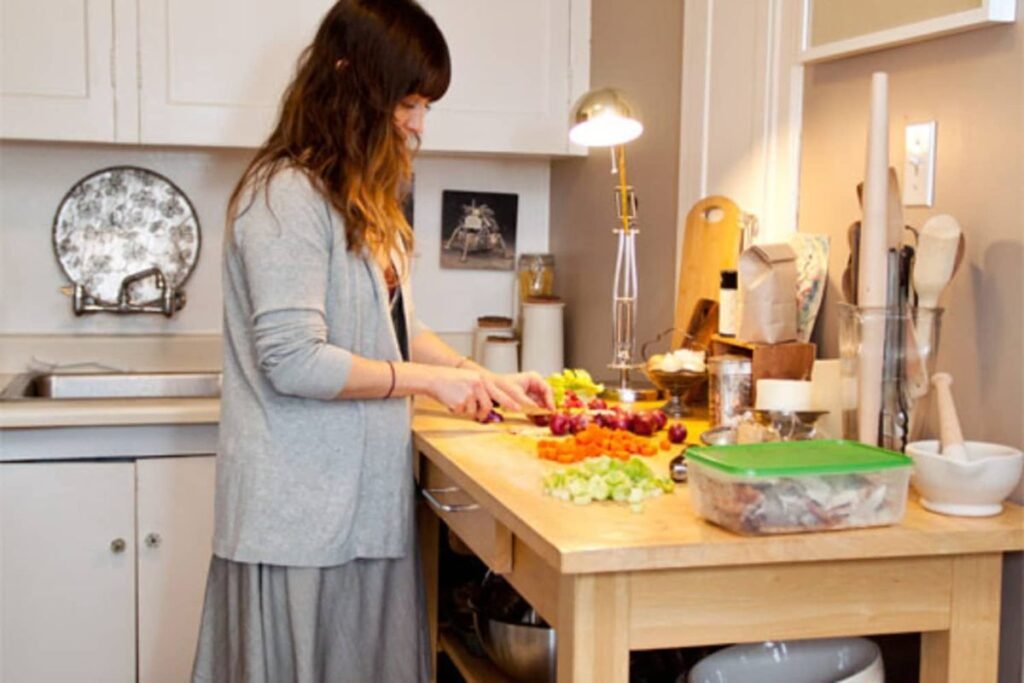
There’s a reflex that shows up the moment someone mentions a tight kitchen. Somebody suggests better storage. A mounted rack, a smarter cabinet system, new organizers. And sometimes that’s the right call, but not before you’ve cleared the counter.
Storage and workspace are not the same thing.
You can have a beautifully organized kitchen with pull-out cabinet shelves, labeled containers, and a magnetic knife strip on the wall and still have no room to cook, because the counter hasn’t changed. Storage is where you keep your things. Workspace is where you prepare them. Solving one does not solve the other.
The mistake I see most often, especially in studio apartments where space is genuinely limited, is people responding to a counter problem by buying more things to put on or near the counter. An additional rack here. A new organizer there. A three-tiered shelf that looks tidy in photos but adds visual weight and takes up floor space. The kitchen now has more stuff in it and the cooking surface is the same or smaller than before.
Clearing comes first. Every time. Organize what earns its way back onto the surface after you’ve made the actual cuts.
The counter clearing piece on Tiny Kitchen Living breaks down specifically what changes when you do this for real, and it’s worth reading before buying anything new for the kitchen. The short version: the counter is either a workspace or it isn’t. Once it’s actually clear, it becomes one again.
- Finding the Prep Surface You’re Not Currently Counting
Here’s the distinction that actually shifts things: counter space is fixed, but prep surface isn’t.
Most tight kitchens have more usable flat surface than people are currently using. The stovetop, for one. A burner that isn’t lit is a flat, clean, easy-to-wipe surface. A dutch oven can sit on a cold back burner while you prep ingredients on the counter. A covered bowl can stage on a cold front burner while you’re still chopping. Using the stovetop as staging is something professional kitchens do constantly and home cooks almost never do, because nobody told them they could.
Here’s a practical comparison of what actually holds up in a tight kitchen:
Surface OptionBest Used ForReal LimitationCold stovetop burnersStaging covered bowls, holding prepped itemsUnavailable once active cooking starts across all burnersRolling cart (pulled out)Primary or secondary prep surfaceRequires floor space to deploy; needs to be stored when not in useOver-sink cutting boardChopping and produce rinsingBlocks sink access while the board is in placeCabinet door with mounted organizerKeeping small tools reachable during prepWeight-limited; door must stay openOpen drawer lined with grip matStabilizing a cutting board at a lower heightTakes some adjustment; not comfortable for everyone at first
A rolling cart is the recommendation I’ve made more times than almost anything else in a small kitchen context. Not as a pantry replacement, though there’s a reasonable case for that too, but as prep surface that appears when you need it and disappears when you don’t. Roll it out before you start cooking. Slide it back against the wall when you’re done. In a studio apartment, that’s often the most effective square-footage move available, and it costs a fraction of what a renovation would.
The over-sink cutting board is the other high-value addition for kitchens with almost no counter. It takes space that’s already there, directly above the sink basin, and turns it into prep area. The trade-off is real: the sink is blocked while the board is in place. But in practice, if you rinse your produce before you start and work in sequence, that’s not much of a constraint.
- Changing How You Cook, Not Just Where You Cook
This is the part that makes the real difference. It’s also the part most kitchen-organization guides skip, because it requires adjusting habits instead of purchasing something.
Parallel cooking and sequence cooking are two different approaches, and they demand very different amounts of surface area.
Parallel means everything comes out at once. All the ingredients are staged, all the tools are within reach, prep and cooking happen in overlapping phases. This is how most home cooks work when they have room, because room makes it easy. It looks like the cooking videos. It feels organized.
In a tight kitchen, parallel cooking is where everything collapses. You’re shuffling to make room, items stack on top of each other, something falls, your rhythm breaks. The cooking itself isn’t hard. The logistics of it are.
Sequence cooking works differently. Prep one component, clear that space, move to the next. Chop the garlic, move it into a bowl, wipe the board. Measure the spices before anything goes on heat. Wash and dry vegetables before you start, not while you’re in the middle, so the sink stays free when you actually need it. Stage finished components on cold burners, on a plate to the side, or on the rolling cart.
This is how professional kitchens work. A prep cook doesn’t have a sprawling workspace. They work clean, they work in order, and they leave room to keep moving. The method translates directly to home cooking, but most home cooks have never heard it described in those terms.
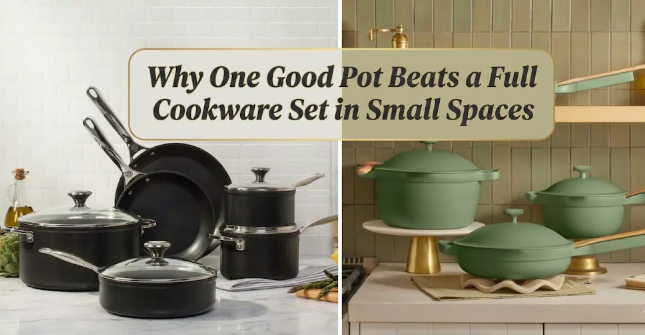
One-pot and one-pan meals belong in this conversation too, not as a consolation prize for not having a bigger kitchen, but as a genuinely efficient strategy. A good cast iron skillet or a dutch oven handles a wide range of cooking with minimal equipment in play. Less juggling, less shuffling, less cleaning mid-meal. For a small kitchen, that’s not a limitation. It’s just smart.
For setup ideas that support this kind of cooking approach, the small kitchen storage ideas roundup has practical additions worth working through before you commit to anything.
Where Most People Get This Wrong
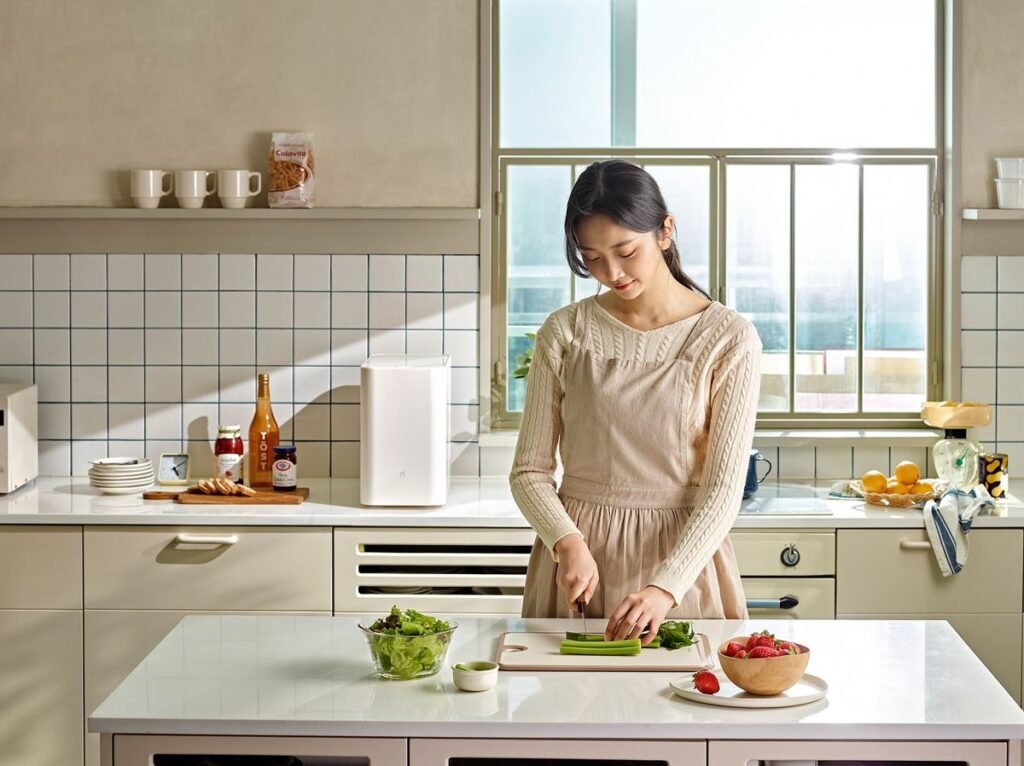
The most common mistake isn’t failing to find enough space. It’s responding to the space problem by adding more things to the kitchen.
More products. More organizers. More systems. More stuff designed to solve the problem, loaded into a space that’s already tight.
I understand the impulse. A chaotic kitchen creates a strong urge to do something. Buying an organizing product feels like doing something. But in a small kitchen, buying things without first removing things almost always makes the situation worse, the kitchen gets more visually crowded, surfaces feel more cluttered, the cooking gets no easier, and somehow the kitchen feels smaller than before.
A client once showed me a studio kitchen that had been fully outfitted with solutions: peg wall, magnetic knife strip, mounted spice shelf, over-door pantry organizer on the cabinet, labeled bins throughout. Everything had a designated place. She’d put real effort and real money into it. But she’d added all of those systems without removing what was already on the counter, so the kitchen was both fully organized and completely cluttered. Nothing got cleared. It just got labeled.
The sequence that works is: clear first, assess second, solve third. What’s actually missing from a cleared counter is almost always smaller than what the cluttered version seemed to require.
FAQs
How much clear counter do you actually need to cook a real meal at home?
Eighteen to twenty-four inches of genuinely cleared surface is workable for most home meals, provided you’re cooking in sequence rather than spreading everything out at once. The stovetop picks up what the counter can’t hold. It’s tight, but it functions well. The tightness matters less than the method.
Should I buy an over-sink cutting board for a small kitchen?
For most tight kitchens, yes. It adds real prep surface over space that’s already there and costs very little relative to what it solves. The practical limit is that your sink is blocked while the board is in use, so it works best when you’ve pre-rinsed everything and are ready to work dry.
What appliances should not live on the counter in a small kitchen?
Anything that doesn’t get used at least four or five times a week doesn’t earn counter space. The coffee maker usually stays. The blender, air fryer, food processor, stand mixer: if they sit idle most days, they’re borrowing workspace from your actual cooking. Cabinet storage with easy access is a better home for all of them, and the difference in retrieval time is usually fifteen seconds, not fifteen minutes.
Is sequence cooking actually different from how most people already cook?
For most people, yes, noticeably different. The shift is from everything-out-at-once to one-step-then-clear. It takes two or three meals to feel natural, and after that it’s usually faster rather than slower, because you’re not working around stacked items and lost tools.
Can someone actually cook well in a kitchen with almost no counter space?
Completely. The cooking doesn’t require much surface. The clutter is what makes it feel impossible. Clear the counter, adjust the method, and most small kitchens turn out to be more functional than anyone believed before they tried working in them properly.
After twenty-four years of walking into kitchens of every size, the thing I’m most certain about is this: the constraint isn’t usually the kitchen. It’s the approach. A small counter doesn’t prevent real cooking. It just requires cooking that fits the space instead of fighting it.
That adjustment is smaller than it sounds.
Find more practical ideas for making a tight kitchen work the way you need it to at Tiny Kitchen Living.