A client once asked me, mid-renovation, why her brand-new induction range felt like it made less room than her old gas stove. It wasn’t the stove. It was everything sitting next to it. Six small appliances, none of them pulling their weight, all competing for the same eighteen inches of laminate.
That conversation stuck with me because it’s the wrong question most people ask. The real question in a small kitchen isn’t “what can I fit on the counter.” It’s “what actually earns the counter space it takes up.” Some tools do. Most don’t. Here are five that consistently do, based on what I’ve seen work in tiny kitchens and studio apartments rather than what looks good in a product photo.
1. A Compact Multi-Function Pressure Cooker
This is the one piece of equipment that replaces the most other equipment. A good multi-cooker handles rice, stews, yogurt, steaming, and slow cooking, which in a full kitchen would mean four separate appliances. In a studio kitchen, that’s the difference between owning a rice cooker, a slow cooker, a steamer basket setup, and a stockpot, or owning one 6-quart unit that does all of it adequately.
The mistake people make here is buying the largest model available because it feels like better value. It isn’t, not in a small kitchen. An 8-quart unit takes up real cabinet space and is awkward to lift one-handed out of a low cupboard. A 6-quart model cooks for two to four people comfortably and fits places the larger one won’t. If you’re consistently choosing between counter space and storage, as discussed in Why Does Cabinet Space Run Out Faster Than You Think, this is exactly the kind of tradeoff worth thinking through before you buy.
2. A Folding or Over-the-Sink Cutting Board
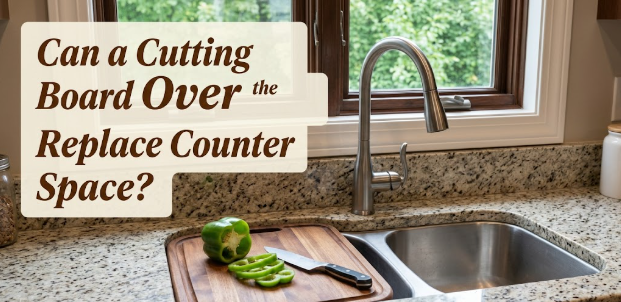
A board that only works flat on a counter is a board that demands counter space exist in the first place. An expandable board that rests across your sink edges, with folding wings or a telescoping frame, effectively creates a second prep surface that didn’t exist a moment ago. When you’re done, it collapses to the thickness of a few stacked plates.
I’ll admit I resisted these for years. They felt like a gimmick the first time I used one in a client’s apartment. And then I used it on a Tuesday making dinner in my own undersized kitchen and never went back to thinking that. The trick is buying one with a lip that actually grips the sink edge rather than a flat board that just rests there and slides when you lean on it.
If your kitchen has no real counter to begin with, this pairs well with the strategies in Counter Clearing in a Small Kitchen: What Changes, since the sink becomes a working surface instead of dead space between meals.
3. An Immersion Blender Instead of a Countertop Blender
A full-size blender is one of the worst offenders for counter-to-usefulness ratio in a small kitchen. It’s tall, it’s heavy, and most people use it for soups, sauces, and the occasional smoothie, all of which an immersion blender handles directly in the pot. No transferring hot liquid into a pitcher, no extra vessel to wash, no permanent six-inch-wide footprint.
The honest tradeoff is texture. An immersion blender won’t give you the same silky consistency as a high-powered countertop model on something like a frozen smoothie. For soups, purees, and emulsified sauces, the difference is negligible. For daily frozen drinks, it’s noticeable. Know which one you actually make more often before deciding this is your one blender.
4. A Magnetic Knife Strip
This isn’t a counter tool in the traditional sense, it’s what keeps your knives off the counter and out of a block that eats four inches of depth permanently. A magnetic strip mounted to the backsplash holds knives vertically, in view, and accessible, without claiming a single square inch of usable surface.
Where people go wrong with this one is mounting placement. Too low, and knives end up at an awkward reach height or too close to splash zones near the sink. Too high, and lifting a heavy chef’s knife off a magnet above eye level is genuinely unsafe. The right spot is roughly at mid-torso height, away from the sink and stove, somewhere your hand naturally lands when reaching for a knife without thinking about it.
For more on rethinking vertical space generally, Cabinet Door Shelving: The Trick Nobody Ever Uses covers a similar principle applied to a different surface.
5. A Stackable, Nesting Mixing Bowl Set With a Lid System
The least glamorous item on this list and maybe the most useful. A set of three to four bowls that nest into each other and double as storage containers with snap-on lids does the job of mixing bowls, prep bowls, and leftover containers at once. The nesting part matters more than people expect. A set that doesn’t nest cleanly takes up the same shelf space as four separate, unrelated items.
This sounds minor until you’ve lived without it. Once you’ve measured ingredients, mixed them, and then realized you have nowhere obvious to put the extra half cup of something, you start to see why having bowls that transition straight into storage actually changes how you cook day to day, not just how you store things between meals.
Where Counter Space Mistakes Usually Start
The pattern I see most often, across years of small kitchen consults, is that people buy tools individually based on need at the moment of purchase, then never audit what’s actually sitting on the counter six months later. A blender bought for one smoothie phase. A waffle maker used twice a year. A toaster oven duplicating what the regular oven already does fine. None of these are bad purchases in isolation. Stacked together, they quietly take over a space that was never large to begin with.
Here’s a simple way to think about whether something has earned its spot:
| Question | If yes | If no |
|---|---|---|
| Used at least 3x per week? | Keep on counter | Move to storage |
| Replaces 2+ other tools? | Keep on counter | Reconsider purchase |
| Takes under 10 seconds to put away? | Fine either way | Counter use only if frequent |
| Could a smaller version do the same job? | Downsize | Current size is justified |
Running your own counter through that table once a season catches the slow creep before it becomes a renovation-level problem. It’s a habit, not a one-time fix, and it’s one I genuinely use myself, not just one I recommend to clients.
If counter clutter is less about appliances and more about everyday habits, Counter Space Killers: 5 Habits to Break Now is worth a read alongside this. And if you’re earlier in the process, still deciding what’s even worth buying for a small kitchen setup, Small Kitchen Storage Ideas Worth Testing in 2026 covers more ground on that decision.
None of these five tools is revolutionary on its own. What makes them work is that each one quietly removes the need for something else, rather than adding to the pile. That’s really the only test that matters in a kitchen this size, not whether a tool is useful, but whether it’s useful enough to justify the inches it costs you.
Frequently Asked Questions
Is a multi-cooker actually worth it if I already have a slow cooker? If your slow cooker still gets regular use and fits comfortably in storage, you don’t need to replace it. The multi-cooker earns its space when it’s genuinely consolidating several appliances you’d otherwise own separately, not when it’s adding a fifth option to four you already use.
How do I know if a folding cutting board will actually fit my sink? Measure the outer width of your sink basin, not just the visible counter gap. Most folding boards list a sink-width range, and a board that’s too wide will rock instead of sitting flush, which makes it unsafe for chopping.
Won’t a magnetic knife strip dull my knives faster? Not meaningfully, as long as you’re placing the blade against the magnet edge-first rather than slamming it down flat repeatedly. The bigger risk to blade edges is usually a drawer where knives knock against other utensils, not a properly mounted magnetic strip.
What’s the single tool I’d tell someone to get rid of first? In most small kitchens I’ve worked in, it’s a full-size countertop blender that’s used less than once a week. The immersion blender swap alone tends to free up more usable counter than any single organizing product will.
Do nesting mixing bowls really save that much space compared to a regular set? Yes, mostly because of how they store, not just how they stack on a shelf. A non-nesting four-bowl set can take up two to three times the cabinet footprint of a properly nesting set of the same capacity.
If you’re working through which of these to prioritize first, Why One Good Pot Beats a Full Cookware Set in Small Spaces walks through the same earn-its-space logic applied to cookware specifically, and it’s a natural next read after this one.