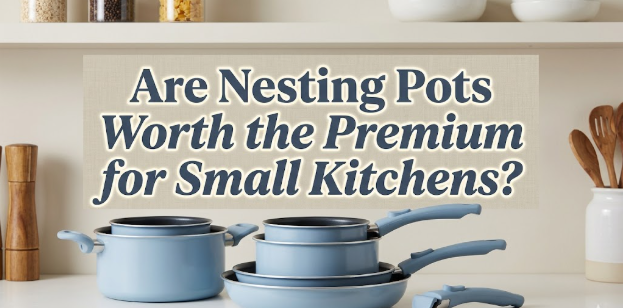
Every few months, someone sits across from me with a tablet in hand, showing me a nesting pot set they found. The marketing photo is always the same: five gleaming pots collapsed into a perfect stack, fitting inside a space roughly the size of a shoebox. “This is what I need, right? For the cabinet situation?”
That question comes up often enough that I’ve started addressing it before it’s even asked.
Nesting pots are a real product that solves a real problem. I want to be clear about that before I complicate it. But the way they get marketed to small kitchen owners builds expectations the product can’t always meet, and I’ve watched clients spend $120 to $250 on a nesting set, use two pieces regularly, and quietly live with three others that never earn their spot. The space they thought they were saving didn’t disappear. It just changed shape.
The real question isn’t whether nesting pots save space in theory. It’s whether they save your space, in your specific cabinet, for your cooking habits, and whether that savings is worth the trade-offs in material quality, heat performance, and genuine versatility.
1. What the Nesting Argument Actually Gets Right
The core logic is sound. Pots designed to share a compatible diameter and stack concentrically do compress better than a random collection of cookware piled into a cabinet. A standard three-pot collection of different sizes stacks awkwardly, handles pointing in different directions, lids sliding, the whole setup running 16 to 20 inches of stacked height before you’ve added anything else. A properly made nesting trio can bring that down to 10 or 11 inches with everything in place, including lids nested face-down on top.
In a kitchen where every vertical inch inside a cabinet is borrowed space, that compression is real.
The people it works best for are those cooking simple, stovetop-only meals, mostly for one or two people, who want a tidy setup without thinking too hard about equipment. For that specific user, a nesting set is a clean solution. It fits, it stacks, it leaves the cabinet feeling manageable rather than chaotic.
But that description doesn’t fit most people who come to me asking about nesting cookware. Most of them are doing real cooking, and they’re expecting the nesting set to handle all of it.
2. The Space Math, Run Honestly
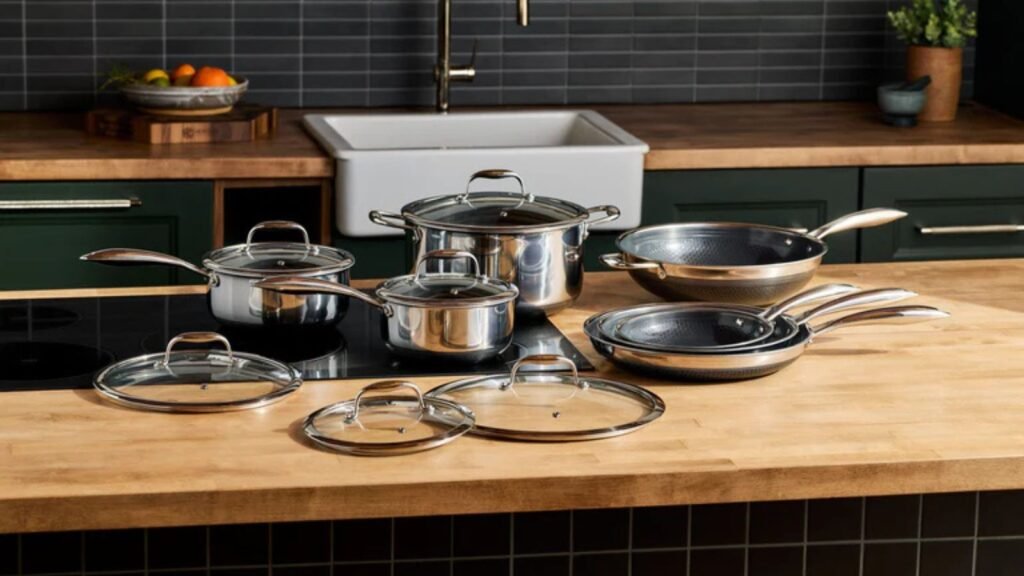
Before any purchase conversation goes further, I ask clients to measure their cabinets, not approximately, but with a tape measure and a pencil. The space savings in nesting cookware marketing are usually accurate for the set in isolation. They don’t account for your lids, your cabinet shelf height, whether your particular set has handles that actually fold flush, or whether you’re sharing that shelf with anything else.
Here’s the honest comparison I walk clients through.
| Factor | Nesting Set (5 pieces) | Curated 2-Piece Collection |
|---|---|---|
| Stacked height with lids | 10 to 13 inches | 11 to 15 inches |
| Shelf footprint | Diameter of the largest pot | Same footprint, same diameter |
| Lid storage | Must stack or find a separate home | One or two lids, far easier to manage |
| Pieces you’ll use weekly | 2 to 3 | 2 |
| Total mid-range cost | $90 to $220 | $120 to $300 |
| Oven-safe temperature | Often capped at 350°F | Depends on material, often higher |
| Handle type | Fold-flat or fixed, varies by brand | Full fixed handles standard |
| Wall gauge thickness | Thinner (stacks more compactly) | Thicker, better heat distribution |
The column that makes people pause is “pieces you’ll use weekly.” Both setups land at roughly the same number of pots doing the actual work. The difference is that the nesting set asks you to store, maintain, and work around pieces that aren’t earning their cabinet space, while a curated pair is already just the things you reach for.
This is something I’ve looked at in more depth in why one good pot beats a full cookware set in small spaces, and the same logic runs through the nesting question. Five pieces that compress down to 11 inches is still five pieces.
3. What You Give Up in Performance
This is where most buying guides skip the details that actually matter.
Nesting cookware is almost always made from thinner-gauge stainless or hard-anodized aluminum, because thicker walls don’t compress efficiently and add serious weight to the stacked set. Thin-gauge material heats quickly and responds quickly to temperature changes. That sounds useful on paper, but it means hot spots develop faster at high heat, and a simmer drifts upward if you look away for a few minutes. For boiling pasta or warming soup, that’s perfectly fine. For braising, reducing a sauce slowly, or anything that needs to hold a steady low heat for 40 minutes, it becomes something you notice.
Oven temperature is the other limitation worth reading carefully on any product page before buying. Many nesting sets cap out at 350°F because the lid handles use plastic or silicone components that can’t go higher. A low-and-slow braise fits that range, just barely. Anything hotter, a 400°F roast, finishing something under a broiler, is already outside what the set can handle.
None of this disqualifies nesting cookware for every use. But “space-saving” and “does everything you need” are two separate selling points, and not every set delivers both at the same time.
4. The Pattern That Plays Out Six Months Later
I’d rather people read this before they buy, not after, because it’s the outcome I see most consistently.
The client loves the nesting set at first. It stacks cleanly, the cabinet looks organized, the visual tidiness alone feels like a genuine win. Then, six months later, I hear back. They’ve added a small saucepan because the set’s smallest piece was too shallow for making a proper pan sauce. They’ve picked up a sauté pan because the nesting set didn’t include one. The cabinet now holds the original nesting set plus two extra pieces, which is more cookware than they started with.
The nesting set didn’t cause this. The mindset that bought it without an honest cooking audit caused it. And it’s a pattern that shows up across every area of small kitchen organization, spice storage, pantry setups, drawer systems. Products layered on top of an undiagnosed problem don’t solve the problem, they bury it a little deeper.
The starter guide to cabinet storage at Tiny Kitchen Living walks through the audit step before the purchase step, which is the order it should always happen. What do you actually cook? How often, for how many people, and what pieces are doing real work right now? Answer those questions first. The product decision almost makes itself after that.
5. When a Nesting Set Is Actually the Right Call
There’s a clear case for buying one. I want to be fair about it.
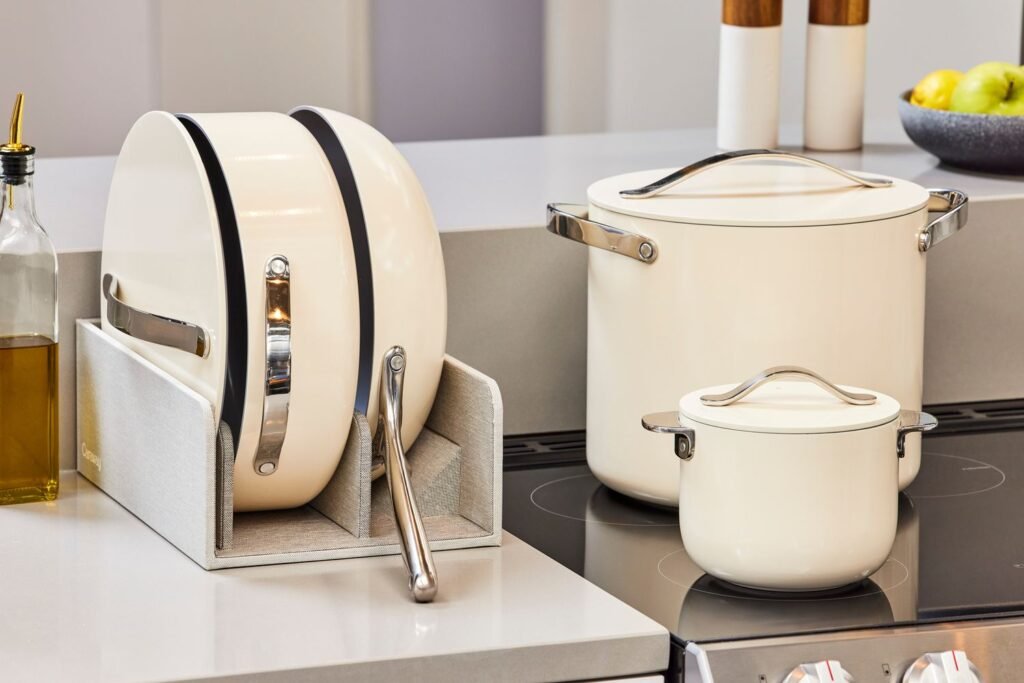
Vacation rentals, guest houses, and temporary living situations are the obvious fit. Cooking variety is limited, durability expectations are lower, and the compact, tidy setup makes practical sense for a space with rotating or occasional use. A nesting set handles that context well.
Kitchens with unusually shallow cabinet depth, not standard 12-inch deep shelves but the 8-to-9-inch shallow upper cabinets found in some older apartment buildings, can genuinely benefit from the reduced footprint a nested stack creates. Same for anyone storing cookware somewhere unconventional, inside an oven drawer, on a rolling cart shelf, or in a narrow cabinet that won’t fit standard pot stacks side by side.
And if you cook mostly stovetop, mostly at medium heat, mostly simple single-pot meals, thin-gauge material won’t register as a limitation. You’re not pushing the equipment anywhere near its edge, so the edge doesn’t come up.
The question to sit with honestly is whether you’re choosing it because your cooking actually suits it, or because it looks like it solves a space problem you haven’t fully diagnosed yet. Those are different reasons, and they lead to different outcomes. If you’re still working through the diagnosis part, counter space killers: 5 habits to break now covers a few of the patterns that quietly drive storage problems in the first place, before any product purchase makes things worse.
After 24 years of designing kitchens and working through decisions exactly like this one, my honest read is that nesting pots sit in the same category as most space-saving products. They deliver on their specific promise. The stack compresses, the cabinet looks cleaner, the tidiness is real. But they don’t automatically deliver on the larger expectation people bring to the purchase, which is that a constrained kitchen can now do more. More often, it’s a kitchen that does the same things with less visual clutter, and that’s a useful outcome, just a narrower one than the packaging suggests.
Know what you cook. Know what you actually reach for. And then decide whether the nesting set fits those answers, or whether two heavier, better-performing pots earn more of your cabinet back and serve you better every single day.
Frequently Asked Questions
Do nesting pots actually save meaningful cabinet space compared to regular cookware? Yes, but the savings depend on your current setup. Compared to a randomly stacked collection of mismatched pots and lids, a nesting set can reclaim 4 to 6 inches of vertical cabinet height. Compared to a deliberately curated two or three-piece regular cookware collection, the difference often narrows to an inch or two, sometimes none at all. Measure what you have before assuming the savings will be significant.
What’s the minimum cookware setup for a studio apartment kitchen? For most studio cooking, a 4 to 5 quart Dutch oven or deep saucepan plus a 10-inch skillet covers the majority of meals. A household of three or four may want a second smaller saucepan to round it out. You don’t need a matching set or a dedicated system for this to work well, just two pieces chosen for your actual cooking habits rather than for how they look in a cabinet.
Are nesting pot sets oven-safe enough for real cooking? Many are oven-safe, but with real limits. Most nesting sets are rated to 350°F because their lid handles use plastic or silicone components. A low-temperature braise fits that range, barely. If you roast at higher temperatures, finish dishes under a broiler, or bake bread, you’ll be past what most nesting sets can handle. Always check the specific temperature rating on the product page, not just the general “oven-safe” label.
Why do nesting pot sets cost more than individual pots of the same size? Mostly the engineering required to make pots that share compatible diameters, have handles that fold or nest cleanly, and come with lids designed to stack without gaps. It’s a more specialized manufacturing process than standard cookware. Whether that premium justifies itself depends on whether the compact stacking solves an actual problem in your kitchen, not a hypothetical one.
Is there a nesting set actually worth buying, or should I always build my own collection? There are well-made nesting sets, particularly from Zwilling, a few mid-tier kitchen brands, and GSI Outdoors for anyone whose small kitchen doubles as a travel or camping setup. Better sets use thicker-gauge material and fully oven-safe components throughout. If you’ve done the honest cooking audit and your habits genuinely suit a nesting setup, a quality set is worth the cost premium. The mistake is buying any set, cheap or expensive, before confirming it solves the problem you actually have.
Small kitchen storage ideas worth testing in 2026 covers more practical ways to evaluate what your kitchen actually needs before adding anything new to it.