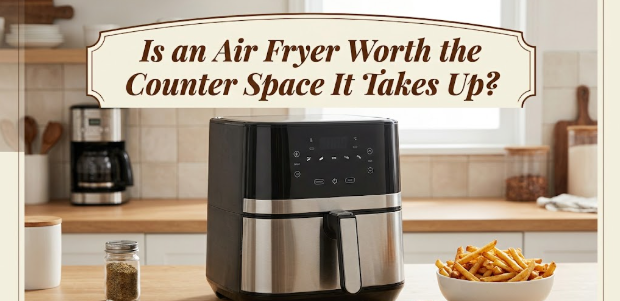
A useful appliance and an appliance that earns permanent counter space are not the same thing. After more than two decades in kitchen and bath design, I’d say the air fryer is the appliance that makes this distinction clearest, mostly because the confusion happens so predictably.
People buy air fryers because they work. That part is accurate. What happens next is the appliance lands on the counter, takes up twelve or fourteen inches of space nobody explicitly budgeted for, and that placement becomes the default. Nobody asks whether it should be there. It just is, and the counter shrinks a little bit, and the kitchen starts feeling smaller than it did before.
Whether an air fryer is worth the counter space depends on three things: how often you actually use it, what it replaces, and whether storing it is realistically manageable in your specific kitchen. All three matter. Skip one and you get the wrong answer.
1. The Physical Reality Before Any Other Calculation
Most air fryers are larger than people expect before they come out of the box.
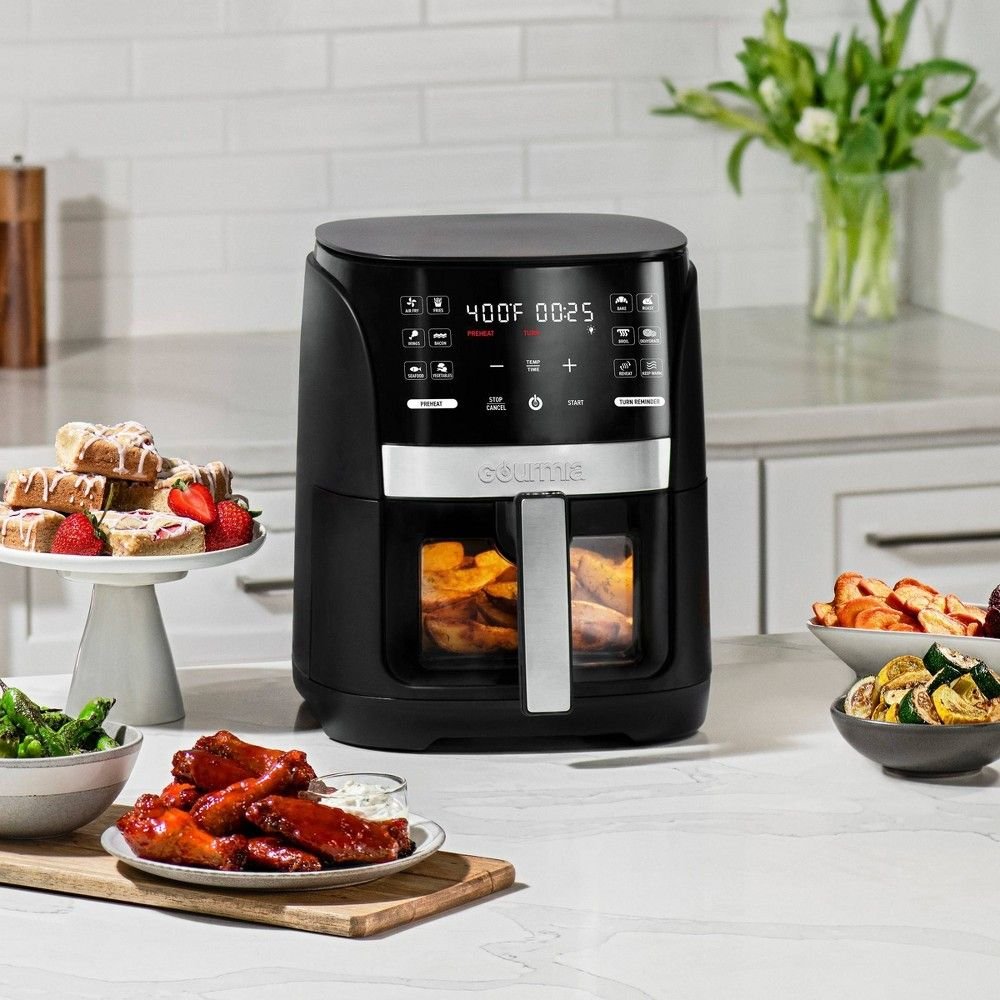
Compact models in the 2 to 3 quart range typically measure around 10 by 10 inches at the base, sometimes a bit wider. Standard 4 to 5 quart models run closer to 12 by 12 inches, sometimes 13 by 11. The larger basket-style fryers and the air fryer/toaster oven combos can reach 15 inches deep by 16 inches wide. And they’re tall. Most stand 12 to 14 inches high.
That height matters specifically in apartment kitchens, where the clearance between the counter surface and the underside of the upper cabinet shelf is typically 18 inches. Once an air fryer is in position, that clearance drops to four or five inches above the unit. The shelf directly overhead becomes essentially unreachable without moving the appliance first.
So the air fryer doesn’t just claim its own footprint. It claims the vertical zone above it too.
In a small kitchen where the total usable counter between the sink and the wall runs 24 to 36 linear inches, a 12-inch-deep model consumes between a third and half of that entire run. That’s not a criticism of the appliance. It’s a measurement. And in a kitchen this size, measurements are how you make decisions.
2. The Appliance Consolidation Argument (and When It Actually Holds)
This is the strongest case for the air fryer, and it’s worth taking seriously.
An air fryer can genuinely replace a toaster oven for most of what a toaster oven does: reheating leftovers, crisping vegetables, roasting a piece of fish, browning anything that needs texture on the outside. It heats up in under three minutes instead of twenty-five. For someone cooking single portions most nights, it’s often the better dry-heat tool in a small kitchen, and in some studio apartments with a slow, undersized oven, it becomes the practical primary cooking appliance for anything dry.
The consolidation logic works like this: if you own a toaster oven and you buy an air fryer and the toaster oven leaves the counter, your surface footprint stays the same while your cooking options improve. That’s a legitimate trade.
But only if the toaster oven actually goes. Keeping both on the counter is the outcome I see far more often. The toaster oven stays because moving it out feels like a task for another day, the air fryer arrives and gets a spot, and the counter absorbs both without anyone making a deliberate decision. That outcome isn’t neutral. It’s additive, and the counter is the one paying for it.
If the air fryer doesn’t replace something specific, it adds to the counter by default.
3. The Use Frequency Test Most People Skip
Here’s where people usually get the calculation wrong: they measure how much they value the appliance, not how often they actually reach for it.
The threshold I apply consistently in small kitchen work is what I think of as the three-times-per-week test. An appliance earns permanent counter placement if it gets used at least three times a week, consistently, and if accessing it from a cabinet would create enough friction that you’d realistically use it less often. Coffee makers meet this test almost universally. Toasters usually do. Stand mixers almost never do, even though people would never describe themselves as rarely using one.
Air fryers land somewhere in the middle, and where exactly depends on the household.
What makes this harder to assess honestly is that the first month of ownership isn’t representative. When an appliance is new, usage spikes. You experiment with it, you test things, it feels essential. Usage normalizes over time into the actual pattern. The air fryer I see permanently on the counter most often is the one that was used five times a week in January and is now used twice a week in April, but nobody revisited the placement decision after the novelty settled.
Track yours for two weeks. Not how you think you use it, how often you actually pull it out. If you’re consistently below three times a week and you have accessible storage, it shouldn’t live on the counter. That’s not a judgment about the appliance. It’s just what the kitchen math says.
The habit underneath this is the same one that drives most counter accumulation in small kitchens generally, and it’s the pattern I went into in depth in counter space killers: 5 habits to break now. The air fryer shows up there specifically because it’s the appliance this pattern applies to most often, it’s also often the biggest one on the counter.
4. The Weight Problem Nobody Solves Before Buying
Most air fryers weigh between 8 and 15 pounds. Larger basket-style models and combination units can reach 18 to 22 pounds.
That weight changes the storage equation in a way that’s easy to underestimate until you’re living with it. A light blender or a toaster can be pulled from a cabinet with one hand without interrupting anything else. An air fryer at 12 pounds requires a two-handed lift, and if the shelf where it lives requires any overhead reaching or repositioning to get to, that inconvenience becomes the actual reason the appliance never goes back to storage.
This is, most of the time, the real mechanism behind permanent counter placement. Not a deliberate decision about the best spot. An ergonomic default. Moving it takes effort, the counter is already there, so the counter wins.
The solutions that actually hold up are specific.
A pull-out shelf installed at counter height inside a base cabinet is the most effective one. The appliance sits on the shelf at the right height, the shelf extends to the cabinet face so you can use the air fryer without lifting it, and it slides back when cooking is done. The counter above that base cabinet opens up for prep. This requires the right cabinet configuration, but it’s a hardware install, not a renovation.
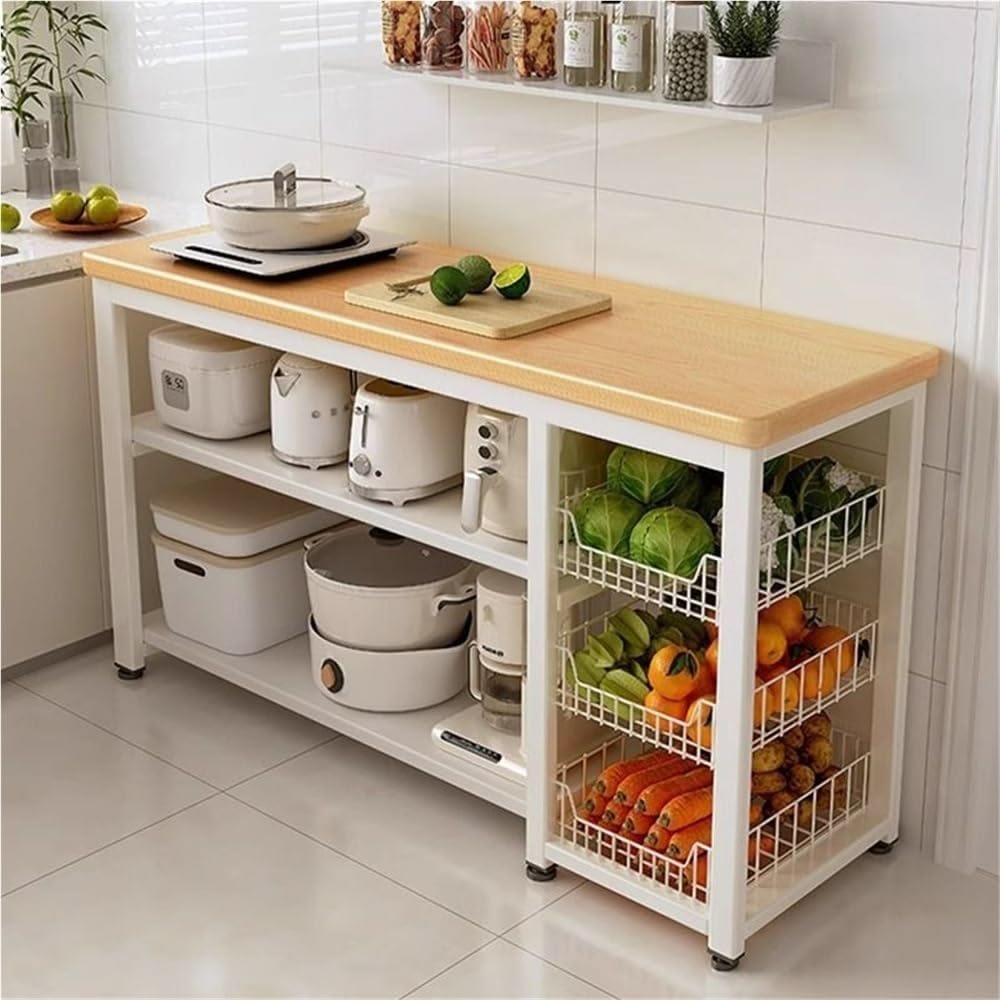
A rolling cart positioned near the counter is the other option worth considering seriously. The air fryer lives on the cart, which rolls out for use and back against the wall when it isn’t needed. The cart functions as additional surface height when the air fryer is in use. For a kitchen where storage flexibility matters more than fixed organization, this arrangement gives more adaptability than any fixed shelf solution. Whether a rolling cart can genuinely anchor a small kitchen storage system is a question worth answering honestly, and the practical case for it is covered in can a rolling cart replace the pantry you never had.
Two things that don’t work, and I want to say this directly: the top of the refrigerator, because air fryers produce and retain heat and parking a warm appliance on a refrigerator compressor creates problems you don’t want. And overhead shelving that requires lifting a 15-pound appliance down from above shoulder height before every use. That’s a habit with a lifespan of about three weeks.
Air Fryer on the Counter vs. Stored Away: A Practical Breakdown
| On the Counter | In Storage (Cabinet or Cart) | |
|---|---|---|
| Setup time per use | None | 30 to 60 seconds |
| Counter space impact | 100 to 225+ square inches permanently | Zero when not in active use |
| Clearance above the unit | Lost (4 to 6 inches remaining) | Available as before |
| Upper shelf access | Blocked or impractical without moving unit | Normal |
| Use pattern | Often habitual rather than intentional | Forces honest look at actual frequency |
| Works best for | Daily users who’ve removed a comparable appliance | Anyone using it fewer than 4x/week with accessible storage |
The Honest Answer
For someone cooking with an air fryer every single day, who has genuinely removed the toaster oven from the counter, and whose storage options require an inconvenient lift or overhead reach, the counter is defensible. Those are specific conditions, and they’re real for some households.
For most small-kitchen households, and this is based on the actual pattern I see rather than a general rule, it isn’t where the air fryer should live. The appliance is good. The placement is a habit that formed by default, not a decision that was made.
At Tiny Kitchen Living, the questions that come up most aren’t whether to own a particular appliance. They’re about whether the appliance’s permanent placement was ever actually decided, or just happened. Clear the air fryer off the counter for two weeks. Use it from a lower cabinet or a cart. Notice how much prep surface opens up. Notice how often you actually pull it out. After two weeks you’ll know whether it earns its spot or whether it was just occupying it.
If you’re in the middle of a broader counter-clearing effort and want a practical framework for what to prioritize, small kitchen storage ideas worth testing in 2026 covers the sequencing well. And for the underlying question of how to actually cook when surface space is already the binding constraint, cooking with almost no counter space at all is worth going through before making any new appliance placement decisions.
Frequently Asked Questions
What size air fryer is actually practical for a small kitchen?
For one person or a couple, a compact 3-quart model with a roughly 10 by 10-inch footprint handles most realistic cooking tasks without claiming the surface area the larger models require. If you’re regularly cooking for three or four people and the air fryer is replacing your oven for most dry-heat cooking, the larger capacity may be worth the footprint tradeoff. The combo units that function as both air fryer and toaster oven are worth considering only if they’re genuinely replacing both appliances, not becoming a third thing on an already crowded counter.
Can I store an air fryer in a standard kitchen cabinet?
Yes, with two conditions. The interior cabinet height needs to clear the appliance with some margin (most air fryers need at least 15 to 16 inches of clearance, some more). And the shelf needs to be at a height where lifting a 10 to 15-pound appliance is manageable without difficulty. A base cabinet with a pull-out shelf at counter height is the most practical setup. Standard upper cabinets are generally too high to make the weight workable over time, and the overhead lift eventually stops happening.
Does an air fryer actually replace a toaster oven, or do they do different things?
For most tasks, yes, the air fryer does what a toaster oven does and does it faster. Reheating, roasting, crisping, browning, small baking jobs. The toaster oven has a slight edge for very flat items where top-down radiant heat produces more even browning across the surface. But for 90 percent of what people actually use these appliances for, the air fryer covers it. If you’re making a genuine swap, the trade is worth making. Just make sure the toaster oven actually comes off the counter rather than staying because the swap felt inconvenient.
Is an air fryer energy-efficient compared to a regular oven?
For comparable tasks, yes. Air fryers typically draw 1200 to 1800 watts and cook faster, which means less total energy per dish than an oven preheating to 400 degrees and holding temperature for a 30-minute cook. The efficiency advantage is most noticeable for single portions and small batches. For larger quantities where the air fryer has to run multiple cycles back-to-back, the gap narrows considerably and the conventional oven often wins on total energy.
My counter is already overcrowded. Where do I even start?
Start with the appliances, not the smaller items. Counters fill up in layers, with appliances forming the base layer that everything else accumulates around. If one appliance can move to a cabinet or cart, it usually clears enough surface to make the next problem visible and workable. The approach detailed in counter clearing in a small kitchen: what changes lays out how to work through this systematically, without just relocating the same clutter from one zone to another.