Most cooking advice is written for kitchens that have room. Ample room. The kind where you set out a cutting board, a mixing bowl, and a sheet pan, and still have two feet of surface left over for your coffee and your phone. If that’s not your kitchen, that advice is quietly useless to you.
I’ve spent 24 years designing kitchens. Some of those projects had more square footage than some studio apartments I’ve toured. But the work that genuinely changed how I think about cooking workflow came from the small ones. The galley kitchens so narrow you couldn’t open a drawer and step back at the same time. The studio setups with a two-burner cooktop, a half-size fridge, and maybe 22 inches of surface between the sink and the wall. Those spaces forced a question I didn’t expect: what if you stopped waiting for counter space and just cooked without it?
That’s what this method is about.
1. Why Your Counter Is Not the Problem
Here’s what typically happens in a tiny kitchen. You set something down on the only available surface. Then something else goes next to it. Now you need the first item and the second is in the way, but there’s no clear place to put it, so it migrates to the stovetop. And suddenly you’re cooking with a third of your burners blocked and a steadily growing frustration that the kitchen is “too small.”
It’s not too small. The workflow is wrong.
Traditional cooking assumes a staging area. You chop here, you prep here, you set down the finished product here before it goes to the plate. That model works in a 14-foot kitchen. In a 6-foot galley, there is no staging area, and trying to create one mid-cook is exactly how the chaos starts.
The no-counter method doesn’t try to recreate that staging area. It removes the need for it entirely.
Before going further, it’s worth reading through counter space killers and the habits behind them because some of what drains your surface has nothing to do with cooking. Clearing that first makes everything else here land better.
2. The Three Core Principles (And Why Most People Only Try One)
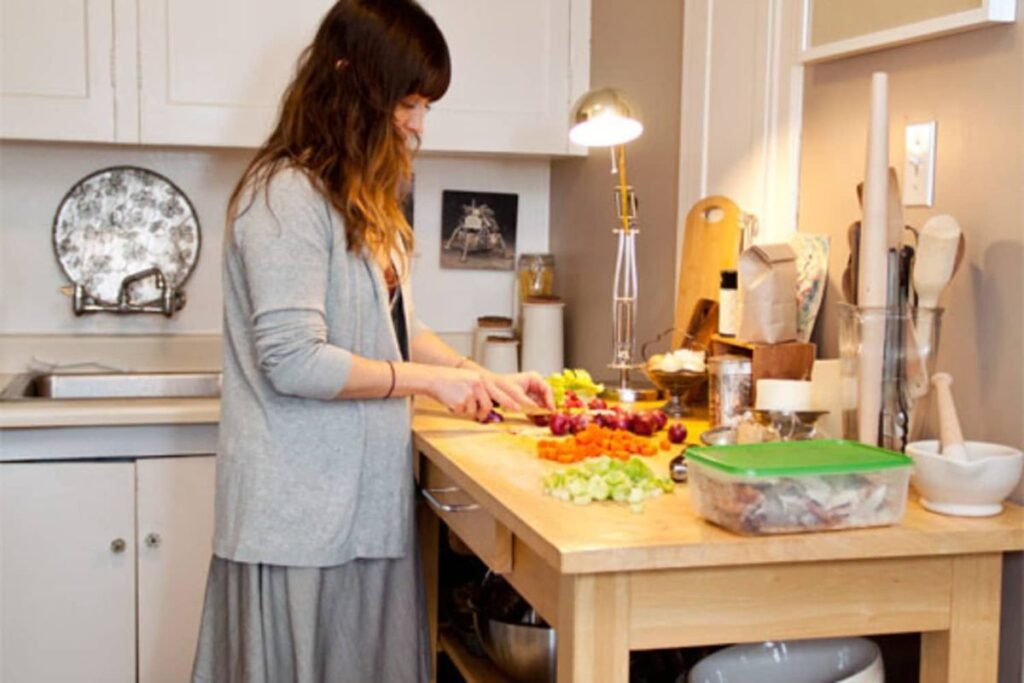
A few years ago, I worked with a client in a Brooklyn studio. She had maybe 18 inches of counter between her sink and her refrigerator. Not 18 inches of usable counter. Eighteen total. She’d mostly been surviving on takeout because cooking felt physically impossible.
What we figured out together wasn’t a gadget fix. It was sequence, containment, and equipment. Three things. Most people find the equipment idea first, buy a few things, and then wonder why the system still collapses.
Sequence means cooking in the right order. Not the order a recipe suggests, which is typically written for someone with three distinct prep surfaces. The order that means you’re never holding something with nowhere to put it. Proteins go into the pan first when they need the most cook time. While they cook, you do any chopping directly over the sink or directly into the pot. You’re not cutting something and then scanning the room for a clear surface because the pan needs your attention.
Containment means your prep always lives inside a container. Not a cutting board that needs to go somewhere once you’re done with it. A large bowl sitting in the sink while you chop into it. A pot that catches everything in sequence. A sheet pan that holds all your raw ingredients, then travels directly into the oven. You stop prepping and transferring. The prep vessel is either the cooking vessel or the direct feeder into it.
Equipment means choosing tools that don’t demand a flat surface. This is where most people get tripped up, and I’ll come back to it in a moment.
3. The Equipment Shift Nobody Talks About
Most kitchen tools assume you’ll set them down somewhere. A cutting board needs a surface. A colander needs a second hand and a clear spot near the sink. Even a basic electric kettle assumes a surface while it heats.
When there’s no counter, or nearly none, you can’t organize your kitchen around equipment that demands one.
The shift is toward things that hang, clamp, sit inside other things, or live on the stovetop. A pot with a built-in strainer lid means no separate colander and no precarious draining situation over the sink while the steam hits your face. A cast iron skillet moves from stovetop to oven without a second vessel. A deep wok functions as a wok, a steamer when you add a bamboo insert, and a makeshift braising pot with a lid. One pan, three cooking functions, nothing sitting on the counter waiting.
The single most underused setup in a no-counter kitchen is an over-the-sink cutting board. Not the flimsy plastic kind. A solid bamboo board that spans your sink completely, gives you a work surface, and lets you sweep everything directly into the water or down into a pot below. That’s a genuine prep area created from dead space.
No counter needed.
If your storage situation is keeping you from getting down to the essential equipment, the small kitchen storage ideas worth testing in 2026 is a good place to look. Because part of no-counter cooking is not having so much stuff that you can’t locate the one tool you actually need when the burner is already on.
No-Counter Cooking: Method at a Glance
| Traditional Cooking Assumption | No-Counter Replacement |
|---|---|
| Cutting board set on counter | Over-sink cutting board or chop directly into a pot |
| Ingredients prepped and staged separately | Prep in sequence, directly into the pan or bowl |
| Multiple bowls for different stages | One large bowl or pot as the single prep vessel |
| Draining pasta in a colander | Pot with strainer lid or a pasta basket insert |
| Electric kettle on the counter | Stovetop kettle or heat water in a saucepan |
| Cooling baked goods on a rack | Sheet pan rested on open oven door or stove grate |
| Paper towels on the counter | Inside-cabinet-door mount or magnetic strip on fridge |
4. Where This Goes Wrong (And It Usually Goes Wrong the Same Way)
People try to apply this method to a counter-heavy recipe. They read “no-counter cooking,” feel encouraged, and then attempt to make croissants or a layered cake in 20 inches of kitchen. That’s not what this is for, and when it fails, they write off the whole approach.
No-counter cooking is built for weeknight meals. Stir-fries, braises, sheet pan dinners, soups, grain bowls, eggs every way. The cuisines that developed historically in small cooking spaces, Chinese home cooking, Japanese teishoku-style meals, most street food traditions, are already built around this method. They didn’t have marble islands and six-burner ranges. They built technique around real physical constraints, and the results are some of the most efficient cooking in the world.
The mistake is treating this as a limitation and mourning what you can’t do. The better frame is treating it as a filter. You cook the things this method does exceptionally well. And there are many of them.
There’s also a common setup mistake that defeats people before they start. They get the sequencing right but leave the storage problem unsolved. If every surface still gets immediately reclaimed by things that have nowhere else to live, the method collapses on the second cook. The counter clearing approach covers this directly. The two problems feed each other, and solving only one of them doesn’t hold.
At Tiny Kitchen Living, the framing we keep coming back to is this: the counter isn’t a workspace you’re missing. It’s a symptom of a system that hasn’t been designed yet.
5. What a Real Weeknight Looks Like Using This Method
Not abstract principles. An actual 25-minute dinner in a tiny kitchen.
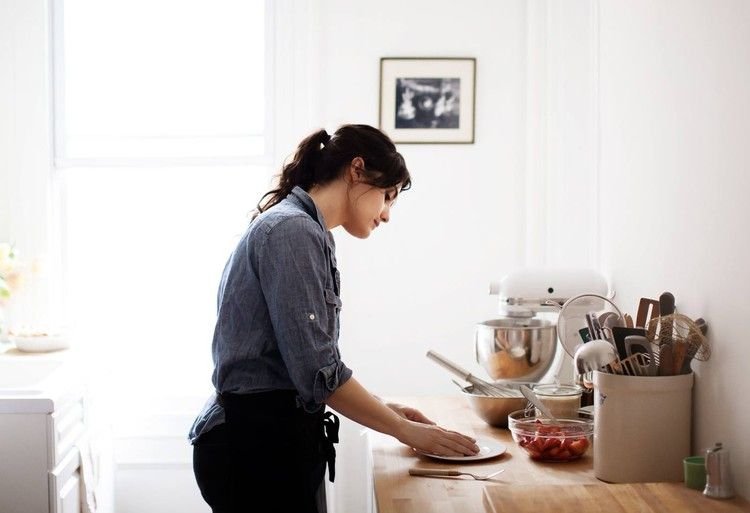
You start with whatever protein you’re cooking. Season it while it’s still in its packaging or directly in the pan. Get it onto heat. While it cooks, you do any chopping using your over-sink board, scraps going straight into the drain or a small bin below. Vegetables go into the pan when the protein is halfway done, or into a separate pot if you’re doing a grain bowl.
You’re not moving things from surface to surface. You’re working in a tight loop: from storage, to prep, directly into heat. The sink functions as your staging area. The stovetop is your staging area. The open oven door, if you need a flat surface for 30 seconds, is your staging area.
Pasta cooks in the pot, strains with a lid, plates directly into bowls. Soup builds in one pot from start to finish. The wok handles four different vegetables in sequence without ever leaving the burner. Is this different from how you’ve been cooking? Almost certainly. Does it take a few tries to stop reflexively reaching for counter space that isn’t there? Yes, it does.
But the adjustment is faster than most people expect, because the method works with the kitchen you have. Not against it.
Once you’re cooking this way consistently, the one-cabinet pantry system becomes a natural companion. How you store things changes when you’re no longer staging everything out first. The pantry and the method start informing each other.
FAQs
Can someone actually cook full meals without any counter space? Yes, and millions of people do it every day without naming it as a method. It requires sequencing prep differently and choosing equipment that doesn’t need a staging surface. Once those two things shift, the complexity of meals you can produce isn’t really limited by available counter space.
What types of cooking are hardest to pull off with no counter? Baking is the most genuinely difficult category. Rolling dough, shaping bread, assembling a decorated cake, all of it wants a large flat surface and often multiple staging points. It’s workable with workarounds but this is where the constraint shows up most clearly. Stovetop cooking adapts far more easily than baking does.
Is an over-the-sink cutting board actually worth buying? For most tiny kitchens, yes. Look for solid bamboo with a built-in strainer or colander section. The thin plastic versions flex under pressure, which is a safety issue when you’re cutting. A well-made one is a genuine functional replacement for a missing prep surface, not just a novelty item.
Do I need to buy all new equipment to cook this way? Not necessarily. Audit what you already own first. The core principle is consolidating toward multi-function pieces. If you have a cast iron skillet, a large pot with a lid that strains, and a deep pan, you’re close. The goal isn’t more equipment. It’s fewer things that each do more.
How does this method hold up for meal prep and batch cooking? It works well because batch cooking in a small kitchen naturally favors things like large pots of grains, sheet pan proteins, and stovetop soups, all of which fit the no-counter approach. The adjustment is that you work through one component at a time rather than prepping everything simultaneously. It’s a sequential method, not a parallel one. And batch cooking, honestly, benefits from that structure.
There’s a version of cooking in a tiny kitchen that’s miserable, and it looks like constantly fighting the space. This method goes the other way. You stop expecting the kitchen to behave like something it’s not, and you build a cook’s practice that fits what’s actually there.
That shift is smaller than it sounds. It makes more difference than most equipment upgrades ever will.