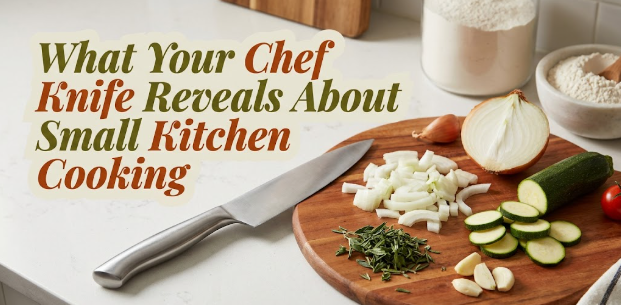
Most people in a tiny kitchen own four knives and use one. The other three sit in a block taking up the only stretch of counter long enough to actually cut something on. That’s not a knife problem. It’s a space problem wearing a knife costume, and it shows up in almost every studio and galley kitchen we hear about at Tiny Kitchen Living.
The knife you reach for, and where it lives when you’re not using it, says more about how your kitchen actually functions than your cabinet layout does. A drawer full of gadgets is forgivable. A dull blade and nowhere good to put it is the thing that quietly makes cooking harder every single night.
1. The One Knife Reality Nobody Plans For
In a full-size kitchen, having six knives is a mild indulgence. In 60 square feet, it’s six things competing for the same twelve inches of counter. Most small-kitchen cooks end up using one knife for nearly everything, whether they meant to or not, simply because pulling out a paring knife for one task and a serrated knife for another isn’t realistic when there’s no room to lay either of them down safely in between.
This isn’t a downgrade. A good 7 or 8 inch chef’s knife handles dicing, slicing, mincing, breaking down a chicken, and even rough bread cuts well enough that most other blades become occasional tools rather than daily ones. The mistake isn’t owning one knife. The mistake is owning five and pretending you’re using all of them, when really you’re storing four and using one.
We talk about this a lot on the site, because the same logic shows up in why one good pot beats a full cookware set in small spaces. Tiny kitchens reward depth over inventory. One tool, used well and kept sharp, beats a drawer of half-used options every time.
2. What a Dull Blade Actually Costs You in Counter Space
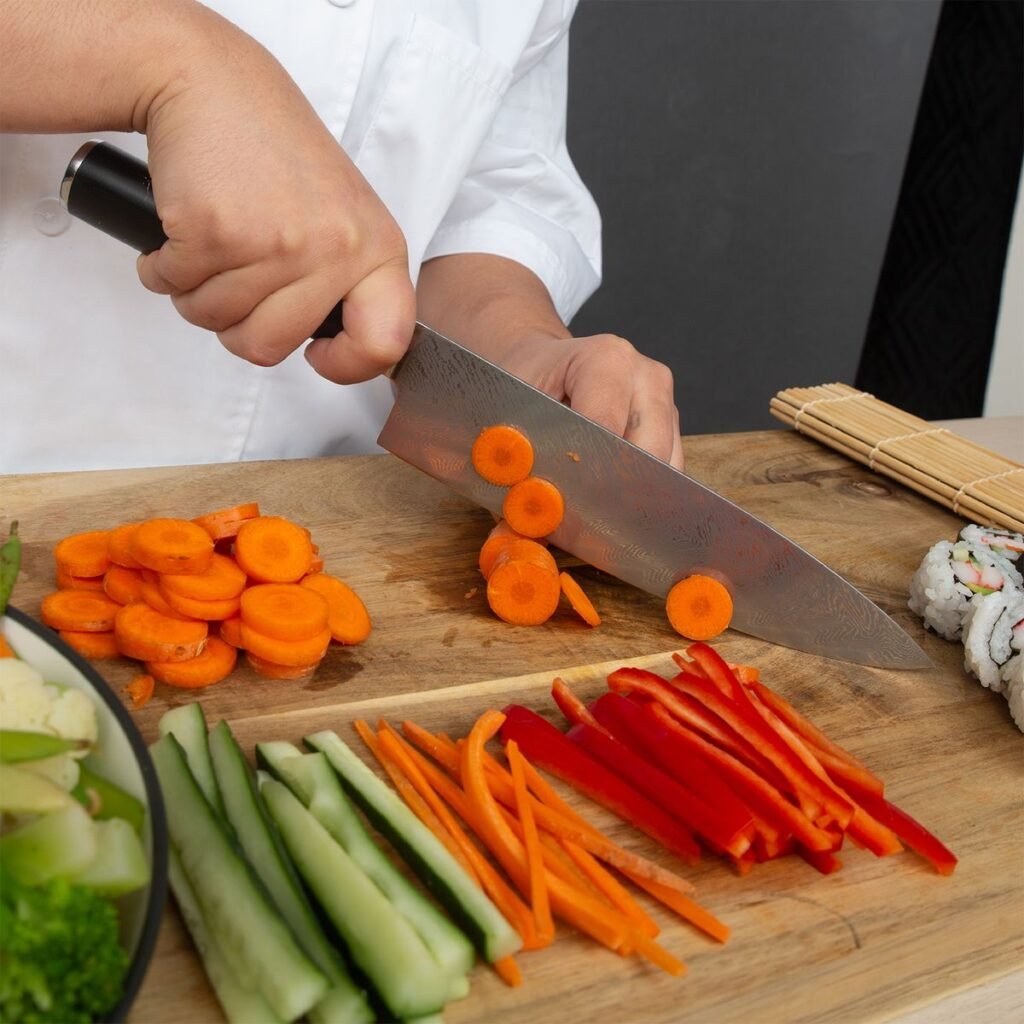
Here’s the part people miss. A dull knife doesn’t just cut poorly, it cuts slower and with more force, which means more wobble, more rocking, and more food sliding off the board onto the counter around it. You end up needing a bigger cutting surface to contain the mess a sharp knife wouldn’t have made in the first place.
And that bigger surface has to come from somewhere. In a kitchen with eighteen inches of counter total, a cutting board that’s grown to compensate for a bad blade is eating space you don’t have to give.
Restaurant line cooks figured this out decades ago, working stations that are honestly smaller than a lot of home kitchens. How professional cooks work in kitchens with no counter covers this in more depth, but the short version is that a sharp blade and good technique let you work in a footprint that would otherwise feel impossible. Sharpening isn’t a nice-to-have here. It’s space management.
A kitchen knife held at the right angle on a whetstone for two minutes a week does more for your usable counter space than another organizer ever will. Most people sharpen maybe twice a year. Once a week, even briefly, with a honing rod between full sharpenings, keeps the blade from drifting dull enough to need that extra room.
3. Where the Knife Lives Matters as Much as the Knife Itself
A knife stored loose in a drawer dulls faster, period. The edge knocks against spoons and measuring cups every time the drawer opens, and you lose the blade angle bit by bit without noticing until everything feels harder to cut. It’s also, frankly, how people get cut reaching into a drawer they’re not looking at.
A magnetic strip mounted on the wall or the inside of a cabinet door solves both problems and adds zero counter footprint, which in a small kitchen counts as a small miracle. If wall space is the one thing you genuinely don’t have, an in-drawer knife guard or blade sheath keeps the edge protected without needing a wall at all.
If your kitchen doesn’t have drawers to work with in the first place, the storage question gets harder, and we’ve written a full breakdown on kitchen with no drawers: what works instead for exactly that situation. The short answer involves rail systems and cabinet door space more than people expect.
4. One Good Knife Versus a Full Block, the Comparison Most People Skip
Before buying anything, it’s worth actually laying this out instead of assuming a knife block is the safer choice because it looks complete.
| One Good Chef’s Knife | Full Knife Block (6-8 pieces) | |
|---|---|---|
| Counter or drawer space needed | Minimal, fits a strip or sheath | 8-10 inches, usually permanent |
| Typical upfront cost | $60-150 for one quality blade | $150-400, quality varies piece to piece |
| Maintenance | One edge to keep sharp | Multiple edges, most neglected |
| Versatility in daily small-batch cooking | Handles 90% of tasks | Most pieces used rarely, if ever |
| Learning curve | Fast, one blade to get comfortable with | Slower, technique splits across tools |
The block isn’t a bad product. It’s a bad fit for a kitchen where every surface does triple duty. Most owners of a full set can name maybe two knives from it they’d actually miss.
5. Where Small Kitchens Usually Go Wrong With Knives
The most common mistake isn’t the knife itself, it’s buying the set before living in the space for a few months. Someone moves into a studio in Queens or a one-bedroom above a shop in Manchester, unpacks a wedding-gift knife block because it’s what they already own, and gives up a foot of counter to it without ever questioning whether they need all eight pieces.
The second mistake is choosing a knife that’s too long for the cutting board you actually have room for. A 10-inch chef’s knife on an 11-inch board means the tip and heel are constantly hanging off the edge, which is awkward and a little unsafe. Matching blade length to the board you can realistically fit, not the board you wish you had, makes the daily experience noticeably better.
And the third, which nobody likes hearing, is treating the knife as a one-time purchase instead of an ongoing relationship. You buy it once. You should be touching it up weekly, whether that’s a few strokes on a honing rod or a proper sharpening every couple of months depending on how often you cook.
If you’re trying to figure out what else is eating your prep space beyond the knife situation, cooking with almost no counter space at all goes through the rest of it room by room.
A Quieter Note on All This
None of this means you need fewer knives than you’re comfortable with. Some people genuinely use a paring knife daily and should keep one within reach. The point isn’t minimalism for its own sake, it’s choosing tools that match the square footage you’re actually cooking in rather than the kitchen you might have someday. A sharp, well-placed chef’s knife in a tiny kitchen does more real work than a beautiful set sitting half-used in a kitchen three times the size.
Frequently Asked Questions
Do I really only need one knife in a small kitchen? For most daily cooking, yes, one good chef’s knife covers dicing, slicing, and most prep work. A paring knife is the second most useful addition if you’re doing a lot of fine work like deveining shrimp or hulling strawberries, but it’s the only other one most people genuinely need.
What size chef’s knife works best in a tight kitchen? A 7 to 8 inch blade is the sweet spot for most small kitchens. It’s long enough to handle real prep work but short enough to use comfortably on a compact cutting board without the tip hanging off constantly.
How often should I sharpen a knife I use every day? Hone the edge weekly with a honing rod, and get a full sharpening done every two to three months if you’re cooking most nights. Less frequent cooks can usually stretch a full sharpening to twice a year.
Is a magnetic knife strip safe with kids around? It can be, as long as it’s mounted high enough that small children can’t reach it and knives are placed with the edge facing the wall, not outward. In households with young kids, an in-drawer guard with a child safety latch is often the more practical choice.
What’s the real difference between honing and sharpening? Honing realigns the existing edge and takes seconds, it doesn’t remove metal. Sharpening actually grinds a new edge and removes a small amount of material, which is why it’s needed far less often. Most knives that feel dull just need honing, not a full sharpen.
If you’re curious how a country with some of the smallest residential kitchens in the world handles exactly this kind of tool minimalism, tiny kitchen cooking: what Japan gets right is worth a read next.