Most studio apartments aren’t actually short on space. They’re short on space that’s being used correctly. I’ve walked into 400 square foot units that felt smaller than they were, and 550 square foot units that lived like a one bedroom. The difference almost never comes down to square footage on paper. It comes down to three specific decisions, and most people get all three wrong without realizing it.
I’m a Certified Master Kitchen and Bath Designer, and studio layouts are where this work gets interesting. There’s no room to hide a bad decision. Every cabinet, every door, every piece of furniture has to justify the floor it sits on. So when I say a handful of changes can functionally double the usable area of a studio, I mean it in a literal, measurable sense, not as a marketing line.
1. The Square Footage You’re Losing to Door Swings
Here’s something most renters and even a lot of new homeowners never think about: a standard 30 inch hinged door needs roughly 6 to 7 square feet of clear floor space to open and close. That’s not storage. That’s not seating. That’s just air, reserved permanently, so a door can swing through it.
In a studio under 500 square feet, that’s often 2 to 3 percent of your entire living area, gone, just for door clearance. Multiply that across a bathroom door, a closet door, and sometimes a second closet door, and you’ve quietly lost the equivalent of a small reading nook.
The fix is almost boring in how simple it is. Pocket doors, barn-style sliders, or even bifold doors on closets reclaim that swing radius entirely. I’ve specified pocket doors on bathroom entries more times than I can count, and the apartment doesn’t look different from across the room, it just suddenly has somewhere to put a chair it didn’t have before.
This is also where I tell people to stop treating their front hall closet door as untouchable. Swapping it for a sliding door, even a basic track-mounted one from a hardware store, is a half-day project for someone reasonably handy. It is not a renovation.
2. Floor-to-Ceiling Storage Most People Stop Short Of
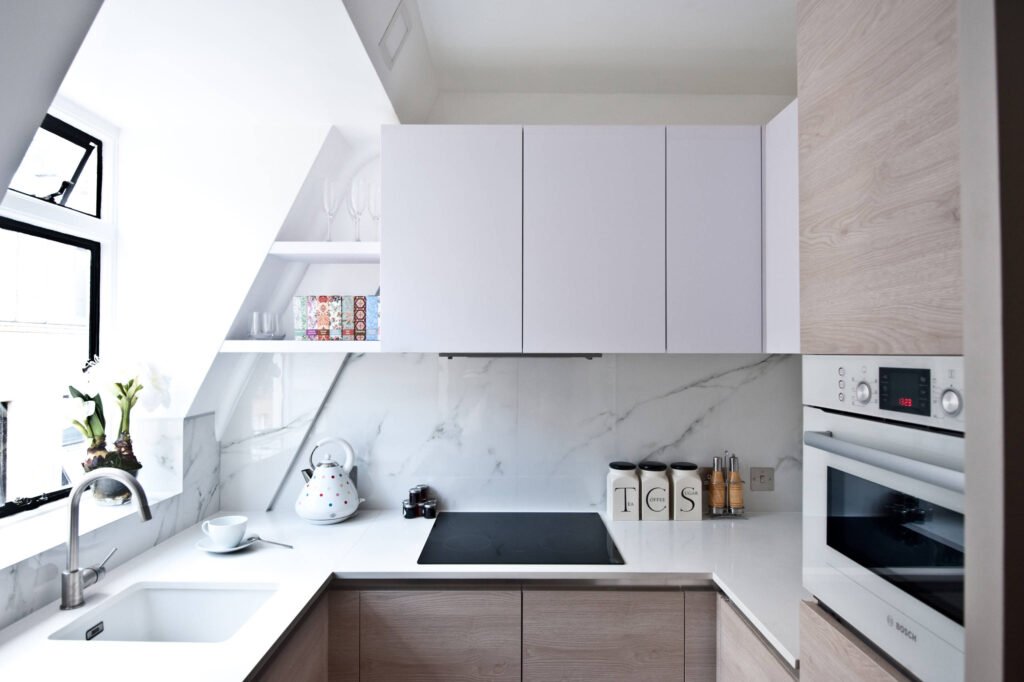
Almost every kitchen cabinet in a standard apartment build stops around 84 inches off the floor. Above that is dead space, usually 12 to 18 inches of it, running the entire length of the kitchen wall. Nobody designed that gap on purpose. It’s just where the contractor’s standard cabinet run happened to end.
Why does cabinet space run out faster than you think is something I get asked about constantly, and the honest answer is that the cabinets were never sized for how much the average person actually owns. Going floor to ceiling, even with a simple stacked shelf unit above existing cabinets, typically adds back 8 to 12 cubic feet of storage in a kitchen that size. That’s enough to move your seasonal dishware, small appliances, or bulk pantry goods entirely out of your primary counter zone.
The same logic applies in the bathroom and the closet. If a wall has height you’re not using, you’re not out of storage, you’re out of storage at a height you’ve decided to ignore.
And yes, you’ll need a step stool. That’s a fair trade for getting your counters back.
3. Furniture That Refuses to Do Just One Job
A studio doesn’t have room for furniture that only does one thing. This is the part people resist the most, because single-purpose furniture is cheaper and easier to shop for. A dining table that’s only a dining table. A bench that’s only a bench. Every one of those is a missed opportunity in a small footprint.
The swap I push hardest is a drop-leaf or extendable table against a wall, paired with stools that tuck fully underneath. Folded down, it reads as a console. Extended, it seats four. That single piece can replace what would otherwise be a dedicated dining set eating up 25 to 35 square feet permanently.
Ottomans and benches with lift tops or interior storage do similar work for linens, shoes, or the bin of cables nobody knows where to put. None of this is exotic. It’s just choosing furniture based on how many jobs it can do, not how it looks in a showroom photo. Counter space killers: 5 habits to break now covers a related version of this same problem in the kitchen specifically, where the same one-job-only thinking shows up with appliances.
Where People Usually Get This Wrong
The mistake I see most often isn’t picking the wrong hack. It’s doing all three at once, in the same month, without sequencing them. Floor-to-ceiling storage built before you’ve solved the door swing problem just means you’ve created more stuff to store in a room you still can’t move around in efficiently.
Start with the door. It’s the cheapest fix and it changes how the whole room functions immediately. Then storage. Then furniture, since furniture choices get easier once you actually know how much floor you have left.
The second mistake, and this one’s smaller but it adds up, is buying multi-functional furniture that’s slightly too big for the space it’s replacing. A drop-leaf table that extends to seat six in a studio meant for one or two people isn’t solving your space problem, it’s relocating it.
A Quick Comparison of the Three Changes
| Change | Typical Space Reclaimed | Approx. Cost Range | DIY Friendly |
|---|---|---|---|
| Swap hinged door for pocket/sliding door | 6-7 sq ft per door | $80-$400 per door | Yes, with basic tools |
| Floor-to-ceiling kitchen storage | 8-12 cubic ft | $50-$600 depending on materials | Mostly yes |
| Multi-functional furniture swap | 20-35 sq ft (vs. single-purpose pieces) | $150-$900 per piece | Yes, no install needed |
None of these require a contractor crew or a permit in most buildings, which is part of why they work for renters as well as owners.
Putting It Together in a Real Layout
If you’re working through this in order, the door swing audit takes an afternoon. Walk your unit and note every door that opens into a room rather than a closet you rarely use. Those are your candidates. The vertical storage pass takes a weekend, mostly because measuring and mounting shelving correctly takes longer than people expect, not because the work itself is hard.
Furniture is the slow one, honestly, because finding the right piece takes more shopping than building. I tell clients to measure twice, sit on or sit at the floor model if at all possible, and resist anything marketed as “space saving” without checking the actual folded and unfolded dimensions against their own floor plan. One cabinet pantry system: how to build it walks through a related approach if your kitchen storage gap is specifically pantry space rather than general cabinetry.
I’d also say, and this is a smaller point but worth raising, that none of this works as a one-time fix. Studios accumulate clutter the same way any home does. The difference is a studio shows it within a week instead of within a year.
Frequently Asked Questions
Will a pocket door actually fit in my existing wall, or does that require construction? Most pocket door installs do require opening the wall to insert the frame, so it’s a bigger project than swapping a hinge. A sliding barn-style door mounted on the wall surface, by contrast, needs no wall modification and can usually go in within a few hours.
Is floor-to-ceiling storage worth it if my ceilings are only 8 feet? Yes, though the gain is smaller than in a unit with 9 or 10 foot ceilings. Even an 8 foot ceiling typically has 10 to 14 inches of unused space above standard cabinets, which is still enough for bins, seasonal items, or extra dishware.
What’s the single best place to start if I can only afford to fix one thing right now? The door swing fix, almost always. It’s the lowest cost change on this list and it immediately changes how a room can be furnished, which affects every decision that comes after it.
Do multi-functional furniture pieces actually hold up over time, or do they break down faster than regular furniture? Quality varies a lot here, more than with single-purpose furniture. Check the hinge and hardware warranty specifically, since that’s almost always the first thing to fail on a drop-leaf table or lift-top ottoman.
Can renters do any of this without violating a lease? Door swaps and furniture changes are almost always fine since nothing structural changes and the original door can be reinstalled at move-out. Built-in shelving is the one to check with your landlord first, particularly if it involves drilling into walls.
If you want a deeper look at how this plays out specifically in the kitchen, small kitchen storage ideas worth testing in 2026 is a good next read, and it pairs well with everything covered here.