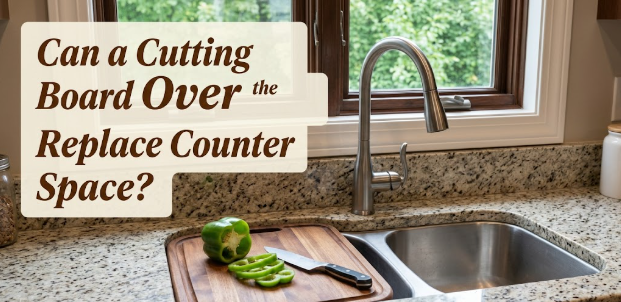
Short answer: no. But that’s not the right question to be asking.
The reason this one keeps coming up is completely understandable. A studio kitchen with nine inches of working surface on one side of the sink and nothing on the other is a genuinely difficult place to cook. An over-sink cutting board looks like the clean fix. Drop it over the basin, reclaim the space, done. Every small-kitchen roundup on the internet has one photographed next to a tasteful linen hand towel, and they always look like the obvious answer.
That framing is part of what creates the disappointment. People buy one expecting a counter replacement and end up with something that functions more like a specialized workstation. When you understand what it actually is, it becomes a more useful tool. When you expect it to be something it isn’t, it ends up in the cabinet after three weeks.
I’ve been designing kitchens for twenty-four years, and at Tiny Kitchen Living we talk about space problems at this scale constantly. The over-sink cutting board question comes in more often than almost any other product question, which is exactly why it deserves a real answer rather than a quick yes.
1. The Actual Function of an Over-Sink Cutting Board
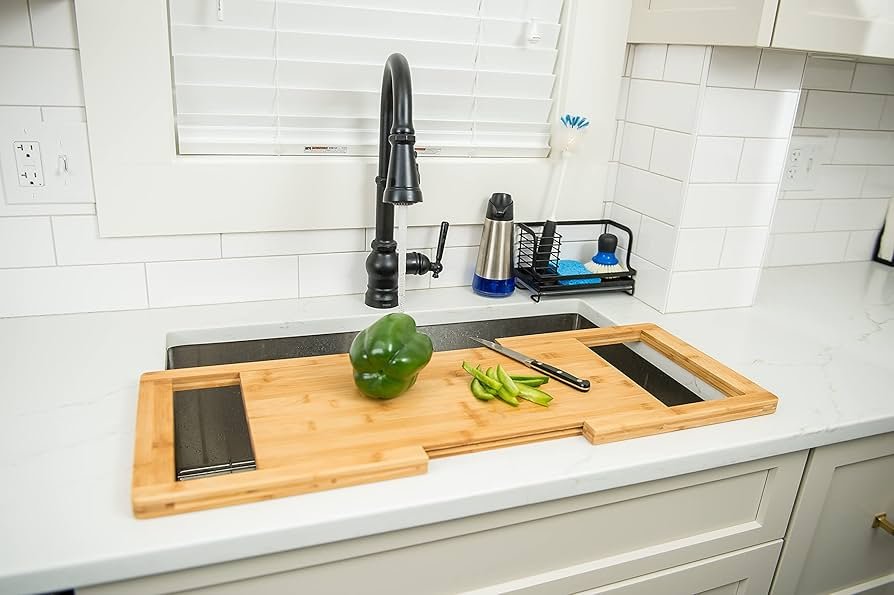
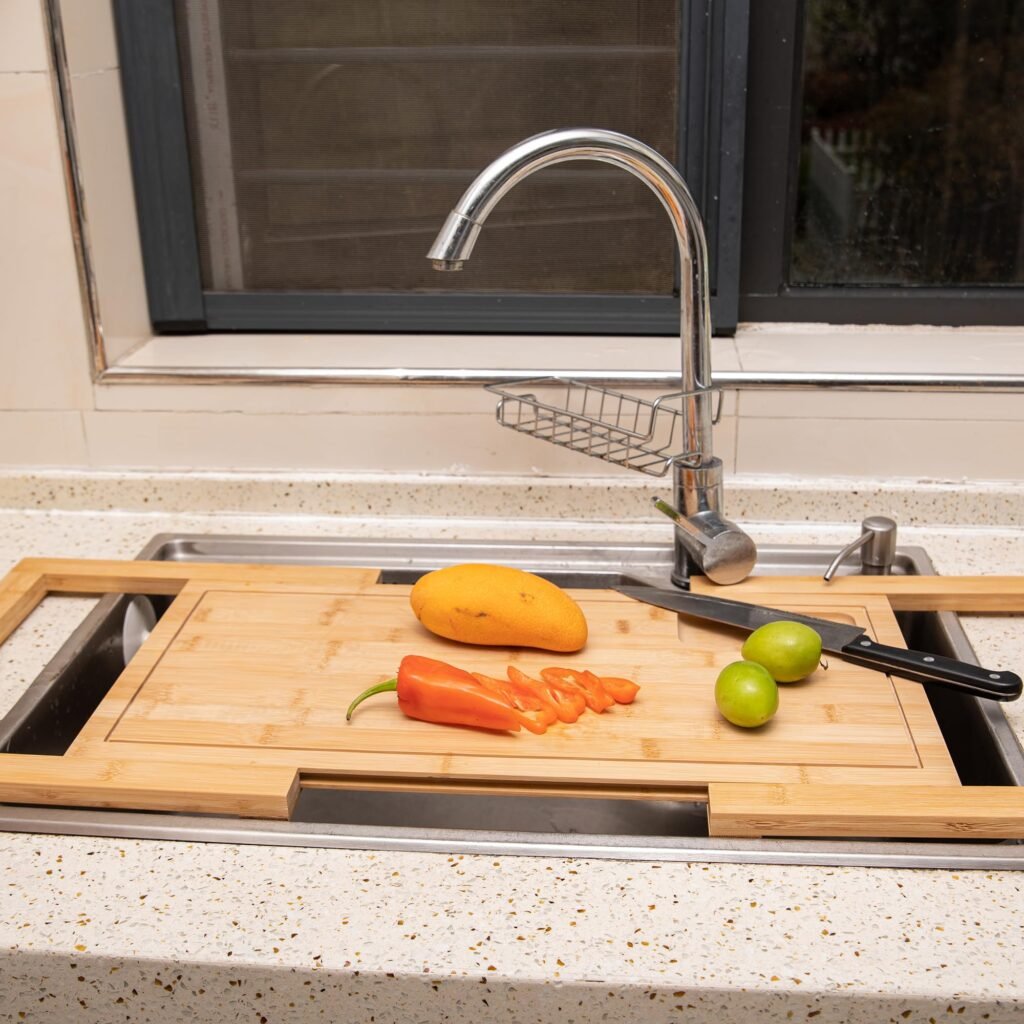
A purpose-built over-sink board spans the basin using the sink rim as its support. The board itself is typically twelve to eighteen inches front to back, fitted with rubber feet, edge channels, or a notched underside that grips the rim on both sides. Better versions include a built-in colander, a drainage slot, or a juice groove so produce can be rinsed and moved directly to the cutting surface without leaving the area.
The appeal in a tight kitchen is structural. You’re not taking counter space to get it. The sink basin becomes the foundation, and that portion of your kitchen that was pure functional dead zone, the space above the running water, becomes a place where actual prep work happens.
That’s a real gain. In a kitchen where fourteen total inches of countertop survive after the coffee maker, drying rack, and knife block have claimed their territory, adding even a sixteen-inch working surface without touching the existing counter is significant.
But here’s the thing that changes the whole calculation: the sink is one of the most active zones in a kitchen, even a tiny one. When the board is down, you lose access to the faucet, the basin, the drain. You cannot rinse a pan, drain a pot, or fill a glass without either working around it or taking the board off. Every time the cooking sequence calls for the sink, the board becomes an obstacle rather than an asset.
That trade-off is the center of the question. It doesn’t make the product bad. It makes it specific.
2. When It Actually Works Well
It earns its place in one reliable scenario: kitchens where produce prep is the dominant bottleneck.
If your cooking routine involves a lot of washing and chopping vegetables, prepping fruit, or handling anything that needs water and a cutting surface in close sequence, an over-sink board is a genuinely smart setup. Rinse the produce, pull it forward onto the board, chop, push the scraps straight down. The whole sequence runs in one spot without moving between zones. For that kind of cooking, it removes the shuffling that makes a tight kitchen feel chaotic.
It also helps when the counter layout is lopsided. Galley kitchens in studio apartments often have one real work surface on one side of the sink and almost nothing on the other. An over-sink board effectively bridges that gap. The total square footage of the kitchen hasn’t changed. The usable surface feels like it doubled.
The kitchens where this product consistently underdelivers are the ones where the cook’s rhythm moves between prepping and rinsing constantly. Not sequential prep, but overlapping tasks where the sink needs to stay free throughout the cooking process. If that’s you, the board creates friction rather than solving it.
Cooking With Almost No Counter Space at All covers the workflow distinction in more depth. The short version: sequential cooking and parallel cooking demand completely different things from a small kitchen, and which one you do determines which tools actually help.
3. What the Product Doesn’t Tell You
Stability is the limitation nobody advertises. The board sits on a sink rim, not a fixed surface. That’s adequate for most chopping and slicing tasks, but it’s not adequate for anything that requires consistent downward pressure. Rolling dough on an over-sink board is a frustrating experience. Breaking down a whole chicken is worse. The board shifts enough that the task becomes unreliable, and some people find the slight movement physically uncomfortable even during lighter tasks.
Faucet clearance is the second issue, and it catches people more often than it should. Measure the height from your sink rim to the lowest point of your upper cabinets, then measure your faucet at its full height including the spray head in upright position. Some over-sink board systems, particularly those with a raised colander attachment, sit eight to ten inches off the rim. That’s enough to conflict with certain faucet configurations, especially pull-down styles with a hose that arcs forward when in use.
Moisture and material choice matter more here than in most cutting board contexts. A wooden board sitting above an active sink basin is in a humid microclimate for as long as it’s in place. Wooden versions that aren’t dried thoroughly and stored flat between uses warp faster than expected, sometimes within a few months. Polypropylene and composite boards handle that environment better, they’re easier to sanitize, and the grip surface holds up over time without absorbing smells or proteins from raw meat.
And one more thing worth noting: if your sink has a garbage disposal, watch the board edge clearance. Some boards sit close enough to the disposal switch that it becomes awkward to reach during heavy use.
The habits that put counter space under pressure before you even start cooking are worth addressing separately. Counter Space Killers: 5 Habits to Break Now covers the patterns that quietly colonize every available surface, because clearing those habits makes any space-adding product work better and last longer in actual use.
4. How It Compares to Other Ways to Add Prep Surface
The question isn’t really over-sink board versus a full countertop renovation. For anyone in a rental or working with a fixed layout, the realistic comparison is between this product and the other practical options.
| Option | Best Situation | Real Trade-Off |
|---|---|---|
| Over-sink cutting board | Produce-heavy cooking, lopsided counter layout | Blocks sink completely while in use; limited stability under pressure |
| Rolling cart (pulled out for prep) | General prep surface needs, portable use | Requires floor space when deployed; must be stored somewhere when not |
| Stovetop staging (cold burners) | Holding prepped components during active cooking | Unavailable once multiple burners are running |
| Folding wall-mounted table | Permanent added prep surface | Requires wall anchoring; fixed position, not for renters |
| Deep drawer with grip mat | Stable secondary surface at a lower height | Works only with specific drawer depth; awkward height for some cooks |
The rolling cart is the recommendation I make most often for a tight kitchen that genuinely needs more prep surface. Not as a pantry stand-in, though there’s a reasonable case for that too, but as a working surface that appears when cooking starts and disappears when it ends. In a studio apartment, that flexibility matters. The over-sink board fills a different role and solves a different problem. They’re not interchangeable.
What this table makes clear is that no single product replaces counter space across all tasks. Each option covers a specific range of use. The over-sink board covers the range best when the sink and prep work need to share the same zone.
5. Getting the Most From It If You Buy One
The people who find this product genuinely useful have usually thought through their cooking sequence before the board arrives. They rinse everything before they start cutting. They stage prepped items in bowls to the side, not back in the sink area. They’re working in phases rather than keeping multiple prep streams open at once.
That workflow is worth building before you build anything physical around it. Tiny Kitchen Living’s small kitchen storage ideas roundup covers several setup changes that support this kind of sequential approach, and most of them are zero cost.
A few things to check before buying:
Measure your sink opening before assuming a standard board will fit. Most boards need at least sixteen inches of rim-to-rim distance to seat properly. A board that rocks in an undersized sink is genuinely unsafe for real prep work.
For undermount or rimless sinks, check whether the board you’re considering is explicitly designed for that configuration. Many are built for drop-in basins and don’t grip the edge properly on flush-mount setups.
Get polypropylene or composite over wood for this specific location. The wood ones look better in photos, I’ll grant them that, but the steam and moisture exposure above an active kitchen sink is real, and a warped board that doesn’t sit flat defeats the whole purpose.
If the wall above your sink is currently doing nothing useful, pairing an over-sink board with proper over-the-sink shelving turns that entire zone into a functional workstation rather than just a single tool addition. That combination works particularly well in galley layouts where the sink wall is the only real vertical real estate available.
The over-sink cutting board doesn’t replace counter space. What it does is convert a zone that was doing one job into a zone that can do two, with the understanding that it can only fully do one of them at a time. For the right kitchen and the right cooking style, that’s exactly enough.
Frequently Asked Questions
Can I just use a regular cutting board over the sink instead of buying a specific product? You can try, but a standard cutting board has nothing to grip the sink rim, so it slides under any real chopping pressure. That’s a safety issue, not just an annoyance. Boards made specifically for over-sink use have rubber feet, edge channels, or notched undersides designed to grip the rim and stay put. The difference in stability during actual use is significant enough that improvising usually ends with the board going back onto the counter.
Does the board interfere with a garbage disposal? Potentially, yes. If your disposal switch is mounted on the wall or counter near the sink, check that the board’s footprint doesn’t block access to it before committing to a placement. Some kitchens have the switch positioned close enough that a full-width board makes it awkward to reach mid-use.
What size over-sink cutting board should I get? Measure the distance between the outer edges of your sink rim first. The board needs to span that distance plus a few inches on each side to have a stable grip. A board that’s too narrow will rock; one that’s too wide may conflict with your faucet handle or nearby cabinet hardware. Most standard kitchen sinks accommodate boards in the twenty-four to thirty-inch range, but measure before ordering rather than assuming.
Will food residue fall into the sink basin while I’m cutting? Some will, yes, depending on how fine your knife work is and whether the board has a raised perimeter. Many over-sink boards include a shallow tray or edge ridge specifically to contain runoff and direct it toward the drain slot rather than letting it fall freely. If food hygiene around your sink basin is a concern, look for boards with integrated liquid channels rather than flat designs.
Is an over-sink cutting board safe to use for raw meat? It’s functional for raw meat prep only if the board is stable enough not to shift during cutting and you’re using a polypropylene surface that can be properly sanitized afterward. The stability requirement rules out boards that don’t grip your sink rim securely. A board that moves under pressure during raw meat prep is a real sanitation and safety risk. Test the grip before you commit it to that use.