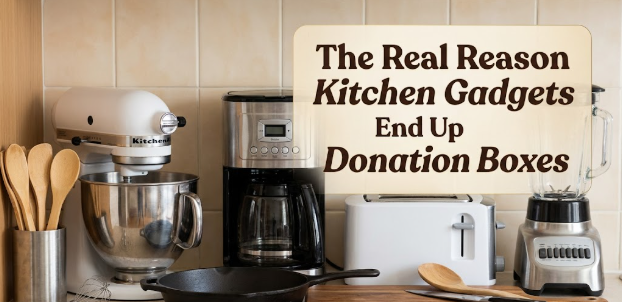
Early in my career, I was hired by a couple moving into their first apartment together, a galley kitchen with maybe nine linear feet of counter. They were excited. I was excited. So when we sat down to plan their kitchen, I let that excitement talk me into recommending almost every specialty tool on the market. An egg slicer. A dedicated avocado tool. A standalone rice cooker even though they had a stovetop that worked fine. A waffle iron shaped like a state they’d never visited. I thought I was being thorough. I was actually setting them up to fail.
Six months later I stopped by to measure for a separate project, and there it was: a cardboard box by the door, half full of kitchen gadgets headed to donation. Most of them still had tags.
That box taught me more about small kitchen design than any course I’d taken up to that point. And it’s the reason I want to talk honestly about why this keeps happening, in apartment after apartment, to people who are not careless or wasteful. They’re just working against a kitchen that was never built to hold everything they were told they needed.
1. The Gadget Was Never the Problem, the Assumption Was
Here’s something I see constantly at Tiny Kitchen Living: people assume a gadget earns its place by being useful in theory. A julienne peeler is genuinely useful. So is a tortilla warmer, a butter bell, an avocado slicer, a strawberry huller. None of these are bad products. The issue is that “useful in theory” and “useful in a nine-square-foot kitchen” are two completely different standards, and almost nobody applies the second one before buying.
A gadget that performs one task, no matter how well, is competing for drawer space against a knife that performs that same task in four seconds with less cleanup. In a large kitchen, that competition doesn’t matter because there’s room for both. In a small one, the knife usually wins, and the gadget loses its job within a few weeks of looking impressive in the cabinet.
2. Why It Takes So Long to Admit a Gadget Isn’t Working
This is the part that surprises people, including, frankly, me at the time. It is rarely the first use that ends a gadget’s life in the kitchen. The first use usually goes fine. It’s the second, third, and tenth use, the moments where you have to dig through a drawer to find it, wash an extra item, and store it back in a spot it barely fits, that wear it down.
People keep gadgets long after they’ve stopped using them because there’s a quiet guilt attached to getting rid of something that cost money and technically still works. So instead it sits. And sits. Until a move, a deep clean, or a new roommate forces the question, and the honest answer comes out all at once, usually into a box headed for donation.
3. Where People Usually Go Wrong When Buying for a Tiny Kitchen
I want to be specific here because vague advice doesn’t help anyone fix this. The mistake almost always happens at one of three moments.
The first is buying based on a video, not a kitchen. A tool looks brilliant in a thirty-second clip filmed in a kitchen with triple the counter space of a typical studio. The second is buying for a hypothetical version of yourself, the one who will suddenly start juicing daily or making fresh pasta weekly. The third, and this is the one that gets the most apartments into trouble, is treating a small kitchen like a smaller version of a big one instead of its own category with its own rules. We’ve written about this pattern before in counter space killers, and the gadget problem is really the cabinet version of the same habit.
A quick gut check before any kitchen tool purchase: would this still earn a spot if I owned it for two years and only had room for fifteen tools total. If the honest answer is no, it’s worth pausing.
4. What Actually Survives Long-Term in a Small Kitchen
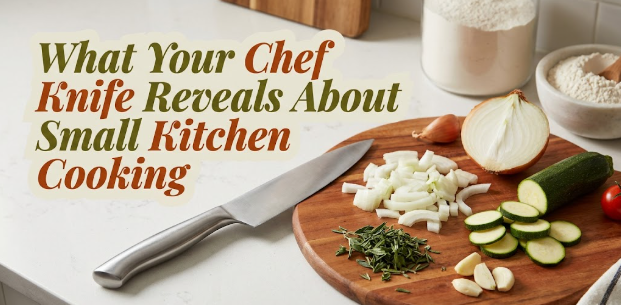
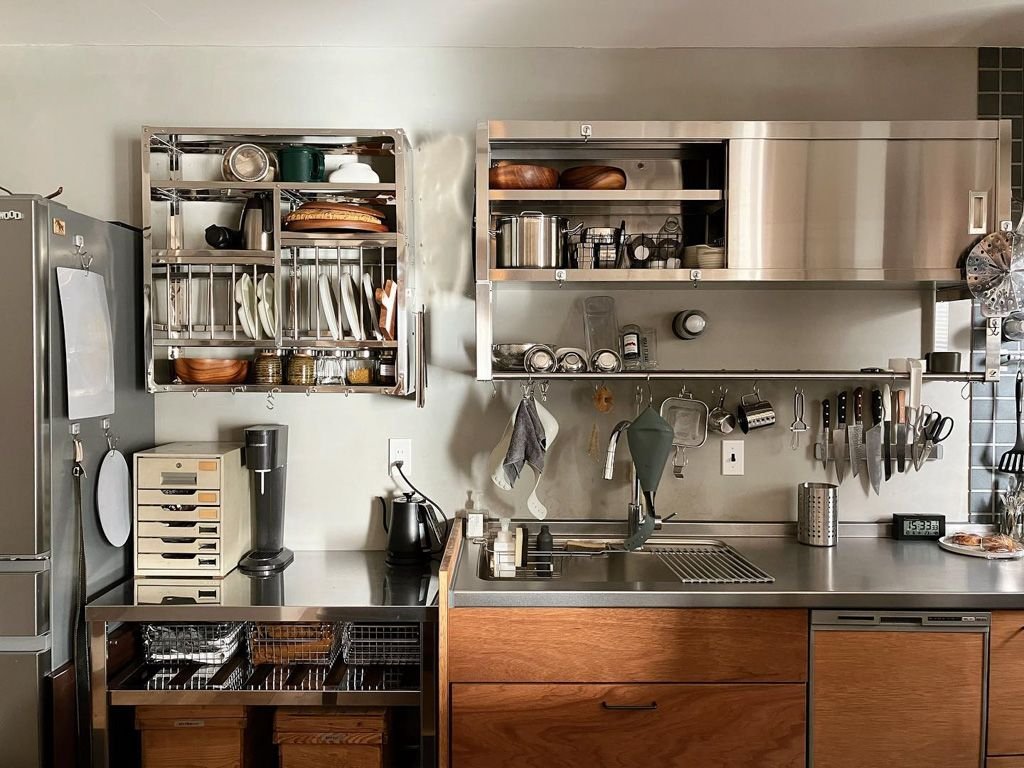
The gadgets that stay tend to share a quiet trait: they replace several other things instead of adding one more thing to the pile. A good chef’s knife replaces six single-task gadgets. A cast iron pan replaces a sauté pan, a roasting dish, and sometimes a baking sheet. We talk about this idea in more depth in why one good pot beats a full cookware set, and it applies just as much to gadgets as it does to pots.
Here’s a simple way to compare the usual single-task purchase against the multi-use alternative most small kitchens actually keep for years.
| Single-Task Gadget | Why It Usually Gets Donated | What Stays Instead |
|---|---|---|
| Egg slicer | One use, hard to store flat | Sharp paring knife |
| Avocado tool | Duplicates a spoon and a knife | Spoon and chef’s knife |
| Electric can opener | Bulky, needs counter space | Manual opener in a drawer |
| Standalone rice cooker | Competes with stovetop | Heavy-bottomed saucepan |
| Garlic press | Hard to clean fully | Flat side of a knife |
This isn’t a rule that every gadget is wrong. It’s a filter. If a tool genuinely does something a knife or pan can’t, like an instant-read thermometer or a good kitchen scale, it earns its space honestly. Most gadgets in that donation box never had to clear that bar in the first place.
If you’re rethinking what stays and what goes, it’s worth pairing this with how you’ve organized the cabinets holding everything, which we cover in the one cabinet pantry system. The two problems, too many tools and not enough structure, tend to show up together.
I’ll admit something else here, slightly off the main point but related. For a long time I thought the fix was better organizers, fancier drawer dividers, that kind of thing. And some of that helps. But it’s a bandage on a purchasing problem, not a solution to it. The real fix happens at the store, not in the drawer.
A Final Thought From My Own Kitchen
I still keep a junk drawer with two or three things I probably don’t need. A wine stopper shaped like a cork I bought at a conference, mostly because I liked the person who made it. I’m not arguing for a sterile, gadget-free kitchen. I’m arguing for a kitchen where everything in it earned its spot honestly, even if one or two things are there because they made you smile when you bought them. That’s a different reason than “it seemed useful at the time,” and it’s one that tends to survive the next donation purge.
Questions I Get Asked About This All the Time
Is it ever worth buying a single-task kitchen gadget? Yes, occasionally. Tools like a kitchen scale or an instant-read thermometer do something a knife or pan genuinely can’t replicate, so they’re worth the drawer space even in a tiny kitchen.
How many gadgets should a small kitchen realistically hold? There’s no fixed number, but most apartment kitchens I’ve worked with function well with somewhere around twelve to fifteen tools beyond basic cookware. Past that, something usually has to be pulled out before something new comes in.
What should I do with gadgets I already own but barely use? Set them aside in a box for thirty days instead of donating immediately. If you don’t go looking for anything in that box during that time, donate it without guilt. The thirty days answers the question for you.
Does buying cheaper gadgets make this problem better or worse? Usually worse. Cheap single-task tools are easier to justify buying on impulse, which means more of them end up in the kitchen and, eventually, in that same donation box.
Is this really about kitchen space, or is it about shopping habits? Honestly, it’s both, but the habit is the bigger driver. People with large kitchens accumulate the same unused gadgets, they just have enough room to ignore the problem longer.
If any of this sounds familiar, it’s probably worth a slow look through your own drawers before the next online sale talks you into something new.