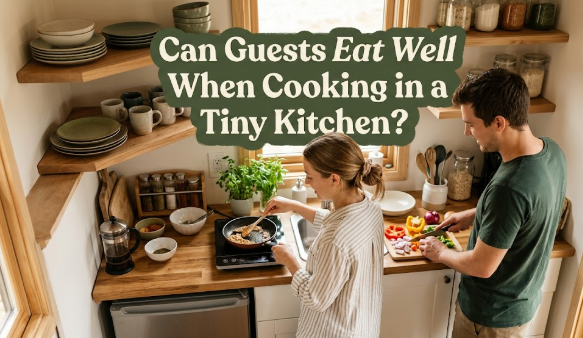
few years back, one of my clients called me three days before a dinner party she’d already committed to. Studio apartment in a mid-rise building, one-wall galley kitchen, maybe fourteen square feet of clear counter space if she pushed everything to the back. She’d invited six people over for a sit-down dinner and wanted to know if she should cancel.
“Don’t cancel,” I told her. “But your menu is going to fight you the entire night.”
She’d planned a three-course meal that required the oven, two burners running at once, and a separate salad station. In a kitchen where the cutting board took up most of the prep zone, that menu was the real problem. Not the square footage.
She swapped the menu. Dinner was wonderful. Guests stayed late. She still texts me about it occasionally.
I’ve been designing kitchens for over two decades, and the pattern shows up constantly: people assume the kitchen is why things go wrong when guests don’t eat well. Usually, the kitchen is just exposing a planning gap that would cause friction anywhere. A small kitchen just gets there faster.
1. The Setup Most People Get Wrong
When someone asks whether guests can actually eat well in a tiny kitchen, there’s almost always an unspoken assumption buried in the question. They’re picturing their usual approach to cooking, scaled up. Same recipes, more people, more pots. That’s exactly where things go sideways.
Cooking for guests in a small kitchen isn’t regular cooking with added stress. It’s a different approach entirely.
The kitchens I work with most often at Tiny Kitchen Living present two primary constraints: limited simultaneous cooking surface and limited holding space. One oven. Two burners, sometimes only one usable at a time depending on what’s already running. No room to rest a finished dish while the next one comes to temperature. No warming drawer. No extra counter to use as a buffer zone.
But here’s what that constraint actually creates: a reason to cook the way professionals cook for groups. Ahead of time. In large vessels. With dishes that don’t need constant attention.
The best entertaining food is often the kind that improves with a rest. A braised short rib. A whole roasted chicken that sits for twenty minutes while you put out bread and pour drinks. A grain salad that gets better the longer it sits. These dishes suit a tiny kitchen perfectly, and they also suit guests better than a dozen things coming off the stove at the same moment.
The limitation can force the discipline. That’s worth sitting with.
2. Equipment That Actually Earns Its Place
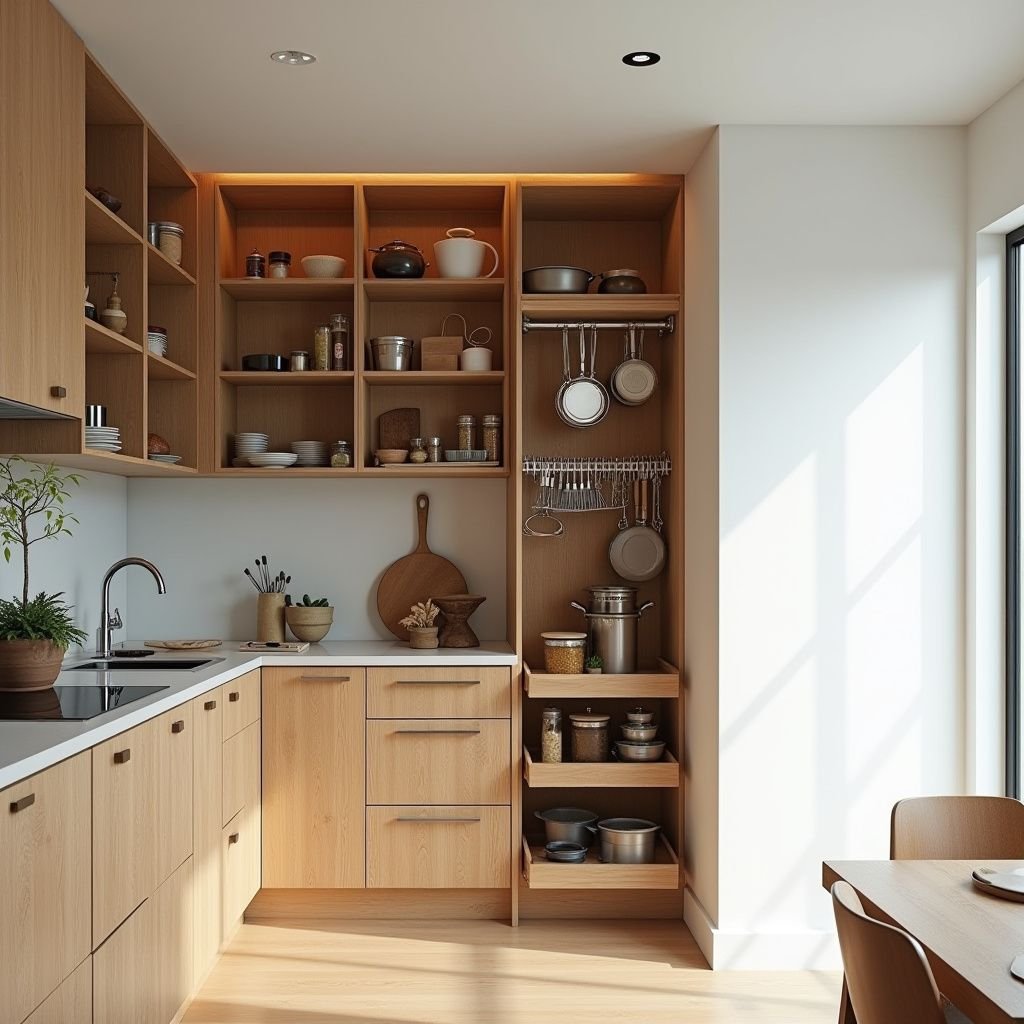
One of the honest conversations I have with clients hosting from small kitchens is about which tools are worth rotating to the front of the rotation before a guest night, and which ones need to step aside.
A stockpot occupying your only burner for forty-five minutes doesn’t serve you during a dinner party. A slow cooker that’s been running since noon does.
A few pieces that consistently prove their worth for small-kitchen entertaining:
The Dutch oven. Probably the single most useful item in a tiny kitchen built for hosting. It braises, roasts, makes excellent soups, and holds temperature well enough that you can slide it into a low oven and forget about it while you’re in the next room with your guests. One vessel, one zone of the oven, minimal monitoring required.
An electric kettle. People don’t always think of this as a cooking tool, but it frees up a burner by handling hot water independently. Pasta water, grain cooking, warming a sauce base — getting these off your stovetop when you only have two burners is more valuable than it sounds.
A sheet pan. Not glamorous. Not exciting. But if your oven has any capacity at all, one well-loaded sheet pan — protein on one side, vegetables on the other — eliminates the need for multiple vessels and keeps cleanup manageable in a space where you may be handwashing between courses.
On the rolling cart question: I’ve written about whether a rolling cart can genuinely replace a pantry, and the answer varies. But as a moveable prep station on guest nights specifically, a well-placed cart can give you a full extra surface while cooking and roll out of the way completely once dinner is served.
Not special. Just versatile. That’s the filter to apply to every piece of equipment in a small kitchen, and especially before a guest night.
What doesn’t help: anything with a single function that can’t be stored out of sight when it’s not running. A panini press. A single-use egg cooker. These feel like additions to the kitchen until you’re trying to plate four things at once and suddenly you’re working around them.
3. The Timing Problem Nobody Actually Discusses
Sequencing is where most small-kitchen entertaining unravels, and it almost never gets talked about directly.
In a larger kitchen, timing manages itself to some degree. You have buffer surfaces. A warming drawer. Maybe an island to rest things on. Small kitchens have no such margin, every finished dish needs a destination while the next one finishes, and if that hasn’t been thought through in advance, you’ll figure it out under pressure.
Working backwards is the method that consistently saves people. Start from the moment guests sit down, then map out exactly what needs to happen in what order for that moment to arrive calmly. What’s already done and resting? What goes into the oven last because it only needs twenty minutes? What was finished that morning and simply needs rewarming?
The goal, in practical terms: the kitchen should be doing its quietest work when your guests are most present.
Dishes that go from a cold start earlier in the day to a table-ready finish without much intervention are worth centering your menu around. Starting a braise or a stuffed vegetable dish hours before anyone arrives means that by the time people are actually hungry, you’re rewarming, plating, and opening wine. You’re not standing over the stove.
And this connects to something I flag regularly on Tiny Kitchen Living: the everyday habits that steal counter space on a normal Tuesday will create real friction on a guest night. A drying rack that lives permanently on the counter, appliances that never get moved, a cutting board that stays out because there’s nowhere convenient to store it. These counter space habits are annoying on a regular cooking night and become genuinely disruptive when you’re trying to plate for multiple people at once.
Guest night is a good forcing function for fixing that, by the way.
4. What a Guest-Ready Menu Actually Looks Like
General advice about “keeping things simple” doesn’t translate well without specifics. Here’s a practical breakdown of how different menu approaches tend to perform in a tiny kitchen context:
| Menu Approach | Works in a Tiny Kitchen? | Why |
|---|---|---|
| Three-course meal with separate hot dishes per course | No | Requires simultaneous burner use, constant attention, real-time plating under pressure |
| Make-ahead braise or stew with crusty bread | Yes | Cooks unattended for hours, holds beautifully, minimal finishing work |
| Sheet pan dinner — protein and vegetables together | Yes | One vessel, oven does the work, all burners remain free |
| Appetizers that require frying or last-minute stovetop heat | Risky | Frying in a small kitchen with guests nearby is messy and takes your full attention |
| Grain or bean bowls with roasted components | Yes | Each component preps separately, assembles quickly at serving time |
| Whole roasted chicken or fish | Yes | One oven vessel, impressive presentation, needs almost no monitoring once it’s in |
| Multi-sauce pasta dinner for a group | No | Demands burner multitasking, large water volumes, and colander management simultaneously |
| Mezze or sharing spread with one warm element | Yes | Almost entirely prep-ahead, the single warm element is completely manageable |
The pattern that holds up: anything with one primary cooking vessel, anything that can be finished before guests arrive, and anything that holds well without degrading.
The dishes that look casual — the sharing spreads, the slow-cooked mains, the build-your-own bowls — are often the most generous. People eat more freely from them. The table stays full longer. There’s no anxious wait for the next hot thing to emerge from the kitchen.
I’ve watched a client in a 65-square-foot kitchen serve seven people a meal everyone still discusses. She planned it like a professional, put almost everything in the oven by mid-afternoon, and spent the actual evening at the table with her guests. That’s the outcome you’re aiming for.
5. Where It Consistently Goes Wrong
A few patterns come up almost every time small-kitchen hosting runs into real trouble.
The menu gets chosen before the logistics do. It should work the other way. Figure out what your kitchen can realistically run at one time, then build your menu around that capacity. If your oven and one burner are the limit, your stovetop contribution on guest night should be exactly one thing.
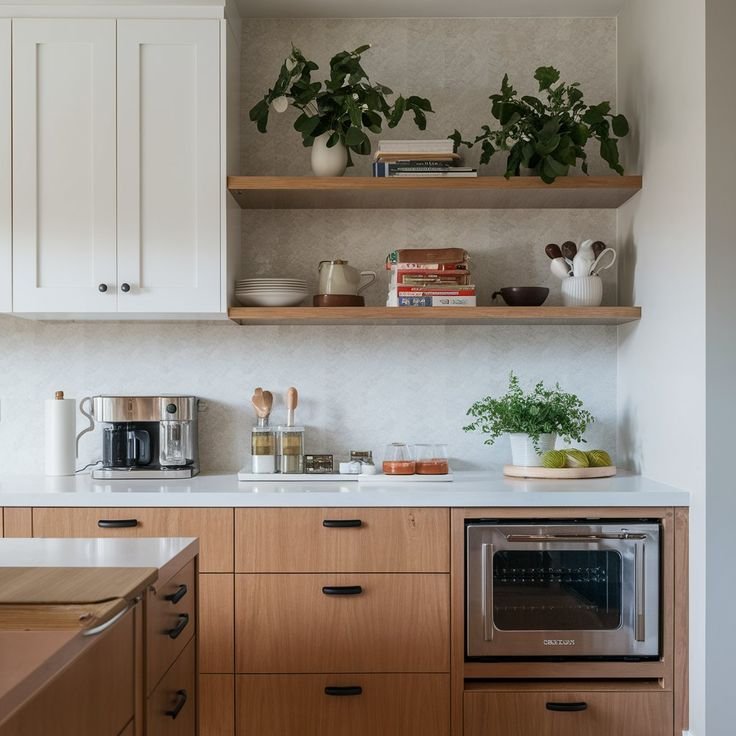
People skip the storage and organization pass before guests arrive. If your pantry situation is already tight on a regular Tuesday, cooking for multiple people will surface every gap in the system. Reviewing what you have, where it lives, and whether anything needs to move before you start cooking makes the actual cooking night far smoother. Small kitchen storage approaches worth testing make hosting nights function better because the foundation is more stable.
And mise en place gets underestimated, consistently. Professional kitchens don’t cook from scattered ingredients, and in a small kitchen there’s genuinely no room to do that anyway. Everything prepped, portioned, and ready before heat touches anything is the single habit that separates a calm hosting evening from a chaotic one. The preparation work is the cooking. The stove is just the final step.
There’s also a tendency to pick recipes that look impressive rather than ones that work quietly. Impressive and quiet are not opposites, but in a small kitchen, the dishes that tend to impress guests are often the ones that spent four hours doing their thing in the oven while you were doing something else. That’s not a compromise. It’s a better result.
If you’re working through how your current kitchen is organized ahead of a hosting occasion, the one-cabinet pantry system approach is worth reading through. Having your ingredients where you expect them before you start cooking for a group removes a layer of friction that compounds quickly when you’re working in limited space.
The kitchens that produce the best guest experiences are usually the ones where someone has done the thinking before the cooking starts. The size of the kitchen matters much less than that.
Frequently Asked Questions
Can I serve multiple courses from a tiny kitchen without it getting chaotic?
Yes, but the structure of the courses matters. Only one should require active heat at serving time. A cold or room-temperature starter, a main that’s been slow-cooking most of the day, and a dessert made that morning means you have a proper three-course dinner with one warm dish to manage. That’s a very achievable sequence in any size kitchen.
What types of dishes work best for guests when counter space is limited?
Anything braised, whole-roasted, or entirely make-ahead. Dutch oven dishes, whole roasted chicken, grain-based mains, and mezze-style spreads all perform well. They don’t require last-minute juggling, they hold temperature gracefully, and most of them taste better after they’ve rested than the moment they come out of heat.
How do I handle cleanup between courses when there’s nowhere to put dishes?
The cleaner answer is to plan around not needing to. Use the same vessel to cook and serve when possible. Serve directly from the pot or pan. If you have a side table or entry console, use it as a staging area for finished dishes during dinner. Stack plates and move them out of the kitchen entirely rather than trying to rinse between courses with guests nearby.
Is a rolling prep cart actually useful for guest nights or just for regular cooking?
More useful on guest nights than regular ones. Moved into position before guests arrive, it serves as extended prep and plating surface. Rolled to a corner during dinner, it’s invisible. It also functions as a serving cart if you need to carry things to a table. The flexibility is exactly what tight-space hosting calls for.
Do I need to spend money on new equipment before hosting in a small kitchen?
Not necessarily. The gap is usually in approach, not tools. That said, if your current setup lacks a Dutch oven or a solid sheet pan, those two pieces cover a wide range of hosting scenarios between them. Everything else is secondary. A sharp knife and good prep work will carry you further than most specialty appliances.
For a deeper look at how compact kitchens can be organized to function better on both regular nights and hosting occasions, the Tiny Kitchen Living archive covers the specifics without assuming you have space you don’t have.