Somewhere around day eighteen, I realized I was cooking faster than I ever had in a full-size kitchen.
That wasn’t the plan. The plan was to find out what actually breaks down when you commit to cooking every single night in under ninety square feet of kitchen space. No takeout nights, no skipping because the prep felt impossible, no leaning on delivery when the pots were already dirty from lunch. Thirty days, every evening meal made at home, in a space most people would write off as unworkable before they’d even opened a cabinet door.
What I found at the end of that month is something I still think about when a client tells me their kitchen is too small to cook in seriously. And the finding is almost the opposite of what people expect.
1. What the Kitchen Actually Looked Like Before I Started
The kitchen I used for this was 82 square feet. One run of upper and lower cabinets along a single wall. A four-burner stove, a half-size refrigerator, one deep-basin sink, and a counter stretch of about 28 inches of usable prep surface, once you accounted for the corner where the stove meets the cabinet end. No pantry. No island. No second counter run on the opposite wall.
This is not an unusual layout. I see versions of it constantly in apartments and studio conversions built between the early 1960s and the late 1980s, and I have spent over two decades designing around exactly these constraints. But designing a small kitchen and living in one daily are genuinely different experiences. I knew this in theory. Thirty days of dinner made that theory concrete.
Before day one, I spent an afternoon doing something I should have done to this kitchen much sooner: I cleared everything off the counter and audited what was actually living there. A knife block taking up nine inches. A jar of cooking utensils. A paper towel stand. The permanent dish rack. An olive oil bottle and a salt cellar that had been parked in the same corner so long I’d stopped seeing them. The actual usable prep surface, once I cleared all of that, was 18 inches wide. Not 28. Eighteen.
The knife block moved to a magnetic wall strip mounted on the backsplash tile. The paper towels went under the sink. The dish rack became something I fold up and tuck away after each use rather than something that just lives there. That single afternoon, before I’d cooked a single meal in this experiment, recovered ten inches of counter. The full pattern behind this kind of surface loss is something I covered in detail in counter space killers: 5 habits to break now, but seeing it in your own kitchen lands differently than reading about it somewhere else.

2. What the First Week Showed Me About Workflow
Days one through seven were what I’d call the friction week. Not because the cooking was complicated, but because everything took longer than it should have.
I’d reach for a pan and move three other things to get to it. The spices I wanted were behind the ones I hadn’t touched yet. The colander lived on a high shelf that required a step stool, which meant I invented creative draining workarounds on three separate occasions because retrieving it felt like too much mid-prep. The cutting board was too small for half the meals I was making, so prep happened in stages when it could have happened all at once.
None of this was the kitchen’s fault. It was the setup.
The most useful single thing I did, somewhere between day three and day five, was reorganize the cabinet nearest the stove to hold only what I needed during active cooking. Not everything I owned. The three pans I actually used most often, the daily oils, the wooden spoon and spatula and tongs that came out every night. Everything else went into less convenient storage. And the near-stove zone became genuinely fast to work in. Maybe two seconds to get anything I needed. That two seconds sounds small. Multiplied across every step of a thirty-minute dinner prep, it adds up in a way that’s hard to overstate.
By day seven I was roughly fifteen minutes faster at dinner prep than I’d been on day one. The kitchen was identical. The habits weren’t.
3. What Broke Down in Week Two (and What That Revealed)
Week two is where the volume problem hit, and it hit in ways I didn’t anticipate.
Cooking seven dinners in a row generates a steady accumulation of dirty dishes, leftover storage needs, and grocery restocking. In a full-size kitchen with a dishwasher and a pantry, all of that has somewhere to absorb. In 82 square feet with no dishwasher, the logistics of it build in a way that isn’t obvious until you’re three days in and the sink is never quite empty.
The dish situation was the sharpest pressure point. Washing by hand, the fold-up rack I was using held maybe six items at a time, which meant multiple wash cycles after a dinner that produced two cutting boards, a pot, and a pan. I got faster at it as the weeks went on, mostly because the alternative was letting things pile up, and a small kitchen with a full sink looks instantly chaotic. Clearing the sink became part of the cooking rhythm, not something I did after the fact.
The pantry pressure was a different issue. I’d set up a dedicated one-cabinet storage system before the experiment started, using the same framework I built out in the one-cabinet pantry guide on Tiny Kitchen Living. It held up well for the first week, when I was being disciplined about buying only what I’d actually use. By week two, I’d bought ingredients for a recipe I didn’t end up making, plus a backup jar of something that didn’t fit where it was supposed to go, and suddenly the cabinet had gaps. Small ones. But in a small kitchen, small gaps compound quickly. A half-organized cabinet on a Tuesday becomes a messy one by Friday when you’re tired and reaching for things in a hurry.
I reorganized the cabinet on day eleven. Twenty minutes. After that, it worked cleanly for the rest of the month. The lesson wasn’t that the system failed. It was that I’d been buying without checking what I had first, which is the same mistake I watch clients make in kitchen consultations on a regular basis.
4. The 30-Day Progression, Week by Week
Looking back at the notes I kept during this, the pattern across four weeks is pretty consistent with what I’d predict if someone described this experiment to me in advance. Except for one thing, and I’ll get to that.
| Week | Main Focus | Biggest Win | What Still Didn’t Work |
|---|---|---|---|
| Week 1 | Learning the friction points | Counter clearing, magnetic knife strip, near-stove zone | Prep time still slow; colander on high shelf; cutting board too small |
| Week 2 | Volume and pantry pressure | Near-stove zone fully dialed in; wash rhythm started | Pantry cabinet drift; dish backlog on busy nights |
| Week 3 | Efficiency and batching | Component prep batching; ingredient flow locked in | Plating and cooling zone still cramped |
| Week 4 | Habit maintenance | Consistent clean-as-you-go routine; cabinet stayed organized | Small appliance retrieval still slightly awkward |
The efficiency curve was not linear. Week two was harder than week one in some ways, because the novelty wore off and the structural problems that first-week energy had papered over started showing up clearly. Week three was when things actually clicked.
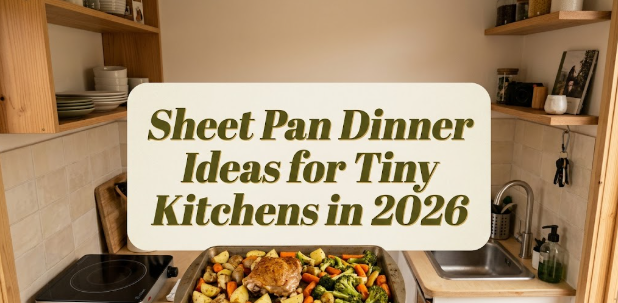
Batching is what changed week three. Instead of cooking each meal entirely from scratch every evening, I started prepping components on the weekends and once mid-week. A batch of cooked grains. A sheet pan of roasted vegetables that could serve as the base of three different dinners. Proteins that worked across multiple dishes across multiple days. This is not a new strategy. It’s been in every meal prep article written in the last ten years. But in a small kitchen specifically, it becomes necessary rather than just efficient, because your prep zone can hold a finite number of active tasks at once, and in 82 square feet that number is smaller than it is in a larger space. Batching meant fewer evenings where I was chopping, sauteing, and plating simultaneously on 18 inches of counter. It created room.
The thing I didn’t predict: by week four, the counter was staying clear on its own. Not because I was consciously maintaining it. Because the habits that put things away had locked in through repetition to the point where leaving something out on the counter actually felt wrong. Anyone who has tried to form a habit in a large kitchen and given up can probably relate to how surprised I was by this. The constraint did some of the work for me.

5. What This Experience Means for Someone Setting Up to Cook Daily
The prep audit comes first. Before buying anything, before rearranging any cabinets, before reading a single storage article, stand in your kitchen and physically walk through one dinner from refrigerator to plate. Where does your hand go for each step? What’s in the way? What requires a detour that shouldn’t require one? The answers to those four questions are your actual problem list. Not a general list of small-kitchen challenges. Your specific list, in your specific space.
Most of the time, the blockers are a smaller set of things than people expect. Counter space that’s being occupied by permanent residents that don’t need to be there. Tool access, meaning the number of movements required to get a pan or a spice jar into your hand. And sink management, which nobody wants to talk about and which is probably the most consequential variable in a kitchen without a dishwasher.
A rolling kitchen cart comes up almost every time I discuss this kind of small-kitchen daily cooking setup. It can genuinely expand functional surface and storage, depending on how it’s positioned and what you ask it to do. We have a thorough look at whether a rolling cart can replace the pantry you never had at Tiny Kitchen Living, and the honest answer is that it depends more on what you’re storing than on the cart itself. For additional surface area it’s almost always useful. For deep dry storage, the cart’s limitations come out quickly.
One thing I’d add from this specific thirty-day experience, something I don’t think gets said clearly enough: a small kitchen is only claustrophobic when it’s disordered. Once the prep surface is clear, once tools are reachable in one motion, once the workflow follows a logical sequence that the space actually supports, the square footage stops feeling like a ceiling. It’s just a kitchen. A compact one. One that works exactly as well as it needs to.
And the cooking, it turned out, got genuinely good. Constraints narrow your choices in ways that can sharpen technique. When you have one cutting board, you sharpen the knife. When you have one prep zone, you learn to use it cleanly. I made better food in month three of cooking in that kitchen than I was making at month one. I don’t think that’s a coincidence.
Closing
I ended day thirty having cooked thirty dinners. A fair number of lunches too, which hadn’t been part of the original plan but became inevitable once the kitchen stopped feeling like an obstacle.
The kitchen was 82 square feet at the end of the month the same way it was 82 square feet on day one. Nothing changed structurally. What changed was the habits, the workflow, the way I used what I had. The counter stayed clear without effort. The one-cabinet pantry restocked itself cleanly every week because I was buying to the system instead of around it. Prep time came down to something that stopped feeling notable at all.
If you tell me your kitchen is too small to cook in daily, I’ll believe you’ve found it frustrating. I don’t think I’ll agree that the kitchen is the reason why.
Frequently Asked Questions
Can you realistically meal prep in a kitchen under 100 square feet?
Yes, though the approach matters more than the size. In a small kitchen you can’t prep four things simultaneously the way you might in a larger space. Work in sequence rather than parallel: one cutting board active at a time, one pan on the heat, and clear the counter between steps. It’s slower than a large kitchen in theory, but batching components once or twice a week compresses the overall time significantly and fits the small-kitchen constraint well.
What’s the single most important thing to fix before committing to daily home cooking in a small kitchen?
The counter, and not by buying more surface. By removing everything that doesn’t need to be permanently there. Knife block, paper towel stand, any appliance that comes out fewer than three times a week, the permanent dish rack. Most small kitchens have more usable prep surface than their owners realize; it’s just occupied by things that have claimed it over time without anyone deciding they should be there.
Is it worth buying new storage products before you start?
Not before doing a prep audit first. The most reliable mistake I see is buying organizers before identifying where the friction actually is. Cook one full dinner as you normally would and pay attention to what slows you down. Those specific friction points are what you buy for. Random canisters and bins rarely solve the real issue, and they create new clutter of their own when they don’t quite fit the space.
How do you manage dishes when cooking every night without a dishwasher?
Build washing into the cooking process rather than leaving it for the end. While something simmers, wash the prep bowls and the cutting board. By the time dinner is on the plate, the sink is mostly clear. It becomes automatic within a week or so of consistent practice, and it makes a genuine difference in how the kitchen feels the next morning when you’re getting ready to do it all again.
Does daily cooking actually get easier in a small kitchen, or does it stay hard?
It gets noticeably easier, but not in a straight line. The first week is harder than most people expect because you’re discovering problems you didn’t know you had. Week two can feel like a plateau where the novelty has worn off but the habits haven’t formed yet. By week three, something shifts. The habits start locking in, the space stops feeling like a fight, and the cooking itself gets better as a result of cooking in the same constrained space repeatedly. The thirty-day mark genuinely feels different from day one.
For anyone building out the broader storage and organization system that makes daily cooking in a small kitchen sustainable, the small kitchen storage ideas worth testing in 2026 roundup at Tiny Kitchen Living covers the specific product and setup decisions that come up most often when someone shifts from occasional cooking to a daily routine.